







Headlines

Meet Rohan Naidu, the MIT astronomer who left engineering at 18; now he is helping uncover how the Universe’s earliest black holes formed

Image(s): Left/Department of Physics, MIT/Right/MoM-BH*-1 A Hyderabad-born astronomer who left engineering school at 18 and counts Test cricket among his favourite pastimes is now helping scientists look deeper into the earliest chapters of the Universe. Rohan P. Naidu, an MIT Pappalardo Fellow in Physics, is the lead author of a new Nature study that examines…
Read More

Scientists are saying that universe may not last forever because Hawking-like radiation could eventually cause its evaporation |

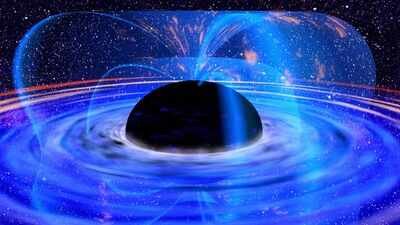
Supermassive black holes are expected to outlast proton decay, but will eventually evaporate completely. Image Credit: D. Berry/Nasa Earth is expected to remain alive for an almost unimaginable length of time, but new calculations suggest that even massive objects could eventually disappear through a process similar to Hawking radiation. Scientists at Radboud University in the…

Read More

nasa aircraft are chasing giant fire clouds over utah: these towering smoke-filled clouds can punch high into earth’s atmosphere |

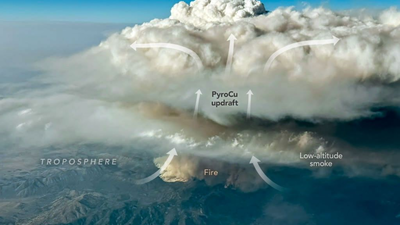
A wildfire in Utah has become the focus of an unusual airborne investigation, after towering clouds of smoke and hot air pushed towards the upper reaches of the atmosphere. Nasa aircraft are chasing these smoke-filled formations to understand what happens when an intense fire effectively starts generating its own weather. The clouds, known as pyrocumulonimbus…

Read More

Quote of the day by Stephen Hawking: “However difficult life may seem, there is always…” – a lesson on resilience, perspective and finding what remains possible |

Stephen Hawking‘s words offer a genuinely powerful reminder that a difficult situation rarely means every single possibility has actually disappeared. “However difficult life may seem, there is always something you can do and succeed at,” he said. “It matters that you don’t just give up.” He said this in a speech to the Oxford Union…

Read More

Meet Astrid Eeuwes: The Dutch amateur astronomer who studies tiny space dust and now has an asteroid named after her |

Representative Image of asteroid (585349) Eeuwes traveling through the main asteroid belt between Mars and Jupiter (AI-generated image) A 1.5-kilometre asteroid orbiting the Sun between Mars and Jupiter now carries the name of Astrid Eeuwes, a Dutch amateur astronomer from Nijmegen who spends much of her time studying micrometeorites, tiny particles of space material that…

Read More

Quote of the day by Marie Curie: “We must believe that we are gifted for something, and that this thing, at whatever cost, must be…” |

Marie Curie once offered a powerful message about self-belief, perseverance and the importance of finding a purpose in life: “We must believe that we are gifted for something, and that this thing, at whatever cost, must be attained.” Curie wrote these words in a letter to her brother Joseph on March 18, 1894, when she…

Read More

Scientists found a mysterious mark inside a 236-million-year-old fossil in Argentina that may reveal ancient mammal relatives gave birth instead of laying eggs

Reconstructed Triassic landscape at the Museum am Löwentor, Stuttgart (Germany), with Chiniquodon theotonicus (left), Batrachotomus kupferzellensis (right), and, poorly visible in the foreground below the water table, a large temnospondyl. Image Credit: Ghedoghedo/Wikipedia A 236-million-year-old fossil from Argentina may have provided the earliest evidence yet that an animal on the evolutionary lineage leading to mammals…

Read More

In 2016, scientists tested drone-dropped peanut-butter vaccine baits to protect prairie dogs and save North America’s rarest mammal |

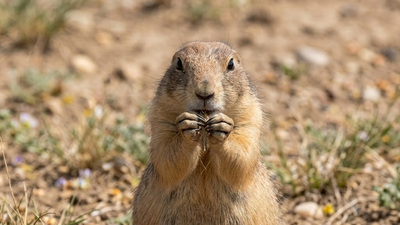
Prairie dog, Image: AI Generated The black-footed ferret is North America’s rarest mammal, with only about 300 estimated to survive in the wild at the end of 2015. The species has been listed as endangered since 1967, and its survival is closely tied to prairie dogs, which provide almost all of its food as well…

Read More

Nasa-backed SPARK project could send tiny ‘aerobots’ into caves on Saturn’s moon Titan |

Nasa-backed SPARK project could send tiny ‘aerobots’ into caves on Saturn’s moon Titan( PC: AI Generated) Nasa has backed a new concept that could send small flying robots into caves on Saturn’s moon Titan. The project, called SPARK, proposes lightweight vehicles known as aerobots that could be released by a larger spacecraft and guided through…

Read More

Hawaii’s native stilt nearly disappeared decades ago; communities and scientists helped its population surpass 1,500 after decades of conservation efforts |

Hawaii’s native Hawaiian stilt, known as aeʻo, has made a remarkable recovery after decades of population decline pushed the bird to roughly 200 individuals in the 1940s. Habitat loss, hunting and introduced predators had severely affected the long-legged wetland bird. More than five decades of legal protection, wetland restoration, predator control and monitoring have since…

Read More