








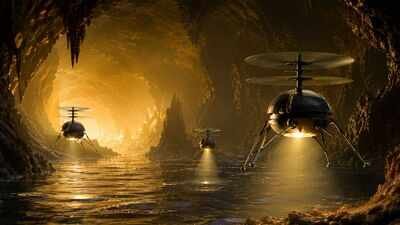
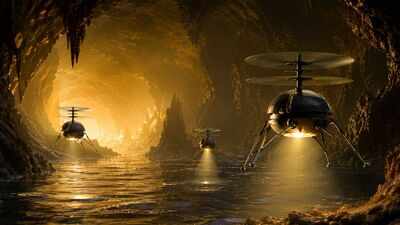
Nasa has backed a new concept that could send small flying robots into caves on Saturn’s moon Titan. The project, called SPARK, proposes lightweight vehicles known as aerobots that could be released by a larger spacecraft and guided through underground spaces. Unlike conventional aircraft that depend on rotors, the proposed vehicles would use solid-state electrohydrodynamic propulsors, also called atmospheric ion thrusters, to move through Titan’s dense atmosphere. The approach could offer a quieter and potentially more efficient way to manoeuvre inside caves where conventional rotorcraft may face difficulties. Nasa says the first phase will test the idea through experiments and computer models under Titan-like conditions. The team will also examine how the technology could keep a balloon-like vehicle in position and develop a possible design for a later prototype. The concept is still at an early research stage, but it could expand how scientists think about exploring Titan’s hidden underground environments in future missions.
How Nasa-backed ‘Aerobots’ could explore caves on Titan
The SPARK concept focuses on small, lighter-than-air vehicles that could enter caves and navigate spaces that may be difficult for larger spacecraft to reach. The aerobots would be carried by a larger spacecraft and deployed when needed. Their movement would come from electrohydrodynamic propulsion rather than spinning rotors. The proposed thrusters are solid-state and virtually silent. They would use electrical forces to move charged particles and create thrust through the surrounding atmosphere. Nasa researchers are particularly focused on Titan because its atmospheric conditions may make this type of propulsion far more efficient than it is on Earth. A Nasa-funded research team led by Daniel Drew at the University of Hawaii in Honolulu has conducted a 2026 Nasa Innovative Advanced Concepts Phase I study.

How Nasa-backed ‘Aerobots’ could explore caves on Titan ( PC: AI Generated)
How Titan’s thick atmosphere could help these flying robots
Titan is an unusual target for aerial exploration because its atmosphere is much denser than the Earth. That makes buoyant flight possible with relatively compact vehicles. Earlier Nasa research examined a robotic balloon designed to explore Titan globally for multi-month periods. The proposed vehicle would have used buoyancy and propellers to travel through the moon’s atmosphere while carrying instruments for imaging, atmospheric measurements and surface studies. The earlier work also highlighted the challenges created by Titan’s extreme cold. SPARK takes a different approach by proposing electrohydrodynamic thrusters that could work with Titan’s atmospheric conditions. The researchers expect these conditions to make the propulsion system much more practical there than on Earth. This earlier aerobot research provides the technological background for considering new types of aerial vehicles on Titan.
How SPARK would use silent solid-state propulsion
The proposed SPARK system replaces conventional mechanical propulsion with distributed electrohydrodynamic thrusters. Because the thrusters have no rotating mechanical parts, the researchers expect them to provide omnidirectional manoeuvrability while producing very little noise. This could be useful inside caves where a small vehicle may need to change direction repeatedly within confined spaces. Nasa says the favourable conditions on Titan could produce power savings of more than 100 times compared with electrohydrodynamic propulsion on Earth. The concept could also avoid some problems associated with rotorcraft operating in Titan’s cryogenic environment. The proposed system would use high-voltage electrical conversion to create the required plasma and airflow effects. These claims remain part of the research proposal and will need to be tested under Titan-like conditions before the technology can be considered ready for a mission.
Nasa’s SPARK project still remains in the early research stage
SPARK is not an approved Titan mission or a working cave-exploration aerobot. Nasa selected it as a Phase I NIAC study, which means researchers are being supported to investigate whether the concept is technically feasible. During this first phase, the team plans to conduct experiments and build numerical models to study electrohydrodynamic propulsion under Titan-like conditions. It will also examine the use of tethered power for keeping balloon vehicles in position and carry out engineering studies for a possible future design. The work is intended to produce a viable point design that could support a Phase II prototype study. Earlier Nasa aerobot research similarly focused on developing and testing technologies before a potential future mission. For now, SPARK should therefore be viewed as a promising exploration concept rather than a planned spacecraft.