








Texas engineers are building fish-like nano-robots that could harvest lithium from seawater and transform the future of clean energy |

Image Credit: Getty Images Lithium is of utmost importance for modern technology. It is powering the smartphones and the huge fleet of electric vehicles. As the world is shifting towards clean energy, the demand for lithium is also increasing quickly, which is placing a huge pressure on land-based mining. However, researchers at Texas A&M University…

Read More

The Southern Ocean may be Earth’s safest place to remove carbon from the atmosphere, scientists find |

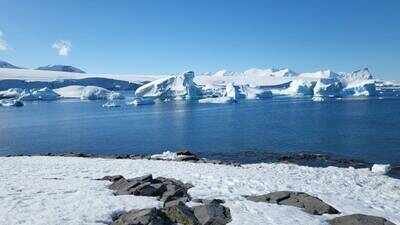
Left/Southern Ocean/Right/Southern Ocean on map/Image: AI Generated As the world searches for ways to remove carbon dioxide already accumulating in the atmosphere, ocean iron fertilisation (OIF) has emerged as one of the most debated climate intervention strategies. The idea is deceptively simple: adding tiny amounts of iron to iron-poor parts of the ocean stimulates the…

Read More

After decades of drought, water is returning to the south of the Sahara Desert as ancient farming techniques and the Great Green Wall breathe new life into the Sahel |

Communities dig water-harvesting pits to restore degraded land and improve soil moisture in the Sahel. For decades, the Sahel has symbolised environmental decline. Stretching nearly 5,900 kilometres across Africa from Senegal on the Atlantic coast to Sudan on the Red Sea, this semi-arid belt has endured recurring droughts, advancing desertification and repeated crop failures since…

Read More

Tiny reef fish flourished beside islands filled with seabirds; where rats removed the birds, the entire underwater food chain took another route

Ecosystems work with each other no matter how far or disconnected they are. Animals and birds have impacts on each other’s lives and deaths. According to a new study, invasive rats on tropical islands are creating winners and losers among tiny underwater animals near the bottom of the food chain that inhabit surrounding coral reefs….

Read More

Physicists reveal why these tiny worms stack their poop into delicate towers that seem to defy gravity |

Most animals leave behind waste that quickly disappears into the landscape. But along Europe’s sandy tidal flats, one marine worm has adopted a remarkably different approach. Instead of scattering its droppings across the beach, it carefully stacks them into tall, coiled towers that seem to defy gravity. These delicate spirals have fascinated naturalists since the…

Read More

Scientists transplanted 42 sea sponges into a polluted Spanish marina; 91.7% of one species survived 455 days and began creating mobile clones

Specimen of Chondrosia reniformis transplanted into the harbor. Image credit: Carlota Escarré Scientists transplanted 42 sea sponges into a polluted Spanish marina, where 91.7 per cent of one hardy species survived for 455 days and began creating mobile clones.The study, published in Frontiers in Marine Science, shows that the chicken kidney sponge (Chondrosia reniformis) can…

Read More

Meet Hikaru Kuribayashi: The 18-year-old teen who started with paper folds and ended with a $100,000 global science win |

At first glance, a sheet of folded paper may seem far removed from advanced engineering. But for Japanese student Kuribayashi, origami became the starting point for a scientific investigation into how structures move. The student from Sapporo Kaisei Secondary School studied the complex folding patterns of a ladybug wing, exploring how its delicate design allows…

Read More

Scientists warn that more than 1.7 million planned satellites could create a new form of space pollution and permanently change the night sky |

The rapid expansion of artificial satellite constellations is changing the appearance and accessibility of the night sky, creating a new challenge to the field of astronomy. For decades, the primary concern for astronomers was light pollution present on earth, but the introduction of large-scale telecommunication networks, such as SpaceX’s Starlink, has introduced a new form…

Read More

Scientists drilled 1,640 feet beneath Michigan and found 689 kinds of fungi living in water that last touched the surface 11,000 years ago

A research team led by University of Michigan isolated and grew more than 200 kinds of fungi from the deep subsurface (Credit: Quinn Moon University of Michigan) Scientists drilling 1,640 feet beneath Michigan have discovered 689 kinds of fungi living in water that last touched the surface 11,000 years ago.The University of Michigan study shows…

Read More

The 16,000-year-old Pando appears to be a forest, but scientists say all 47,000 trees belong to a single living organism |

At first sight, Pando appears to be an ordinary forest of thousands of trembling aspen trees stretching across Utah’s Fishlake National Forest. As reported by PBS, the reality beneath the ground is far more unusual. Those estimated 47,000 trunks are not separate trees competing for space, but parts of a single living organism connected by…

Read More