








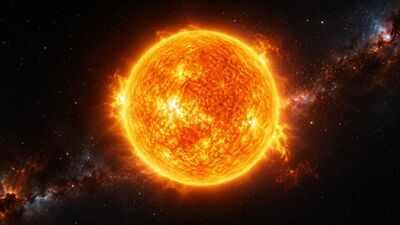
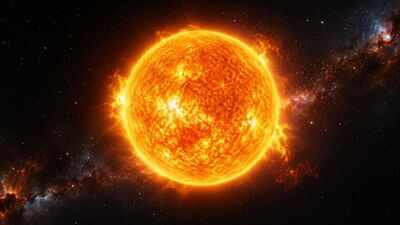
For nearly three decades, the Sun seemed to be winding down. Sunspot counts fell, the solar wind weakened, and by 2008 our star had reached its faintest measured state since satellites began watching it. Astronomers braced for a repeat of history’s great solar lulls, centuries-long stretches when the Sun barely stirred. Then, quietly, the numbers stopped falling. Speed, density, temperature, pressure and magnetic strength all began climbing again, and they haven’t stopped since. A study published in The Astrophysical Journal Letters, titled “The Sun Reversed Its Decades-long Weakening Trend in 2008”, has now put figures to that shift, and Nasa has confirmed the pattern using its own decades of spacecraft data. What looked like the start of a historic silence turned out to be a pause before the Sun woke back up.
Why scientists thought the Sun was entering another solar minimum
From roughly 1990 through 2008, the Sun’s output was in steady retreat. Sunspot numbers dropped, and solar cycle 24, which peaked around 2014, went down as the weakest cycle recorded during the space age. Researchers tracking this decline, including a 2013 analysis by Dan McComas and colleagues, documented falling mass flux, momentum flux and energy flux in the solar wind over that period. Nasa’s Jet Propulsion Laboratory notes that scientists had genuine grounds for concern: the trend so closely echoed the build-up to earlier historic minima that a repeat performance seemed the obvious conclusion.Two precedents loomed large. Between 1645 and 1715, the Maunder Minimum saw sunspot numbers collapse almost entirely for seven decades. A second, milder lull, the Dalton Minimum, ran from roughly 1790 to 1830. Both periods coincided with unusually cool spells on Earth, though scientists are still unsure whether the Sun was the cause. By 2008, with activity at record lows, the working assumption among many researchers was that a third such minimum might be beginning.
Nasa study reveals the Sun reversed its decades-long decline
That assumption didn’t hold. Jamie Jasinski of Nasa’s Jet Propulsion Laboratory, lead author of the new study alongside Marco Velli, described the Sun’s behaviour as a genuine surprise, saying every indicator had pointed towards a prolonged quiet phase before the trend flipped entirely. Reportedly, using data from Nasa’s ACE and Wind missions, held in the publicly available OMNIWeb Plus archive, the team tracked solar wind measurements from 2008 to 2025 and found the decline had not merely levelled off; it had gone into reverse.As per the study, the scale of the turnaround is considerable. Between 2008 and 2025, proton speed in the solar wind rose by around 6 per cent, while density climbed roughly 26 per cent and temperature about 29 per cent. Thermal pressure showed the largest jump, up by close to 45 per cent, with dynamic pressure and energy flux rising by roughly a third and 40 per cent respectively. The interplanetary magnetic field strengthened by around 31 per cent overall. Even comparing the early years of solar cycles 24 and 25 directly shows the same upward drift, suggesting the recovery is a durable trend rather than a short-lived blip.
How a more active Sun could affect Earth and space missions
A more active Sun has consequences that reach well past scientific curiosity. Stronger solar wind and magnetic fields mean a greater likelihood of flares, coronal mass ejections and geomagnetic storms, events capable of disrupting satellites, GPS signals, radio communications and even power grids on Earth. Nasa’s Heliophysics Division monitors these changes partly because they bear on astronaut safety; understanding space weather is considered essential groundwork for the Artemis missions to the Moon and, eventually, Mars.Increased solar wind pressure also reshapes the heliosphere, the vast magnetic bubble the Sun projects around the entire solar system, and compresses the magnetic shields of individual planets. Jupiter and Saturn, with their more compressible magnetospheres, are expected to feel this most acutely, though Earth’s own magnetic environment is not immune.
The future of the Sun’s solar activity remains uncertain
Despite the recovery, the Sun hasn’t fully returned to its late-20th-century vigour. The study notes that current dynamic pressure, at around 1.9 nanopascals, remains below the roughly 2.4 nanopascals recorded at the century’s end. In other words, the Sun has clawed back much of what it lost, but not all of it.What happens next is genuinely open. Researchers admit the longer, multi-decade rhythms of solar behaviour remain poorly understood; even the 40-year Dalton Minimum still lacks a clear explanation. Whether the current upswing continues through future cycles or plateaus is something only continued observation will settle.