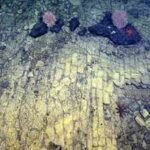








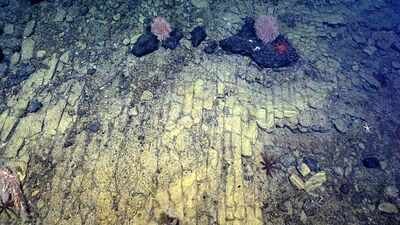
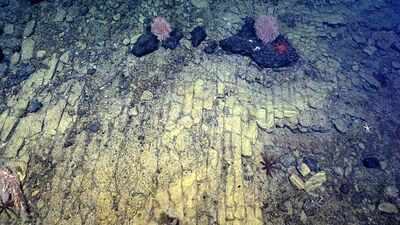
A strange formation resembling a yellow brick road was discovered on the Pacific Ocean floor during an expedition by the Ocean Exploration Trust’s research vessel E/V Nautilus. The structure was found at a depth of 1,029 metres near Nootka Seamount, within the Papahānaumokuākea Marine National Monument. Its unusually regular pattern made it resemble a brick sidewalk, but scientists identified it as a natural geological formation.According to a report published by The Oceanography Society on the Ocean Exploration Trust’s 2022 field season, the formation likely consists of fractured hyaloclastite, a type of volcanic rock created when hot magma meets cold water. Researchers suggested that its yellow colour likely resulted from low-temperature hydrothermal alteration of the volcanic glass.
Scientists spotted a yellow brick road 1,029 metres beneath the Pacific
The unusual pattern was observed during an E/V Nautilus expedition in the Pacific. The formation lay at a depth of 1,029 metres near Nootka Seamount, inside Papahānaumokuākea Marine National Monument. Its fractures intersect at right angles, giving it the look of a brick sidewalk. The resemblance prompted the description ‘yellow brick road’, but the appearance did not indicate that people had built or laid anything there.The report identifies the feature as a geological formation on the seafloor. It was one of several discoveries documented during the vessel’s 2022 field season, when the team explored deep-ocean environments and used remotely operated and autonomous systems to investigate remote and poorly surveyed areas.
Right-angled cracks gave the formation its unusual appearance
The report explains that the formation likely consists of hyaloclastite. This rock forms when hot magma comes into contact with cold water, causing volcanic material to break into fragments. Scientists said the surface likely represents fractured hyaloclastite, rather than a constructed pathway.The cracks intersect at right angles, producing the unusually neat pattern that gives the site its road-like appearance. The geometry may look carefully arranged, but it is part of the rock’s natural structure. The report attributes the formation to volcanic activity on the seafloor. The report says the formation is natural, not human-made.
How did volcanic glass develop its yellowish appearance
The yellow appearance also has a natural explanation. According to the report, the colour likely developed through low-temperature hydrothermal alteration of the volcanic glass. This process changes the material after it forms, leaving iron oxyhydroxide that gives the surface its yellowish colour. Hydrothermal alteration refers to changes caused when heated fluids interact with rock. In this case, the report presents it as the likely reason for the colour. Together, the fractured rock, right-angled cracks and altered volcanic glass give the seafloor feature the appearance of a road, although it was formed through natural geological activity in the area.
The 2022 field season documented several other deep-sea discoveries
The yellow brick road was one finding from the 2022 field season aboard E/V Nautilus. The report describes a wider programme of seafloor mapping, remotely operated vehicle dives and work with autonomous systems. It records 120 uncrewed vehicle deployments during the season. The expeditions also documented deep-sea coral and sponge communities, fossilised whale bones and a fossilised Megalodon tooth.Researchers observed and collected a sea pen from the genus Solumbellula, marking its first recorded observation and collection in the Pacific, according to the report. The work combined exploration with scientific research and public outreach, allowing people on shore to follow discoveries through live broadcasts and ship-to-shore connections during the same field season.