








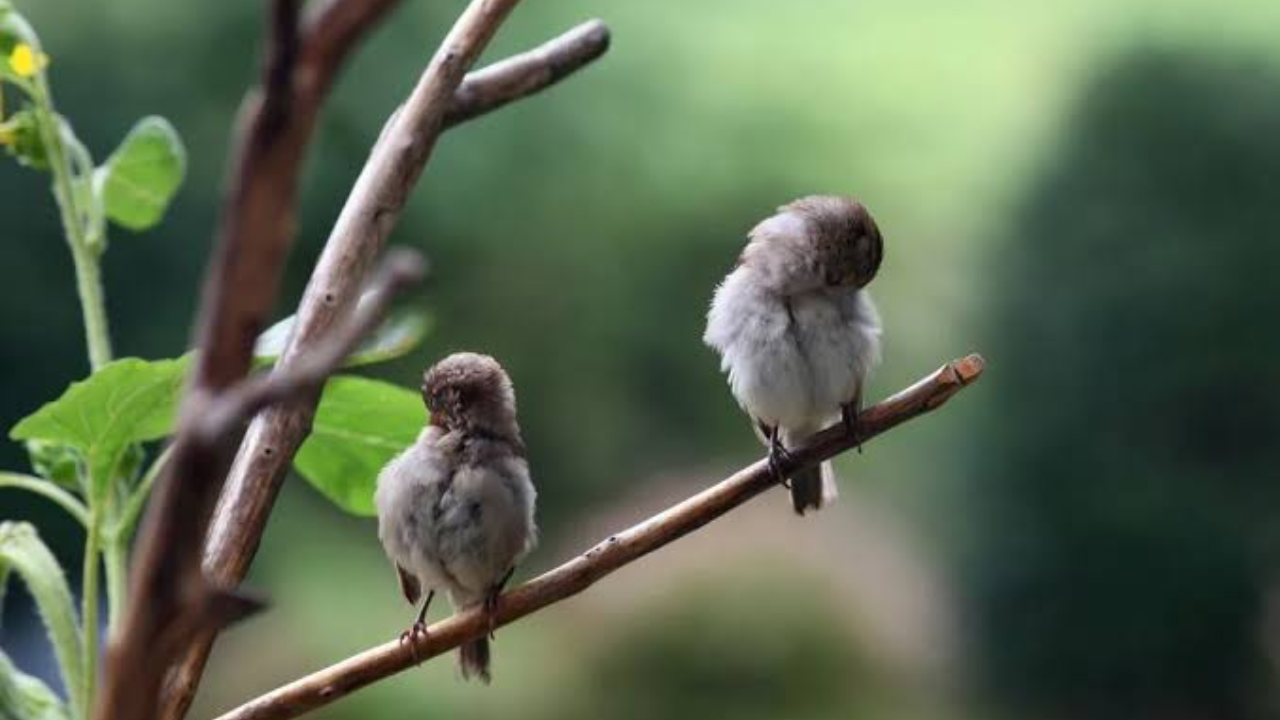
Have you ever seen a bird sleeping on a thin tree branch and wondered why it does not fall? While humans may lose their grip when their muscles relax during sleep, many birds can remain safely perched for hours. The answer lies in the structure of their legs, feet and tendons. But the explanation is not exactly the same for every bird.
How birds hold on to branches while sleeping
Most small birds that regularly sit on branches belong to a group known as perching birds (passerine). These birds have feet adapted for gripping branches, with three toes pointing forward and one toe pointing backwards. The backward-facing toe is called the hallux. Together, the toes help the bird hold a branch from different sides. When a perching bird lands on a branch, its legs bend at the knee and ankle. This stretches the tendons running down the back of the leg and into the toes. The movement causes the toes to curl around the branch, helping the bird maintain its grip without having to consciously hold on.The Cornell Lab of Ornithology explains that when a bird places weight on its feet, the leg muscles tighten the foot tendons, keeping the toes closed around the perch. This means a sleeping bird does not need to keep thinking about gripping the branch. Its leg structure helps maintain the hold while it rests.
The grip is not simply about strong muscles
Birds such as flamingos, herons and many other species can rest on one leg.
For years, the common explanation was that a bird’s toes automatically lock around a branch as soon as it bends its legs. However, scientific research has shown that the mechanism is more complicated. A 2012 study published in The Anatomical Record examined the perching behaviour of European starlings. The researchers found that sleeping starlings did not always tightly curl their toes around the perch. Instead, their feet often formed a stable, saddle-like position, allowing them to balance their weight over the central pad of the foot.The study also found that starlings could remain perched even when the usual tendon-locking mechanism was not working. This suggests that some birds rely not only on toe gripping but also on balance and the shape of their feet. So, the popular explanation that all sleeping birds simply lock their claws around a branch is too broad. The exact mechanism differs between species.
Why sleeping birds do not lose their balance
Birds have several physical adaptations that help them remain stable on a perch. Their legs are positioned differently from human legs. What appears to be a bird’s backward-bending knee is usually its ankle. The actual knee is higher up and is often hidden beneath feathers. The arrangement of the bones and tendons allows a bird to keep its body balanced above its feet. In some birds, the tendons also help reduce the muscular effort needed to remain perched.A 2019 review published in Frontiers in Neuroscience examined how birds sleep while standing. It noted that birds can sometimes enter rapid eye movement, or REM, sleep while perched, even on one leg. The review discussed both tendon mechanisms and the role of muscle tone in maintaining balance. This is different from most humans, who normally lie down during REM sleep because muscle tone decreases.
Some birds sleep on one leg
Birds such as flamingos, herons and many other species can rest on one leg. This reduces the amount of heat lost through their legs and feet, which can be useful in cold conditions. Small birds may also pull one leg up into their feathers while sleeping. The Cornell Lab of Ornithology notes that birds often tuck one leg close to the body and place their beak into their back feathers. Their fluffy down feathers help trap body heat during the night. A bird resting on one leg still needs to maintain balance. Researchers believe that the arrangement of the hip, leg and foot helps, but some muscle activity is also involved.
Why birds do not fall even when the branch moves
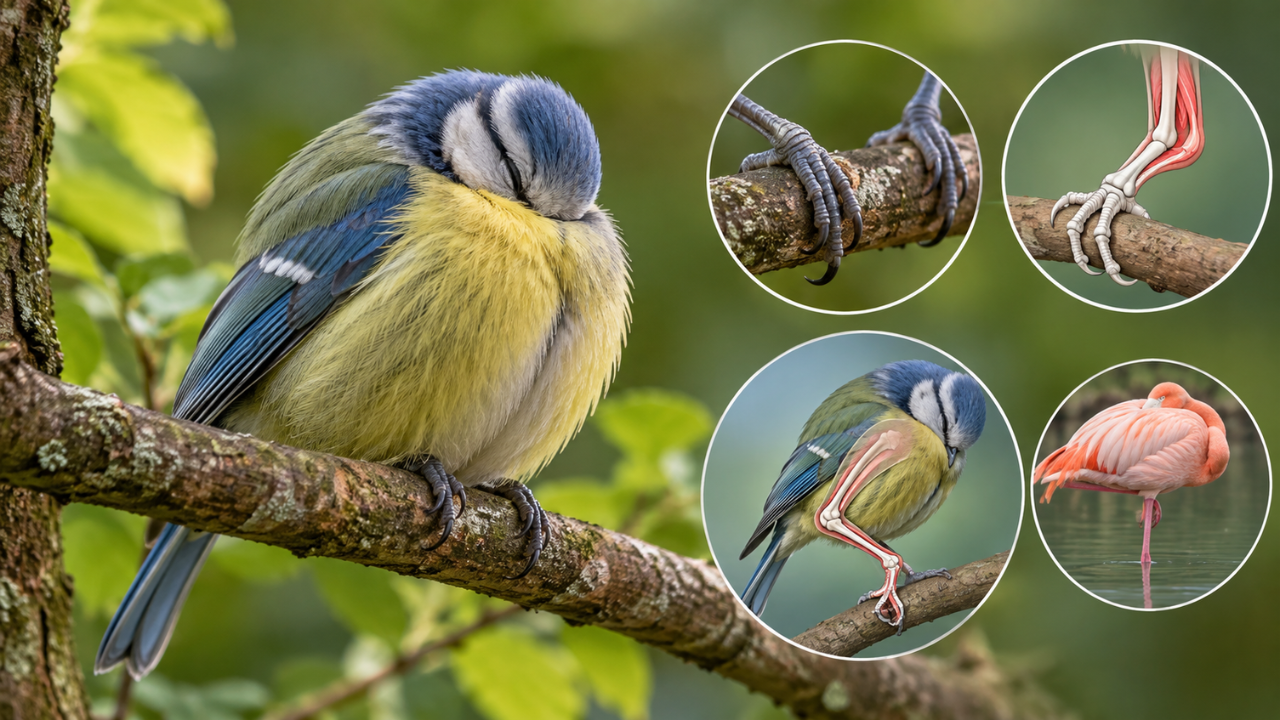
Birds have several physical adaptations that help them remain stable on a perch. Their legs are positioned differently from human legs. (AI representation/ChatGPT)
Birds often sleep on branches that sway in the wind. Their feet and body posture help them respond to small movements. A 2023 study discussed by CNRS News used a digital model based on the anatomy of a small bird, the mandarin diamondbird. The researchers examined how bones, muscles, tendons and ligaments work together to keep a bird stable. The model showed that several tendon-like structures, including one running behind the knee, help create a stable system. The researchers also found that the stiffness of bird tendons is important because it reduces the effect of small disturbances and helps the bird return to a balanced position. This helps explain why a bird can remain perched even when the branch moves slightly.
What happens if a bird dies while sleeping?
A bird does not remain permanently attached to a branch after death. The grip depends on the living bird’s posture, muscle activity and body structure. When the bird dies, the muscles relax and the body loses the ability to maintain its normal balance. As a result, the bird usually falls from the perch. Research on European starlings also found that anesthetised birds could not remain perched in the same way as conscious birds. This challenges the idea that the tendon mechanism works entirely without muscle activity in every species.
Do all birds use the same mechanism?
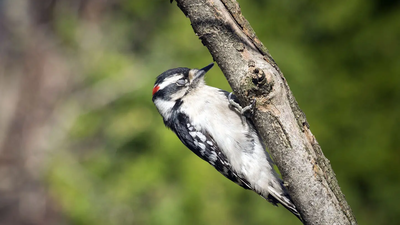
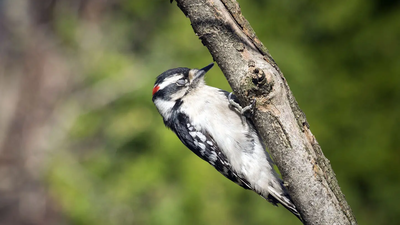
No. The automatic gripping explanation mainly applies to birds adapted for perching. Different birds have different foot structures depending on how they live. Woodpeckers, for example, have two toes pointing forward and two pointing backwards. This arrangement helps them grip tree trunks while climbing. Parrots also have two toes forward and two backwards. Their feet help them climb, hold food and grip branches. Birds of prey have strong talons for catching and carrying prey, while ducks have webbed feet for swimming. This means a duck, owl, woodpecker and sparrow may all sleep differently because their feet serve different purposes.Birds do not usually fall from trees while sleeping because their feet, tendons, bones and balance systems are adapted for perching. In many small birds, bending the legs helps the toes grip the branch. In others, balance and controlled muscle activity play a larger role. The important point is that birds are not simply holding on with their claws throughout the night. Their anatomy allows them to rest while remaining stable on a branch, even when they are asleep.