






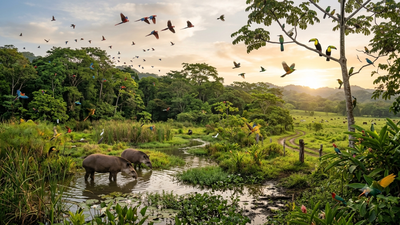
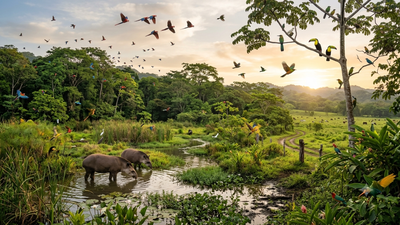
A former cattle ranch in northern Costa Rica has become an unlikely refuge for wildlife. Near Tenorio Volcano National Park, Tapir Valley Nature Reserve has spent the past decade restoring land that was once used for grazing. Cattle were removed, trees planted and a lagoon restored, allowing a mixture of forest, wetlands and regenerating pasture to develop. The changes have attracted Baird’s tapirs, hundreds of bird species and a wide range of frogs and reptiles. The reserve has also become known for the discovery of a tiny tree frog that had never been formally documented. What began as a conservation effort has grown into a diverse wildlife habitat.
How a former cattle ranch became a wildlife refuge
The reserve lies near Bijagua, on the eastern side of Tenorio Volcano National Park. Its history is tied to a period when cattle farming was expanding in the area. During the 1990s, government programmes encouraged settlement and cattle raising, with land being cleared for agriculture as part of the process. In 2005, three local families joined forces to acquire a cattle ranch adjoining the newly established protected area. The original intention was conservation, particularly because the property still supported an impressive range of birds despite its agricultural use.It was not an untouched piece of rainforest waiting to be discovered. Much of the land had been shaped by cattle and pasture.
The former ranch begins its return to nature
The most active phase of restoration began in 2016. Cattle were taken off the property, new forest was planted in lower parts of the reserve and an existing lagoon was restored. The changes did not involve replacing the whole landscape with a single type of forest. Wet areas, open ground, regenerating vegetation and established forest now occur alongside one another. That mixture creates different conditions for wildlife, from amphibians using shallow wetland areas to birds moving through the forest and its edges.The reserve has since expanded into a much larger conservation property. Reportedly, Tapir Valley currently describes the protected area as a 220-hectare reserve, while its history records the original 100-hectare cattle ranch acquired in 2005.
Tapirs become a sign of the reserve’s recovery
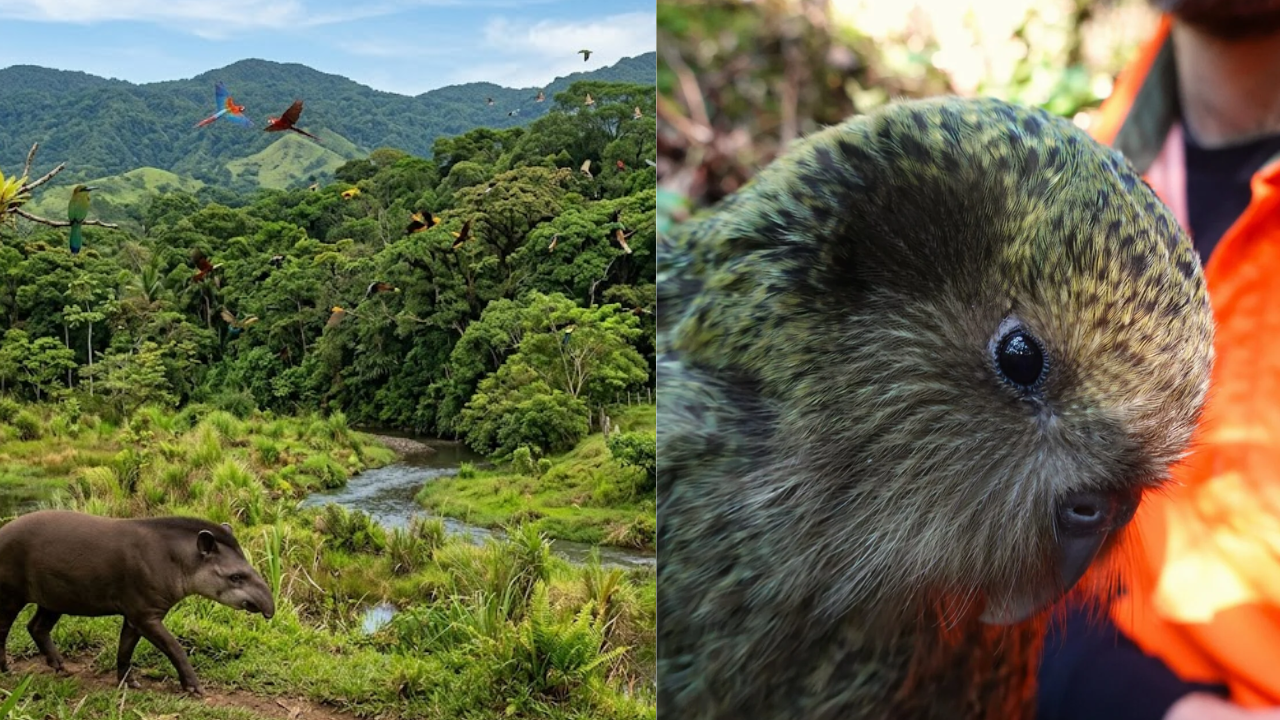
The animal that eventually gave the reserve its name is the Baird’s tapir, a large herbivore native to Central America. Tapirs are now among the main attractions for visitors, but their presence also became a useful sign that the recovering habitat could support large mammals.Tapir Valley says at least six or seven tapirs now move through the reserve. One female, known as Mamita, has produced at least 10 calves during her time there, according to the reserve. Her daughter Lunita and younger animals have also been recorded in the area.The return of such a large animal is quite different from seeing an increase in insects or small birds. A tapir needs food, cover and enough connected habitat to move around. The animals are also capable of travelling beyond the boundaries of individual reserves, making the surrounding landscape important as well.A 2026 conservation project from the Walker Foundation identifies Tapir Valley as part of a proposed biological corridor connecting Tenorio National Park with larger forested areas towards the Monteverde and Arenal region. Tapir tracks and sightings have been recorded in the reserve as part of that wider conservation picture.
PC: Australian Geographic
More than 440 bird species have been recorded
The reserve’s birdlife was one of the reasons conservationists were interested in the property in the first place. Even when cattle were still present, the area supported a notable variety of birds. As reported by Tapir Valley Nature Reserve, it reports more than 440 bird species. The reserve’s birding tours move through several habitats, including forest edges, streams, undergrowth and canopy areas. Toucans, trogons, hummingbirds and crested guans are among the birds visitors may encounter.It represents the number recorded in the reserve. Still, the range gives an indication of how much wildlife can use a relatively small area when different habitats are available. The wider reserve also supports mammals such as howler monkeys, white-faced capuchins and agoutis, alongside its better-known tapirs. Reptiles and amphibians become more conspicuous, and the sounds of the wetland provide clues to species that would be easy to miss during daylight.
A reserve made up of many small habitats
Tapir Valley’s recovery is not simply a story of cattle pasture turning back into dense rainforest. The reserve contains wetlands, lagoons, forest and regenerating areas, each supporting different forms of life. That variety helps explain why the wildlife count extends well beyond birds and tapirs. The reserve reports more than 50 reptile species and more than 50 frog species.For visitors, the differences become particularly apparent after sunset. Night tours focus on creatures that spend the day hidden among vegetation or become active only when temperatures fall and darkness arrives. The reserve says its nocturnal surveys have recorded more than 50 species of reptiles and 50 species of frogs.
Ten years changed what visitors can see
Restoration at Tapir Valley did not happen overnight. The more intensive work started in 2016, and the reserve’s current wildlife reflects a process of habitat recovery rather than a single release or reintroduction programme.Removing cattle allowed vegetation to recover. Planting forest accelerated that process in selected areas. Restoring the lagoon brought back wetland habitat. Wildlife then used those spaces, sometimes in expected ways and sometimes with surprises that nobody could have predicted.