







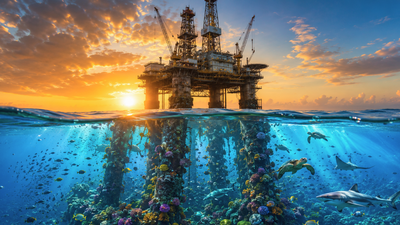
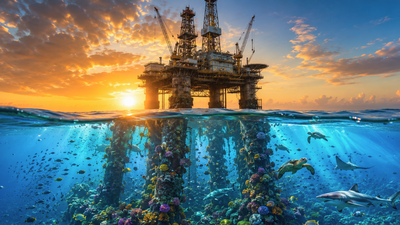
The last place most people would expect to find a thriving marine ecosystem is beneath an abandoned offshore oil rig. Built to drill for crude oil and often criticised for their environmental impact, these massive steel structures are now supporting colourful corals, schools of fish, sea turtles and even sharks in several parts of the world. Marine scientists say decades of underwater colonisation have transformed many retired platforms into artificial reefs, creating rich habitats where marine life flourishes. The remarkable transformation has prompted researchers and governments to reconsider the fate of ageing offshore infrastructure, raising an unexpected question about whether some of these industrial giants have become too valuable to ocean ecosystems to simply remove.
How abandoned oil rigs became thriving marine habitats
The transformation begins with a natural ecological process known as biofouling. Once an offshore platform has spent years beneath the sea, its submerged steel legs become covered with barnacles, mussels, oysters, algae, sponges and corals. These organisms create the foundation of an entirely new ecosystem by providing food, shelter and breeding surfaces for countless marine species.As the habitat grows, small fish, crabs and shrimp arrive, followed by larger predators including snapper, grouper, barracuda, amberjack, tuna and sharks. Marine ecologists describe this as ecological succession, the same process through which natural reefs develop over time. Although the structures were never designed for conservation, many have evolved into highly productive marine habitats that support complex food webs.The science behind the ‘Rigs-to-Reefs’ movementOne of the best-known examples of this transformation is the Rigs-to-Reefs programme in the Gulf of Mexico. Introduced by US coastal states in the 1980s, the initiative allows selected decommissioned offshore platforms to be converted into permanent artificial reefs instead of being completely dismantled.Research conducted by scientists at institutions including Louisiana State University, Texas A&M University and the US Bureau of Safety and Environmental Enforcement (BSEE) has documented the ecological importance of many of these structures. Today, more than 500 retired offshore platforms in the Gulf of Mexico have been converted into artificial reefs, creating habitats that support commercially and ecologically important fish species.The programme has become one of the world’s largest examples of industrial infrastructure being repurposed for marine conservation, inspiring similar discussions in Australia, Brunei, Malaysia and parts of the North Sea.
What scientists have discovered beneath offshore platforms
Marine biologists have spent decades studying the extraordinary diversity that develops around offshore platforms. Research led by Dr Milton Love, a marine biologist at the University of California, Santa Barbara, has shown that offshore oil platforms off the California coast rank among the most productive fish habitats ever scientifically recorded.Love’s studies found that platforms support exceptionally high numbers of rockfish, including species that have become increasingly rare elsewhere along California’s coastline. Some juvenile rockfish use the towering steel structures as nursery habitats before moving into surrounding waters as adults.Research published in the journal Proceedings of the National Academy of Sciences (PNAS) has also highlighted how artificial structures can provide valuable habitat in regions where natural rocky reefs are limited. Meanwhile, studies in the Gulf of Mexico have documented hundreds of marine species living around offshore platforms, including corals, sea anemones, sponges, sea turtles, reef fish and pelagic predators.
Why offshore platforms attract so much marine life
Unlike the mostly soft, sandy seabed found across large areas of the continental shelf, offshore platforms create vertical underwater landscapes extending from the seafloor to the ocean’s surface. This enormous three-dimensional structure offers shelter, feeding opportunities and breeding sites at multiple depths.Corals and sponges form intricate living surfaces that attract tiny crustaceans and juvenile fish. These smaller animals become prey for larger species, creating a food chain that continues all the way to top predators. Schools of jacks, snappers and groupers are common around many platforms, while sea turtles frequently forage among the dense marine growth. In tropical waters, researchers have even recorded whale sharks visiting offshore installations in search of food.Because these habitats continue to develop over decades, some platforms now support marine communities comparable in complexity to naturally occurring reefs in the same region.
From California to the North Sea
The ecological importance of ageing offshore infrastructure is now being studied around the world.In the Gulf of Mexico, retired platforms have become some of the region’s best-known artificial reefs, attracting recreational divers and supporting important fisheries.Off the coast of California, researchers have documented large populations of rockfish living around oil platforms, fuelling debate over whether some structures should remain after oil production ends.In the North Sea, where hundreds of ageing oil and gas installations are approaching retirement, scientists and policymakers are examining whether parts of selected platforms could continue serving as marine habitats while balancing environmental and legal obligations.Countries such as Malaysia and Brunei have also incorporated retired offshore structures into reef conservation programmes, recognising their ecological value in supporting marine biodiversity.
A second life for industrial giants
The story of abandoned offshore oil rigs is one of nature’s most unexpected transformations. Structures originally engineered to extract fossil fuels have, in many locations, become vibrant underwater ecosystems filled with corals, fish, sea turtles and other marine life. Their remarkable evolution has challenged long-held assumptions about what happens when industrial infrastructure reaches the end of its working life.As hundreds of offshore platforms around the world near decommissioning over the coming decades, their future will remain a subject of scientific research and policy discussions. What is already clear, however, is that beneath the waves, many of these former symbols of oil production have acquired an entirely new identity. Instead of pumping crude from the seabed, they are now sustaining thriving marine communities and revealing the extraordinary ability of nature to reclaim even the most unlikely places.