







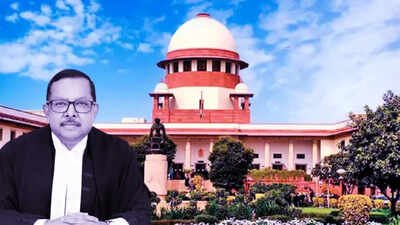
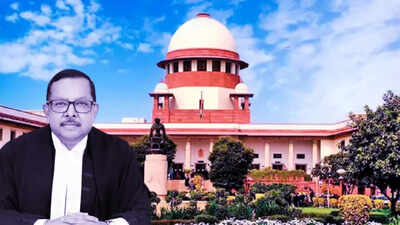
NEW DELHI: Supreme Court judge Justice Ujjal Bhuyan on Saturday questioned the criminalisation of ordinary activities while highlighting delays in granting relief to citizens facing criminal action for protest or dissent, saying there is “no law prohibiting consumption of chicken over the Ganga river.“Speaking at the Justice GP Singh 4th Memorial Lecture at the National Law Institute University (NLIU) in Bhopal, Justice Bhuyan cited the arrest of 14 Muslim men who were accused of consuming chicken biryani while breaking their Ramzan fast on a boat in the Ganga as an example of what he described as the criminalisation of normal activities.“Take for example the case of a group of youngsters breaking their fast over the river Ganga by consuming chicken biryani. I am sure consuming chicken biryani is not an offence. It can’t be an offence. There is no law prohibiting consumption of chicken over the Ganga river. They were arrested for that very reason and they had to remain in jail for 3 months,” he said, as quoted by Bar and Bench.
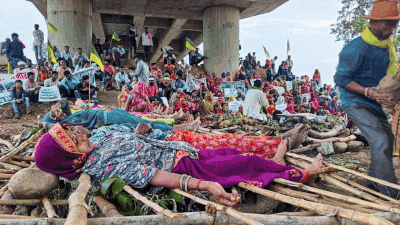
CJP Jantar Mantar Protest Updates
Justice Bhuyan said such cases also highlighted broader concerns over how courts deal with petitions filed by citizens accused in protest-related cases.He observed that while courts often grant bail or other relief, it frequently comes after considerable delay and is accompanied by restrictive conditions.
Raises concerns over delayed bail, restrictive conditions
The judge said the space for expressing divergent opinions in India was shrinking and cautioned against the criminalisation of peaceful democratic activities.“It will not be an exaggeration to say that public space for expressing divergent opinion is shrinking in India. The right to express one’s views and to demonstrate peacefully are fundamental freedoms of the citizens. Debate and dissent are the essence of democracy. Unfortunately, even normal activities are being criminalised,” he said.Justice Bhuyan also questioned the nature of conditions imposed while granting bail, suggesting that some restrictions could have a chilling effect on citizens exercising their right to dissent.“These issues raise serious questions. Citizens are finding that though the courts are responsive and do grant bail, do grant relief, many a times it is belated. But it is the restrictive conditions which are imposed while granting bail that are causing the greatest concern. By such restrictive orders, are the courts indirectly telling the citizens or discouraging the citizens not to express their dissent?” he said.He also cited cases where courts granted bail but directed accused persons not to attend public meetings, post on social media or leave the country, saying such conditions could undermine fundamental freedoms.
Refers to Bombay HC order on Gaza protest
Justice Bhuyan also referred to a July 2025 Bombay high court order dismissing a petition filed by the Communist Party of India (Marxist), which had sought permission to hold a protest at Mumbai’s Azad Maidan against the alleged genocide in Gaza.The high court had observed, “Our country has enough issues. We don’t want anything like this. I am sorry to say, you are all short-sighted. You are looking at issues in Gaza and Palestine. Look at your own country. Be patriots. This is not patriotism. People say they are patriots.”Commenting on the order, Justice Bhuyan said he found it “very amusing” that a judge questioned why citizens wished to protest over developments outside India.
Calls for scrutiny of judicial decisions
Justice Bhuyan said the judiciary is not above criticism and stressed that judgments should be critically examined by lawyers, students and the wider legal community.“Judgments, after being delivered, are required to be critically examined and criticised if necessary. Criticism of a judgment does not amount to criticism of a judge.”Referring to recent Supreme Court decisions, including the verdict on reservation for Economically Weaker Sections (EWS), he encouraged students to analyse judgments critically rather than accepting them unquestioningly.“If everybody goes and tells the judges, ‘Sir, wonderful thing. Sir, what you say is excellent. Sir, you are a jurist,’ then how will the system improve?” he said.Justice Bhuyan also said judges should regularly introspect if they wish to retain public confidence in the institution.“For the judges and the judiciary to remain legitimate and to remain relevant, public perception is most crucial… It is not for us to make that comment. It is for the citizens to assess. Perception of the citizens as to where the judiciary stands today, more particularly the Supreme Court, 75 years after we have become a Republic, is what matters,” he said.He added that institutional improvement depends on introspection and that robust public debate, including criticism of judicial decisions, strengthens democratic institutions.
Similar concerns raised earlier
Justice Bhuyan has previously voiced similar concerns about shrinking space for debate and dissent.Speaking at a Supreme Court Bar Association conference in Bengaluru earlier this year, he said a developed India would require greater tolerance for diverse views and cautioned against criminalising dissent.During that address, he also questioned the extensive use of the Unlawful Activities (Prevention) Act (UAPA), pointing to low conviction rates and arguing that prolonged incarceration without timely trials could not be a model for a developed nation.