









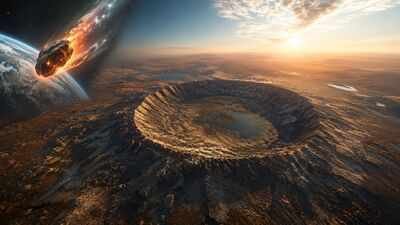
Around three billion years ago, long before animals, forests, or even complex life existed, a large asteroid struck a young Earth. The collision happened at a time when the planet looked very different from today, with early continents still taking shape and geological processes operating in conditions that remain difficult to reconstruct. Much of the evidence from that distant era has been erased by time, buried beneath younger rocks or altered by billions of years of heat and pressure.That is why a rocky outcrop in Western Australia has continued to attract attention from geologists for decades. Known as the North Pole Dome, the site has long been suspected of preserving traces of an ancient cosmic impact. The challenge was never finding signs of disturbance. The real difficulty lay in determining exactly when the event took place. A new study has now provided what scientists believe is the clearest answer yet, placing the impact at roughly three billion years ago and establishing the structure as the oldest known impact crater on Earth.
An ancient crater hidden within some of Earth’s oldest rocks
The North Pole Dome sits within Western Australia’s Pilbara region, an area famous among geologists for preserving some of the oldest rocks on the planet. The study published in GeoScience World, titled, ‘How old is the North Pole Dome impact, Western Australia?’, states that these ancient formations offer rare windows into Earth’s early history, making the region an important destination for researchers trying to understand conditions during the Archean eon.For years, scientists have debated the origin and age of the North Pole Dome structure. Certain features suggested that a meteorite strike had once occurred there, but proving such an event becomes increasingly difficult as geological time stretches into billions of years. Ancient rocks rarely remain unchanged. They are folded, fractured, heated and chemically altered by countless processes that can blur evidence of what happened long ago.The result was a site that appeared promising but remained uncertain. Establishing a precise date became one of the most significant unresolved questions.
The mineral clues hidden inside the damaged rocks
The breakthrough came from minerals hidden within the rocks themselves.As reported by the study, researchers focused on zircon, a remarkably durable mineral often described as one of geology’s most reliable record keepers. Zircon crystals can survive extreme conditions and preserve information about events that occurred billions of years earlier.Within samples collected from the North Pole Dome, scientists identified unusual zircon crystals whose shapes differed from those normally formed during standard geological processes. Some displayed branching and skeletal patterns that pointed towards a history of intense disruption.The team argues that these crystals were affected by the extreme temperatures generated during an asteroid impact. Existing zircon appears to have been partially altered and, in some places, regrown as the surrounding rocks responded to the enormous energy released by the collision.
Two mineral records pointed to the same impact event
Dating ancient events often requires more than one piece of supporting evidence. Geological records can be complicated, and a single mineral system may sometimes reflect later changes rather than the original event.To test their findings, the researchers turned to another mineral known as apatite. Unlike zircon, apatite formed when hot fluids moved through rocks that had already been damaged by the impact. When analysed independently, the apatite produced essentially the same age as the zircon record.The agreement between two different mineral systems strengthened confidence that both were recording the same episode in the region’s history. Rather than reflecting separate geological processes occurring millions of years apart, the minerals appeared to point towards one major event.
The oldest known impact crater on Earth
Meteorite impacts have played a significant role throughout Earth’s past, but tracing that history becomes harder the further back researchers look. Many younger craters remain visible at the surface, their outlines still recognisable despite erosion. Ancient structures rarely enjoy that luxury. Over immense timescales, tectonic activity, chemical alteration and repeated cycles of burial and uplift can erase much of the original evidence.Because of this, confirmed impact craters from Earth’s earliest chapters are exceptionally rare. The newly dated North Pole Dome structure now occupies a unique position. Scientists regard it as the oldest known impact crater currently identified on the planet and the only recognised example from the Archean eon. That places the event during a period when Earth’s first stable continental fragments were emerging and the planet itself was still evolving in ways very different from the modern world.