









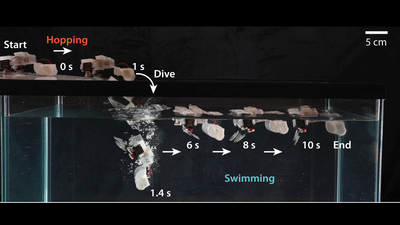
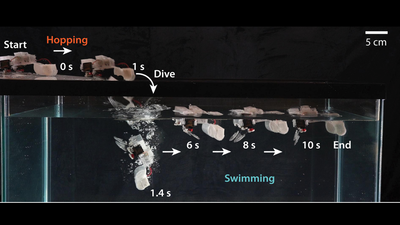
Researchers have developed a small, untethered robot that uses snapping elastic rods to hop across sand, grass, glass-like acrylic and other surfaces, as well as swim in water. According to the study published in Science Advances, titled ‘Geometry-controlled instability pathway selection in elastic helices enables fast, efficient robotic locomotion’, the study describes how superelastic nickel-titanium rods store energy before releasing it in a rapid movement called snap-through. The robot measures 11 centimetres by 8 centimetres by 4 centimetres and weighs 98.2 grams. It reached speeds of 3.21 body lengths per second, with tests showing improved movement across six terrains compared with a rigid-legged control.
How do nitinol rods power the hopping robot
The robot’s limbs are made from superelastic nitinol rods, a nickel-titanium alloy, held in place by specially designed connectors. A micro-servo rotates one end of each rod, gradually loading the elastic structure until it reaches a critical configuration. At that point, the rod rapidly changes shape, releasing stored elastic energy. The motor then reverses its movement to reset the limb for the next hop. This cycle allows the robot to repeat the process without requiring the motor to produce the entire burst of mechanical output directly.To establish how the mechanism works, the researchers combined mathematical modelling, computer simulations and automated experiments. Their analysis mapped the conditions under which an elastic helix undergoes either smooth, continuous buckling or a sudden snap-through transition. The distinction is important because continuous buckling does not produce the same rapid energy release required for the robot’s hopping motion. The researchers used this framework to select a limb configuration that balances energy release with the time and movement required to reset the mechanism between hops.
How fast can the 98.2-gram hopping robot move across six terrains
The untethered prototype measures 11 centimetres by 8 centimetres by 4 centimetres and weighs 98.2 grams. It carries two independently driven elastic limbs, two micro-servos, an onboard 7.4-volt lithium-polymer battery and a custom control board. During testing, the robot achieved a peak speed of 3.21 body lengths per second and a hop height of approximately 1.08 body heights. Its movement consists of limb preloading, snap-through against the ground, ballistic flight, an airborne reset and touchdown.In controlled experiments, the researchers compared the robot with a rigid-legged version built using the same basic platform, battery, electronics, servos and control sequence. The elastic-limbed robot recorded average speeds of 3.21 body lengths per second on wood, 2.50 on cloth, 2.48 on acrylic, 2.09 on leather, 1.91 on grass and 2.54 on sand. The rigid-legged control achieved 1.20, 0.10, 1.11, 1.08, 0.22 and 1.05 body lengths per second on the same surfaces, respectively. The results showed that the snap-through mechanism improved forward speed across all six tested terrains.
How does the hopping robot transition from land to water
The robot’s performance was not limited to movement across land. The researchers developed a sealed version that could transition from land to water and swim at approximately 0.5 body lengths per second. In water, periodic snapping of the elastic limbs generates oscillatory body movements that produce thrust. The team also demonstrated that the robot could climb and descend stairs, hop across outdoor sand containing small rocks, and swim in a natural outdoor pool with underwater obstacles.The robot’s electrical input and the contribution of its elastic limbs to locomotion. Under matched testing conditions, the snap-actuated robot consumed an average electrical power of 1.63 watts, compared with 1.41 watts for the rigid-legged control, while achieving substantially higher speeds. Its minimum electrical cost of transport was reported as 4.79. The researchers concluded that the improvements in speed, efficiency and terrain adaptability were associated with elastic energy storage and rapid release through snap-through. They also noted that the mechanism produces burst-like rather than continuously variable movement and requires the limbs to reset after each snap.