









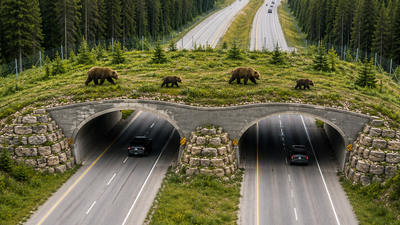
Building bridges for bears, wolves and elk sounded like an expensive fantasy when Canadian officials first proposed the idea in the 1990s. Many critics questioned whether wild animals would ever use specially designed crossings over one of the busiest highways in the Canadian Rockies, while some even mocked the proposal as a waste of taxpayers’ money and laughed at the idea of building bridges for animals. The project, however, has since proved its critics wrong. More than 250,000 documented wildlife crossings have been recorded in Banff National Park, while collisions between vehicles and large animals have fallen by over 80%, transforming the way countries think about protecting wildlife alongside modern roads.
The problem that made Canada build bridges for bears and other wildlife
Banff National Park in Alberta is Canada’s oldest national park and is home to grizzly bears, black bears, wolves, cougars, elk, moose, deer, bighorn sheep, mountain goats, lynx, wolverines and many other species. Running through the park is an approximately 82-kilometre stretch of the Trans-Canada Highway, one of the country’s busiest roads.As traffic increased over the years, the highway became a dangerous barrier. Animals trying to reach food, mates or seasonal habitats often had to cross several lanes of fast-moving traffic. Many were killed, while others became isolated from neighbouring populations, affecting the long-term health of wildlife.Instead of accepting wildlife deaths as inevitable, Parks Canada developed a bold solution. Engineers designed specially built wildlife overpasses and underpasses that would allow animals to cross the highway without coming into contact with vehicles. The proposal faced scepticism, with critics arguing that animals would never trust artificial crossings and that spending millions of dollars on bridges for wildlife was a poor use of public money. Conservation scientists, however, believed that animals would eventually adopt the crossings if they closely resembled natural habitats and were built along existing movement corridors. Their confidence proved well founded, as wildlife gradually began adopting the crossings in growing numbers over the following years.
How the crossings are designed
The Banff wildlife crossing system is far more than a few bridges. Today, it includes six wide vegetated overpasses, 38 wildlife underpasses and more than 80 kilometres of fencing running alongside sections of the highway.The overpasses are covered with soil, native grasses, shrubs and trees so they blend into the surrounding forest rather than looking like conventional bridges. This natural design helps reduce traffic noise and encourages animals to treat the structures as part of their habitat. Underpasses vary in size and shape depending on the animals expected to use them. Large, open tunnels suit species such as elk, while darker, narrower passages are often preferred by predators such as cougars and black bears.The fencing is just as important as the bridges. It keeps animals off the highway and guides them towards designated crossing points, making the entire system far more effective.
More than 250,000 successful crossings
To understand whether the project was working, scientists have monitored the crossings for nearly three decades using motion-triggered cameras, GPS collars, snow tracking and DNA analysis, making Banff one of the best-documented wildlife crossing systems in the world. The results have exceeded expectations. Since monitoring began, more than 250,000 documented crossings by large mammals have been recorded, with the number continuing to grow each year. Much of this work has been led by wildlife biologist Dr Anthony P. Clevenger, whose research has helped shape similar wildlife crossing projects around the world.
Wildlife deaths fell dramatically
Perhaps the biggest success has been the reduction in wildlife-vehicle collisions.According to Parks Canada and long-term research conducted in Banff, collisions between vehicles and large animals have dropped by more than 80% overall along fenced sections of the highway. For deer and elk, collisions have fallen by more than 96%.Besides protecting wildlife, fewer collisions have also reduced injuries to motorists, lowered vehicle repair costs and improved road safety along one of Canada’s busiest mountain highways.
The crossings do more than prevent accidents
The benefits extend far beyond reducing roadkill. Roads can divide wildlife populations into isolated groups, making it harder for animals to find unrelated mates and increasing the risk of reduced genetic diversity over time.By reconnecting habitats on both sides of the highway, the crossings allow wildlife to move freely in search of food and mates. This is especially important for wide-ranging species such as grizzly bears and wolves, while also helping maintain healthy genetic diversity across animal populations.
A model copied around the world
Banff’s success has inspired wildlife crossing projects across North America, Europe and Australia. Countries including the United States, the Netherlands, Germany, France, Norway, Sweden and Australia have incorporated similar designs into road projects as governments increasingly recognise that protecting biodiversity can also improve road safety.One of the best-known examples is California’s Wallis Annenberg Wildlife Crossing, which is designed to reconnect habitats separated by a major motorway and help protect mountain lions and other native wildlife.
The significance of Canada’s wildlife bridges
As roads continue to expand worldwide, balancing transport needs with wildlife conservation has become increasingly important. Banff’s wildlife crossings have shown that carefully planned infrastructure can reconnect habitats, reduce wildlife deaths and make roads safer for motorists. What began as an idea that many people laughed at has become one of the world’s most celebrated conservation success stories and a blueprint for countries looking to protect nature without slowing development.