








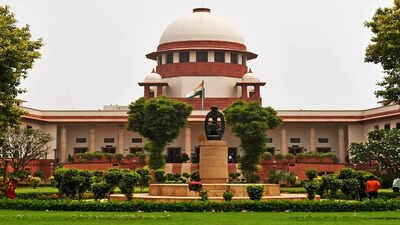
NEW DELHI: The Supreme Court Thursday observed against making third-langauge compulsory in Class 9 under the New Education Policy, noting that students begin preparations for board exams when the “pressure starts”.The court said Central Board of Secondary Education’s (CBSE) introduction of third language from Class 9 increases stress level of students.(CBSE) has made the study of three languages compulsory for students from Class IX. The board has also clarified that there will be no Board examination for the third language (R3) in Class X.“No that is very bad. 9th standard is stressful. Why do you introduce a new language in 9th? You introduce it in 6th. When we were there in our school we had both ICSE and SSLC. We were taught both syllabus. Only at the end of 9th standard we had to select,” Justice BV Nagarathna, who was hearing plea challenging Madras high court direction to establish Jawahar Navodaya Vidyalayas in each district, said according to Live Law.“… Union of India please don’t have 3rd language in 9th standard. CBSE ICSE State board 10th standard is a board exam. From the end of 8th standard onwards, the pressure starts. The chapter on Light which was in SSLC 10th standard was taught to us in 8th standard ICSE. Prepairing for us for 10th,” Justice Nagarathna further reiterated.The case arises from the Tamil Nadu government’s appeal against a Madras high court order that directed the setting up of a Jawahar Navodaya Vidyalaya (JNV) in every district of the state. The high court had ruled that refusing permission for JNVs deprived students of their freedom to choose where they wanted to study and was not in line with the objectives of the Right of Children to Free and Compulsory Education Act. It also instructed the state to arrange temporary facilities for 240 students in each district until permanent schools were established.However, in December 2017, the Supreme Court stayed the high court’s directions after the Tamil Nadu government challenged the verdict. During a hearing on December 15, 2025, the apex court asked the Centre and the Tamil Nadu government to hold discussions on the possibility of establishing JNVs in the state. It directed both sides to identify suitable land for schools in every district and submit the outcome of their consultations before the court, describing the exercise as an effort to encourage cooperative discussions between the Union and the state rather than impose an immediate decision.In 2025, ;the Supreme Court also asked both the Centre and the Tamil Nadu government “not to make it into a language issue” while hearing the state’s plea challenging a Madras high court order.The observation was made by a bench of Justices BV Nagarathna and R Mahadevan after senior counsel P Wilson, appearing for the DMK-led Tamil Nadu government, argued that the Centre should adopt a two-language formula in line with the state’s policy instead of the three-language formula under the National Education Policy (NEP) 2020.As the Centre’s counsel began to respond, the bench urged both parties to refrain from turning the matter into a language issue.