








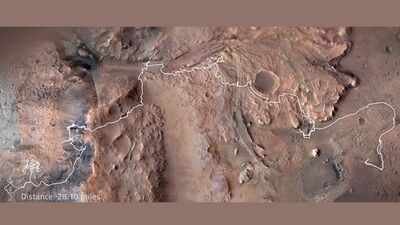
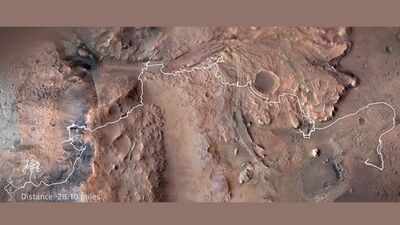
NASA’s Perseverance rover has set a new record for distance travelled on the surface of another planet. On October 11, 2026, after five and a half years on Mars, the six-wheeled rover’s odometer reached 28.10 miles, or 45.22 kilometres, surpassing the 28.06-mile record set by NASA’s Opportunity rover over nearly 15 years of exploration. According to NASA’s Jet Propulsion Laboratory, Perseverance achieved the milestone on the 2,006th Martian day, or sol, of its mission.The achievement is more than a numerical landmark. It reflects how far robotic exploration has advanced since NASA’s earliest Mars rovers, and it gives scientists faster access to the varied geology of Jezero Crater and its ancient surroundings. Perseverance is now operating beyond the original mission plan, with NASA approving an extended mission that will carry its crater-rim exploration through roughly the end of 2028, as per the report.
A record set in half the time
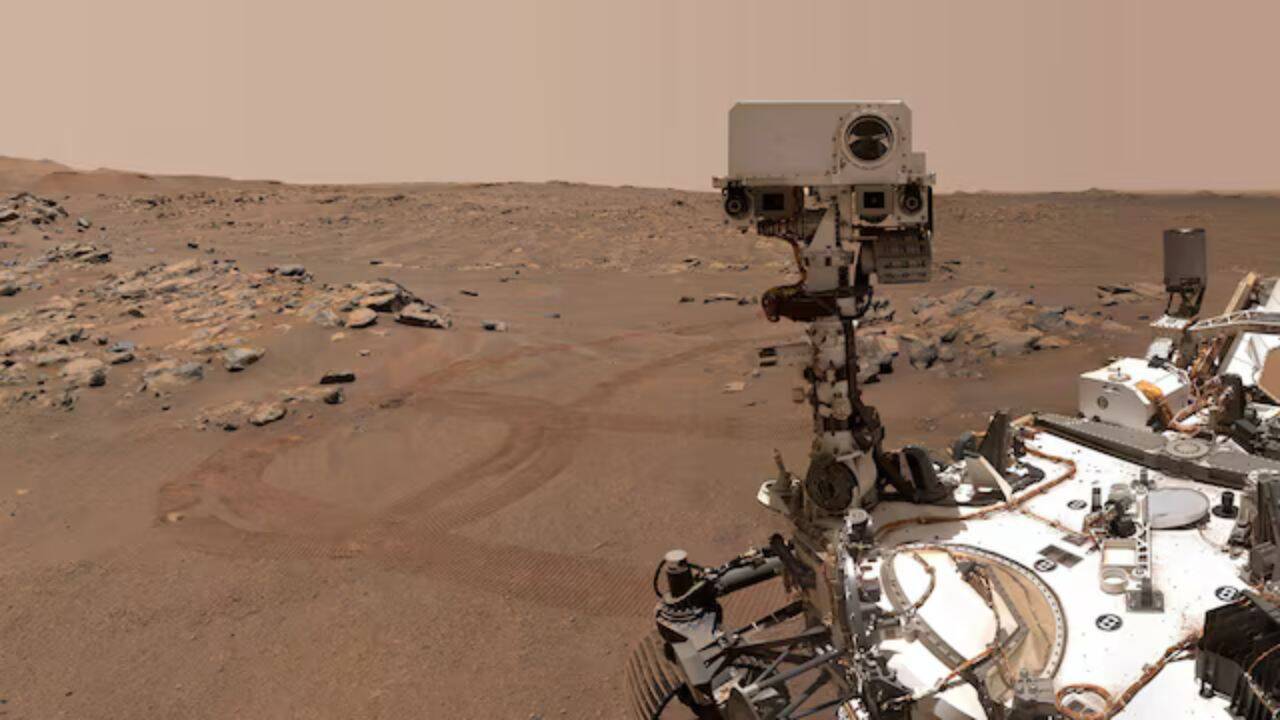
Nasa’s Perseverance Mars rover is seen in a “selfie” that it took over a rock nicknamed “Rochette” (Nasa)
Opportunity held the previous off-world driving record for years. The rover landed on Mars in 2004 and continued operating until 2018, covering 28.06 miles across 5,111 Martian days. Its endurance made it one of NASA’s most successful planetary missions and set a benchmark that seemed difficult to match.Perseverance reached a slightly greater distance in just five and a half years. It covered the distance on its 2,006th sol, meaning it travelled farther than Opportunity did in less than half the time. NASA says the rover has already driven well beyond its original mission requirement of no more than 12.4 miles.The record also places Perseverance ahead of other major off-world vehicles. It has passed the 22.2 miles travelled by Apollo 17 astronauts Gene Cernan and Harrison Schmitt on the Moon in 1972, as well as the 24.2 miles covered by the Soviet Union’s Lunokhod 2 rover in 1973, as per the report.
How Perseverance drives so far
A major reason for the new record is Perseverance’s autonomous navigation system, known as AutoNav. As the rover moves, it images the terrain, builds a three-dimensional map of hazards, and plots a route between waypoints selected by engineers on Earth. NASA describes this ability as “thinking while driving.”This autonomy allows Perseverance to move at or near its top speed without waiting for every decision to be made from Earth. In a single Martian day, the rover can cover as much as 1,351 feet, or 412 metres. More than 90 percent of its total distance has been driven using AutoNav, compared with about 5 percent for NASA’s earlier Opportunity and Spirit rovers, as per NASA’s Jet Propulsion Laboratory.The difference in computing power is equally striking. NASA’s first Mars rover, Sojourner, assessed the path ahead using 20 measurement points. Perseverance processes 600,000 points with every look, allowing it to identify obstacles and choose safer routes with far greater precision.
Exploring ancient terrain
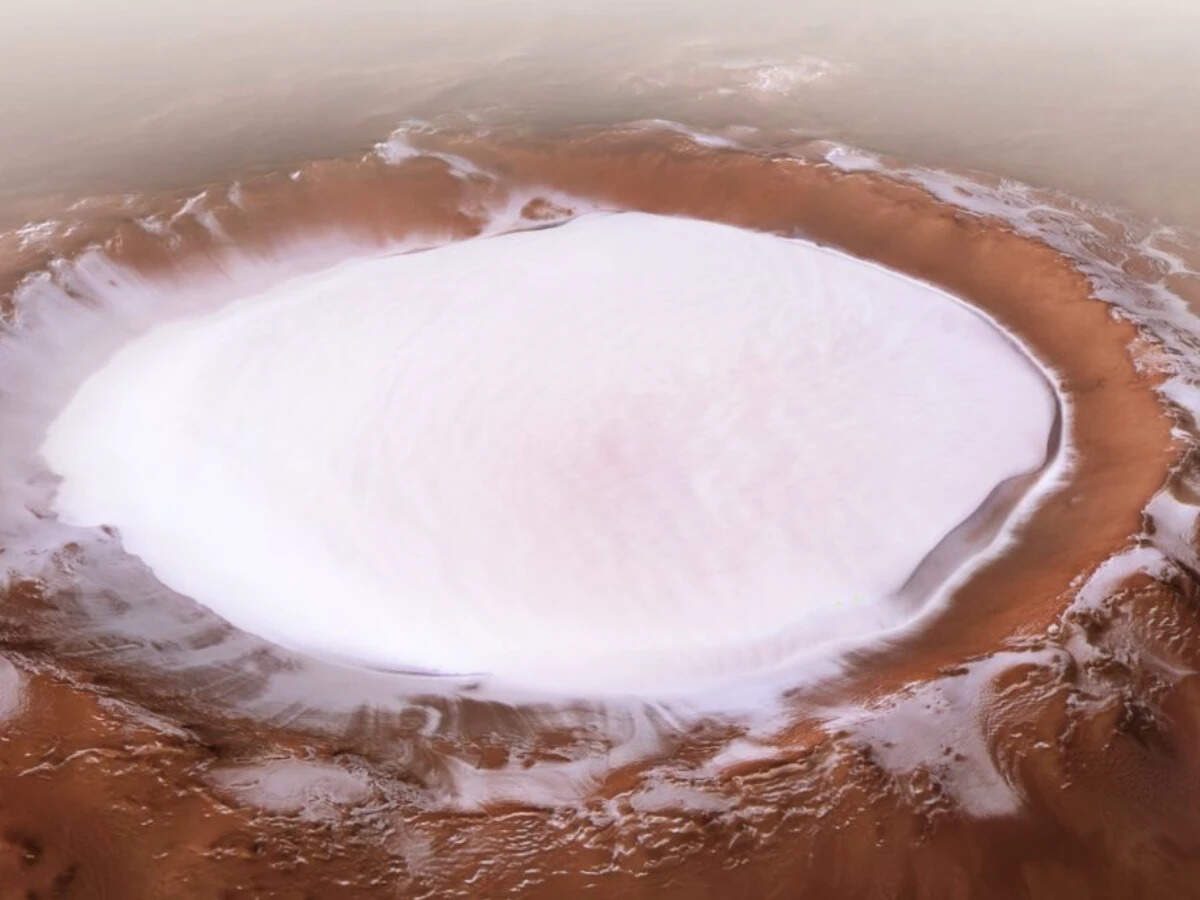
Top surface layer water appears readily visible at some places on Mars. Image Credit: ESA/DLR/FU Berlin
The record-setting drive occurred as Perseverance travelled toward an area called Idubi, through a region west of Jezero Crater nicknamed Lac de Charmes. NASA says the rocks there may include some of the oldest terrain ever explored in the solar system.The terrain is so ancient that comparable rocks on Earth have largely disappeared because of erosion and plate tectonics. Mars does not have tectonic plates, which helps preserve a longer record of its early geological history. At Idubi, scientists hope to find evidence of ancient hydrothermal systems, environments where heated water may once have circulated through rock.Perseverance’s journey has taken it from an ancient lakebed up a fossilised river system and toward the crater rim. Along the way, it found a potential biosignature in a rock called Cheyava Falls, a discovery that makes the rover’s ability to travel efficiently across varied terrain especially important.
A legacy of Mars rovers
Perseverance’s record is the latest chapter in nearly three decades of NASA rover operations on Mars. Sojourner, the agency’s first Mars rover, travelled about 330 feet during its 83-sol mission in 1997. The twin rovers Spirit and Opportunity arrived in 2004 with planned prime missions of 90 sols, but both far exceeded expectations.Spirit logged 4.8 miles before it was silenced by the Martian winter in 2010. Opportunity continued for 5,111 sols, completed the first extraterrestrial marathon in 2015, and set the distance record that Perseverance has now broken.NASA’s Curiosity rover remains active as well. Since landing in Gale Crater in 2012, it has travelled more than 23.65 miles. Together, these missions show a steady improvement in rover durability, mobility, and scientific capability.
What the record means for science
Distance is only part of the achievement. Longer and faster drives allow Perseverance to examine more rock formations, collect samples from more environments, and build a broader picture of Mars’ past. NASA says the rover’s reach has already carried it from an ancient lakebed to a fossilised river system and then to the crater rim.So far, Perseverance has collected 29 rock and regolith samples from the crater floor, a former river delta, and the crater rim. In the rim region, it is studying impact-generated rocks that are about 4 billion years old, preserving a chapter of planetary history that has been almost entirely erased on Earth.After exploring Lac de Charmes, the rover will continue along the crater rim and head south toward Rainbow Falls, a 328-foot-wide block of ancient crust uplifted by the impact that formed Jezero Crater.
The record is not finished
NASA expects Perseverance to continue adding to the record. Project manager Steven Lee said the rover’s mobility systems remain fully operational and that extended ground-life testing suggests it can keep driving for many years. The mission’s first extension began in October and will support exploration of the crater rim through approximately the end of 2028.Engineers are also looking for ways to extend the rover’s working day. Bright glare in its navigation cameras currently forces the team to stop driving by mid-afternoon when the rover is heading toward the Sun. Future software improvements could help the rover see past those visual artefacts, potentially allowing later missions to drive for longer periods each day.For now, Perseverance holds the off-world driving record, but its journey is far from over. Each additional mile brings scientists closer to understanding whether Mars once offered conditions suitable for life, and how its ancient landscapes changed over billions of years.