





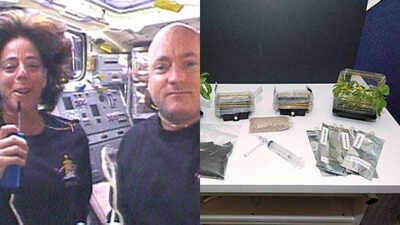
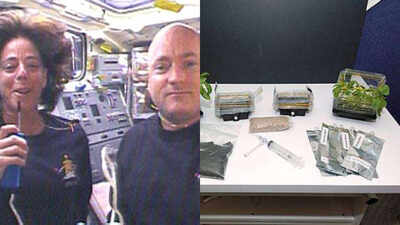
A seed does not look like much. Tucked into a packet, it is barely noticeable, carrying the promise of a plant in a form that seems almost impossibly small. But in 2007, millions of them became part of an experiment that linked a Space Shuttle mission, classrooms across the US and a much bigger question: could humans one day grow plants on the Moon?On August 8, 2007, Space Shuttle Endeavour lifted off on its STS-118 mission carrying approximately 10 million cinnamon basil seeds as part of NASA’s Education Payload Operations – Educator programme. The seeds were being carried by teacher-turned-astronaut Barbara Morgan, who was finally making her long-awaited journey into space after a 22-year wait.Morgan’s presence gave the educational mission an added significance. A former teacher who had spent years preparing for a flight that was repeatedly delayed, she was uniquely placed to connect the experience of spaceflight with students on Earth. During the mission, she hoped to conduct as many as three video sessions with students, bringing the realities of life aboard a spacecraft into classrooms.
From teacher to spaceflyer
Morgan’s route to space was anything but conventional. She had originally been selected as NASA’s backup candidate for the Teacher in Space programme and trained alongside Christa McAuliffe, who was selected to fly aboard Space Shuttle Challenger in 1986.Following the Challenger tragedy, Morgan returned to teaching before eventually joining NASA as an astronaut. More than two decades later, she finally travelled into orbit aboard Endeavour.As she and her crewmates prepared for their arrival at the International Space Station, Morgan was already carrying a piece of the classroom with her. The 10 million cinnamon basil seeds aboard Endeavour were destined to make a return journey of a different kind—from orbit back into schools across the country. The seeds were not simply passengers on the shuttle. They formed part of a broader NASA educational initiative designed to allow students to engage directly with space science.
From endeavour to the classroom
Once back on Earth, the space-flown seeds were distributed to students and educators. The programme encouraged children from kindergarten through Grade 12 to participate in investigations connected to spaceflight.That physical connection mattered. Space was no longer something confined to photographs, television screens or science textbooks. Students could work with seeds that had actually travelled aboard a spacecraft, grow them and compare their development with seeds that had remained on Earth.By spring 2008, NASA had distributed more than 30,000 sets of Earth and space-flown seeds to classrooms.The exercise was part of the Education Payload Operations – Educator investigation led by Jonathan Neubauer of NASA’s Johnson Space Center. The programme used spaceflight as a starting point for classroom activities in science and mathematics, while also involving an educator crew member in activities conducted in orbit.
Designing a garden for the moon
The most ambitious part of the programme was NASA’s Engineering Design Challenge: Lunar Plant Growth Chamber.The premise was deceptively simple. If future astronauts are going to spend extended periods on the Moon, they will need reliable ways to grow plants. Students were therefore asked to design, build and evaluate their own plant-growth chambers for potential future lunar missions. That meant thinking beyond simply putting a seed into soil and adding water.Students had to consider the requirements of a controlled growing environment, including light, water, temperature and available space. They also had to think about how conditions change when familiar Earth systems are no longer guaranteed.The exercise introduced students to the engineering design process through a problem with a genuine connection to human spaceflight. They could develop an idea, construct a model, test it, observe the results and then improve the design.
Nearly one mlilion young scientists
The scale of the programme was remarkable. According to NASA’s results for the EPO-Educator investigation, nearly one million students in grades K–12 participated in the Lunar Plant Growth Chamber Engineering Design Challenge.For NASA, the objective went beyond teaching children about plants. The programme was designed to encourage the next generation of scientists and engineers by allowing students to participate in the design process themselves. Morgan’s role reinforced that philosophy. She was not only an astronaut carrying out a mission; she was a former classroom teacher helping create a direct link between a spacecraft in orbit and students on Earth.Her planned video sessions offered students an opportunity to see the space environment through someone who understood both sides of the experience—the classroom and the cockpit.
What the seeds taught us
The space-flown seeds also provided an opportunity to observe what happened after their return. NASA’s plant-growth investigation found that the cinnamon basil seeds germinated and grew during the experiment. The plants eventually deteriorated, with the investigation indicating that they appeared to have received more water than necessary.That result was valuable precisely because it exposed an unexpected problem. A scientific experiment does not have to produce a perfect outcome to be useful. In this case, students could see how something as ordinary as watering a plant becomes a design consideration when growing conditions are carefully controlled The lesson extended beyond basil. Every adjustment to light, water or the structure of a growing chamber could affect the outcome, demonstrating why future space agriculture will require careful experimentation.Images Courtesy: Space and Phys Org