








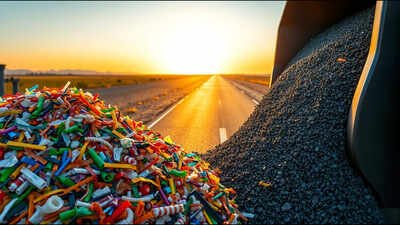
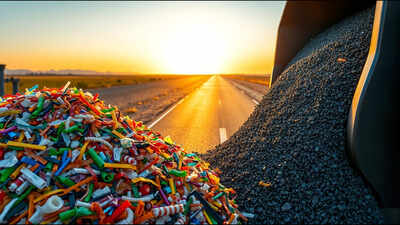
On State Highway 205 in Rockwall, a suburb east of Dallas, engineers paved a 3,500-foot stretch of road using about 4.5 tons of recycled plastic mixed directly into the asphalt. The project, led by Sahadat Hossain, a civil engineering professor at the University of Texas at Arlington, replaces a portion of the petroleum-based bitumen that normally binds asphalt with melted plastic made from discarded bags, bottles and other everyday waste. After years of laboratory testing and smaller pavement trials, the May 2025 project brought the technology onto an active Texas highway. The team is now watching how the material performs under regular traffic, heavy vehicles and Texas heat. The idea is relatively simple: instead of sending difficult-to-recycle plastic to landfills or letting it escape into the environment, researchers want to give some of it another use while also reducing the amount of conventional petroleum-based binder needed to build roads.
How researchers turn discarded plastic into road material
The technology developed by Hossain’s team is designed to change the composition of asphalt without requiring an entirely different type of road. Conventional asphalt is made from aggregates such as crushed stone and sand held together by bitumen, a sticky petroleum-based binder. In the Texas project, roughly 8% to 10% of the bitumen is replaced with recycled plastic. The plastic waste is first cleaned and shredded into small pieces before being introduced into the hot asphalt mixture. At high temperatures, the plastic melts and becomes incorporated into the material as the asphalt is produced. The approach is aimed at two problems at once. Plastic waste is notoriously difficult to manage, particularly when it comes from thin bags and other products that are not easily processed through standard recycling systems. At the same time, road engineers are constantly looking for ways to make asphalt last longer and withstand increasingly demanding conditions. Texas provides a particularly useful testing ground because pavement is exposed to intense summer heat as well as heavy traffic. When conventional bitumen becomes softer under high temperatures, roads can become more vulnerable to deformation, including the grooves and depressions known as rutting.Hossain’s team had already spent years testing plastic-infused asphalt before taking the material onto State Highway 205. Laboratory experiments allowed researchers to examine the physical properties of different mixtures under controlled conditions, while smaller pavement trials provided an opportunity to see how the material behaved outside the lab. The Rockwall project represents a much more significant test because the road is being used normally rather than being reserved for research. Cars and trucks are passing over the material every day, while the pavement is exposed to the full range of weather conditions. That real-world exposure is important because a road can perform well in a controlled experiment and still behave differently once it is subjected to years of traffic, temperature changes and moisture. Researchers can now monitor the Rockwall section for cracking, rutting and other forms of deterioration. The results should provide a clearer picture of whether recycled plastic can remain stable inside asphalt over a long period and whether the material offers any practical advantage over conventional road construction.
Why Texas is testing plastic in highways
The project comes at a time when plastic waste has become a global environmental problem. More than 400 million tons of plastic are produced around the world each year, but less than 10% is recycled. The remainder can end up in landfills, be incinerated or enter rivers, oceans and other parts of the environment. While recycling rates vary considerably depending on the type of plastic and the country where it is collected, many everyday plastic products have limited value in existing recycling systems. That is part of the reason researchers are interested in finding uses that do not depend entirely on traditional recycling. Instead of turning waste plastic back into another plastic product, the Texas approach incorporates it into infrastructure that could remain in service for years. A road therefore becomes a potential long-term destination for material that might otherwise have been thrown away. There is also a practical reason for looking at plastic as part of asphalt. Bitumen itself is derived from petroleum, and asphalt production and road construction require large quantities of it. Replacing even a relatively small portion of the binder with another material could reduce the amount of bitumen required for a road, although the environmental and economic benefits depend on how the plastic is sourced, processed and incorporated.The researchers are not presenting the technology as a complete answer to either plastic pollution or road deterioration. Instead, the Rockwall project is testing whether the two problems can be addressed together. If the modified asphalt performs well over time, it could create another outlet for certain types of waste plastic while giving transportation agencies another material option for pavement construction. There are still questions to answer. A road has to remain safe and structurally sound for years, and any new material used at highway scale has to meet demanding engineering requirements. Researchers also need to understand how the plastic behaves as the pavement ages and whether there are any environmental concerns associated with its long-term use. Those questions cannot be answered by a single paving project, which is why continued monitoring will be central to the research.
What the Rockwall road could mean for future projects
The 3,500-foot section of State Highway 205 is therefore best understood as a large-scale field experiment. The UTA team can now observe how its recycled-plastic asphalt responds to the conditions that matter most to transportation agencies: traffic, heat, weather and time. The road’s performance will help researchers determine whether the laboratory results translate into a material that can be used reliably on public highways. The team has also discussed extending the work to other parts of Texas, including Fort Worth and Amarillo. Testing the material in different locations could be particularly useful because pavement conditions are not identical across the state. Traffic volumes, temperatures, weather patterns and soil conditions can all affect how a road ages. Comparing different sites would allow researchers to see whether the material’s performance remains consistent outside Rockwall.For Hossain, the broader appeal of the technology lies in giving waste plastic a purpose beyond its short original lifespan. A plastic bag or bottle may be used for only minutes or days, but once incorporated into road infrastructure, the material could remain part of a working pavement for years. That does not eliminate the need to reduce plastic production, improve recycling or prevent waste from reaching the environment, but it does offer another possible route for dealing with some of the plastic that is already being discarded.