








Four years after researchers began studying the restoration of oyster reefs in China’s Bohai Bay, the newly created habitats are showing signs of recovery. A survey conducted in March 2026 found an average of 286 oysters per square metre on artificial reefs. The amount of suspended material in the surrounding water was also about 62% lower than it had been before the restoration work began.The findings come from a study by Chang Liu and fellow researchers, published inFrontiers in Marine Science. Their work followed changes in marine life and water conditions at Dashentang, near Tianjin, from 2022 to 2026.The reduction in suspended particles was among the changes recorded during this period. In May 2022, researchers measured an average of 19.3 milligrams of suspended particulate matter per litre of water. When they returned in March 2026, the figure was 7.28 milligrams per litre. Suspended particulate matter includes fine sediment and other small particles carried in the water.Although oysters can remove particles from water as they feed, the study does not establish that they caused this decline. The researchers did not directly measure the oysters’ filtration activity, and changes in the surrounding environment may also have affected water conditions.
How the oyster reefs were restored
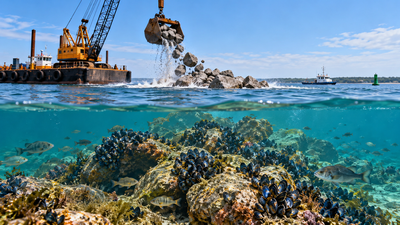
Dashentang once had a much larger natural oyster habitat. During the 1970s, its reefs covered around 35 square kilometres. In recent years, that area had fallen to just 1.69 square kilometres.According to Devdiscourse, fishing activities, shoreline development and changing seabed conditions were among the factors behind the decline. The problem is not limited to China, with the study citing estimates that approximately 85% of oyster reefs worldwide have been lost.Restoring the habitat is not easy as the reefs remain underwater, at depths of around two to five metres. Fine sediment on the seabed can also be moved by currents and cover the surfaces needed by young oysters to settle and grow.The restoration work, carried out between August 2022 and December 2023, involved placing 4,500 reinforced-concrete structures and 41,250 oyster-shell frames in the area. The aim was to provide surfaces where oysters could attach themselves while also creating habitat for other marine animals. The installed structures had a combined volume of 345,000 cubic metres.
Oyster numbers increased over time
The first surveys showed that oyster populations on the artificial structures were still small. In November 2023, while construction was under way, researchers recorded an average of 65 oysters per square metre.There was little improvement at first. The average fell to 58.8 in March 2024 before increasing to 86.6 in June that year. A much larger rise was recorded in March 2026, when the figure reached 286 oysters per square metre.The existing natural reefs supported considerably more oysters. Their average density had been around 80 per square metre before restoration, but increased sharply during the construction period. By March 2026, researchers counted an average of 1,830.4 oysters per square metre on natural reefs.Another finding concerned the arrival of young oysters. Scientists refer to this process as recruitment, which helps indicate whether new oysters are joining a population.In March 2026, artificial reefs had an average of 204.2 young oysters per square metre measuring less than 20 millimetres. Most oysters on these structures were still small or medium-sized, suggesting that the populations had not yet fully developed.
Other marine animals also began returning
The researchers did not limit their observations to oysters. They also counted macrobenthos, a term used for animals such as clams, worms and crustaceans that live on or within the seabed.These animals initially became less numerous. Before restoration, the study recorded an average of 140.5 individuals per square metre. During construction, that number dropped to 30.4. By March 2026, however, the average had reached 255.6.The change was particularly noticeable on artificial reefs. In March 2024, these areas supported 29.4 seabed animals per square metre. Two years later, the number had risen to 405.2.It was not just the number of animals that changed. Before restoration, molluscs made up 98.1% of the recorded seabed community. Their share decreased during the early stages of recovery and stood at 66.3% in March 2026.Worms and arthropods accounted for a greater share than before. According to the researchers, the developing reef structures provided different places for marine animals to live, find shelter and feed.The team also examined dissolved oxygen, which marine organisms need to survive. Its concentration had fallen during construction and the early restoration period, but reached 7.87 milligrams per litre by March 2026, close to the level measured before restoration. Meanwhile, Nitrogen concentrations and chlorophyll-a varied during the monitoring period.
Why more monitoring is needed
The findings point to an increase in marine life at Dashentang, but the researchers stopped short of attributing every change to the restoration work.The study was based on five surveys conducted in different seasons between 2022 and 2026. Some sampling locations also changed during that time. Importantly, there were no separate comparison sites outside the restoration area that could help establish what might have happened without the project.Several questions therefore remain unanswered. The researchers did not directly measure how much material the oysters filtered from the water, how much nutrient removal occurred or whether sediment was accumulating around the structures. They also did not assess whether the artificial reefs were sinking.The team recommended further monitoring of young oyster survival, sediment build-up and the stability of the structures. While the March 2026 findings show that oyster populations and other seabed animals have increased, it is still too early to determine whether the restored reefs can sustain themselves over the long term.