









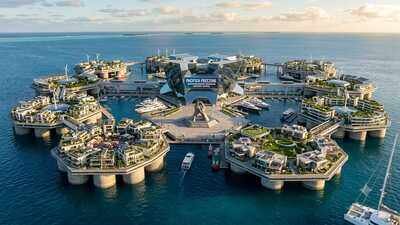
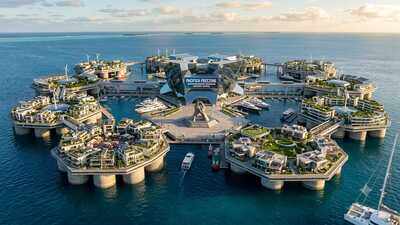
What if you could build your own country, write your own laws and never pay taxes again? That was the extraordinary vision behind the Republic of Minerva, a self-declared nation founded on an artificial island in the South Pacific in the early 1970s. Backed by wealthy investors and libertarian ideals, the project sought to create a sovereign state free from taxation, government regulation and political control. Sand was dredged onto a remote coral reef, a flag was raised, and independence was proclaimed. But the dream collapsed almost as quickly as it began. Within months, a neighbouring kingdom claimed the territory, international recognition never arrived, and one of history’s most ambitious attempts to create a country from scratch came to an abrupt end.
A millionaire believed a new country could be built on an unclaimed coral reef
The project was the brainchild of Michael Oliver, a Lithuanian-born American real estate millionaire and advocate of libertarian political philosophy.According to the historical analysis ‘The Republic of Minerva: A Reconsideration’ by Lili Song, published in The Journal of Pacific History, Oliver believed individuals should be free from what he regarded as excessive taxation and government interference. Rather than reforming an existing state, he proposed creating an entirely new one on land reclaimed from the sea. His organisation selected the Minerva Reefs, two remote coral atolls located roughly midway between New Zealand, Fiji and Tonga. Because the reefs were submerged except at low tide and appeared to lie outside the clearly administered territory of any nation, the founders argued they were available for occupation under international law.Thousands of tonnes of sand were dredged onto the reef to create a small artificial island capable of supporting temporary structures, marking the beginning of what became the Republic of Minerva.
The founders raised a flag, issued coins and declared independence
The project quickly evolved from an engineering experiment into an attempt at nation-building. The founders adopted a national flag, drafted a declaration of independence and proposed a constitution centred on minimal government, private property and virtually no taxation. Coins and commemorative stamps were also produced as symbols of sovereignty.The founders hoped their new country would attract entrepreneurs, investors and residents seeking economic freedom outside the jurisdiction of established governments. The project attracted considerable international media attention, but no recognised state formally acknowledged Minerva’s independence. Without diplomatic recognition, the fledgling nation lacked the legal standing needed to participate in international relations despite its bold declaration of sovereignty.
Tonga moved quickly to assert control over the reefs
The Republic of Minerva’s greatest challenge came not from engineering or finance, but from geopolitics. The Kingdom of Tonga, led by King Tāufaʻāhau Tupou IV, rejected the claim that the reefs were ownerless. As discussed in the study, Tonga argued that the Minerva Reefs had historically fallen within its sphere of influence and secured support from neighbouring Pacific nations for that position. In June 1972, Tongan forces travelled to the reef, removed the Minervan flag and raised the Tongan flag in its place. The operation was peaceful but decisive. Without military resistance or international backing, the Republic of Minerva effectively ceased to exist only months after proclaiming independence.Most governments subsequently accepted Tonga’s claim over the reefs, ending any realistic prospect of Minerva becoming a recognised sovereign nation.
International law proved harder to overcome than the ocean
The Minerva experiment highlighted a fundamental reality of international law: creating land is not the same as creating a country. Legal scholars have long noted that sovereignty depends not only on territory and a permanent population but also on recognition and the ability to maintain relations with other states. Even though Minerva had managed to recover its lands, adopt national symbols, and declare its independence, there was no diplomatic recognition by other states in the international community.In this context, the assessment asserts that the failure of the endeavor emanates from an underestimation of the role of regional politics.
The Republic of Minerva remains one of history’s boldest micronation experiments
More than fifty years later, the Republic of Minerva continues to fascinate historians, political scientists and advocates of experimental governance.The founders were convinced that modern engineering would be able not only to build new territory but also to form a new state independent of existing states. In reality, however, this experiment showed that being a nation does not depend solely on the geography of the place.Even though this man-made island did not become a state that its founders dreamed about, the Republic of Minerva is certainly one of the most extraordinary attempts to build a nation from scratch in the middle of the ocean.