






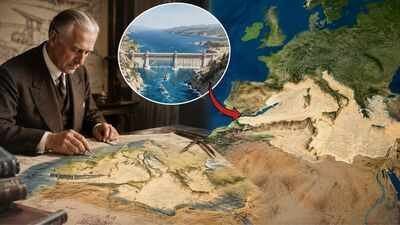
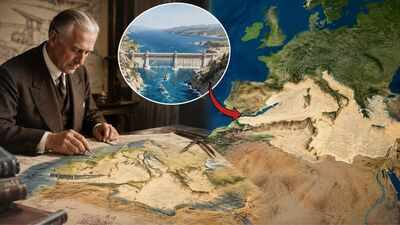
In 1928, German architect Hermann Sörgel unveiled one of the most ambitious engineering visions ever imagined: Atlantropa, a plan to block the Strait of Gibraltar, lower the Mediterranean Sea level and create a new Europe-Africa supercontinent. The extraordinary proposal aimed to generate massive hydroelectric power, reveal vast areas of new land and reshape the relationship between two continents through a network of bridges, railways and settlements. Although the project was never built, Atlantropa remains one of history’s most fascinating examples of extreme human ambition; a forgotten dream of using technology to redraw the planet itself.
Hermann Sörgel’s Atlantropa project: The 1928 plan to reshape the Mediterranean with a giant dam
Atlantropa was the work of German architect Hermann Sörgel, who introduced the concept in 1928, as reported by Environment & Society Portal. His proposal centred on the Strait of Gibraltar, the narrow stretch of water connecting the Atlantic Ocean with the Mediterranean Sea. By constructing a colossal dam across this gateway, Sörgel believed it would be possible to generate an unprecedented amount of hydroelectric power.The project was presented as far more than an energy scheme. It was intended as the foundation of a completely new geographical and economic order. Electricity produced by the dam was expected to supply a significant share of Europe’s growing demand, while the structure itself would become the key to transforming the Mediterranean basin.At a time when concerns about future energy supplies were gaining attention, the proposal attracted interest from people fascinated by technological progress. Large engineering works had become symbols of national ambition, making even extraordinary projects appear worthy of discussion.
Atlantropa’s plan to lower the Mediterranean Sea level and create new land
The idea depended on controlling the Mediterranean’s connection to the Atlantic. Once the inflow of ocean water had been restricted, evaporation was expected to exceed the amount of water entering the basin from rivers. Over many decades, the sea level would gradually fall.As reported by Environment & Society Portal, Sörgel estimated that parts of the Mediterranean could eventually sit around 200 metres lower than their existing level. As the shoreline retreated, enormous areas of land would emerge from beneath the water. New plains would appear along large sections of the coast, fundamentally changing the appearance of southern Europe, North Africa and parts of the eastern Mediterranean.The proposal imagined these newly exposed landscapes becoming productive territory rather than empty ground. Agricultural development featured prominently, alongside transport networks, industrial zones and entirely new settlements planned on land that had previously been seabed.
How Atlantropa aimed to create a Europe-Africa land bridge
Perhaps the most striking aspect of Atlantropa was its political ambition. Sörgel did not simply want to generate electricity or reclaim land. He believed the changing geography would physically connect Europe and Africa, encouraging closer economic and cultural ties between the two continents.Roads and railways would cross areas where open water had once existed. Ports would have to be redesigned as coastlines shifted, while cities facing the Mediterranean would gradually find themselves much farther from the sea than before.The proposal reflected the belief, common among some planners during that period, that engineering could reshape society itself. Geography was treated as something that could be redesigned to serve political and economic objectives rather than accepted as a fixed reality.
Ecological cost of Atlantropa’s plan to reshape the Mediterranean
Modern discussions of Atlantropa often focus on the environmental effects that would almost certainly have followed such an enormous intervention. Those concerns, however, received remarkably little attention during the years when the project was actively promoted.Reducing the Mediterranean’s water level would have altered marine ecosystems on a vast scale. Changes in salinity alone would have transformed conditions for countless species, while coastlines, fisheries and regional climates could all have experienced lasting disruption.Yet environmental protection occupied only a small place in debates surrounding the proposal. Supporters concentrated instead on economic growth, electricity production and the promise of newly available land.
Why the project never progressed
Although Atlantropa attracted public interest and was promoted through exhibitions, books and illustrations, it never moved beyond the planning stage.Political circumstances proved to be a major obstacle. Europe entered a period dominated first by dictatorship and then by global war, leaving little room for a multinational engineering project requiring cooperation across numerous countries. The practical and financial challenges were equally immense, involving decades of construction and unprecedented international coordination.
The end of an ambitious dream
Hermann Sörgel did not live to witness the changing direction of post-war energy policy. Reportedly, he died in a road accident on Christmas Day in 1952. Without its creator, the movement steadily lost momentum. The Atlantropa Institute, established to promote and develop the proposal, continued for only a few more years before closing in 1960. By then, the vision had largely become a historical curiosity rather than a serious engineering proposal.Its striking illustrations and maps survived, offering a glimpse into a period when technological optimism often encouraged planners to imagine reshaping the planet itself.