








For thousands of years, the burial chambers beneath Egypt’s Nile Delta remained closed, preserving more than just human remains. Every object placed beside the dead reflected ideas about protection, status and the journey into the afterlife. That quiet record has grown richer following fresh excavations at Tell Quesna, where archaeologists uncovered a funerary complex containing hundreds of carefully arranged burial objects, including an extraordinary collection of 560 tiny ushabti figurines. According to Egypt’s Supreme Council of Antiquities, the discovery offers a rare opportunity to examine how burial customs evolved during the Late and Graeco-Roman periods while also revealing traces of Egypt’s wider connections with the Mediterranean world.
Newly uncovered tomb complex sheds light on ancient burial practices
The newly uncovered funerary unit was designed around a central hall leading into several burial chambers through vaulted entrances. Surviving architectural features indicate that the chambers were originally covered by vaulted ceilings, allowing archaeologists to reconstruct much of the monument’s original appearance despite centuries underground.Inside, excavators encountered multiple burials laid in the traditional Osirian position, reflecting beliefs associated with Osiris, the Egyptian god linked with death and rebirth. Preservation differed from one burial to another, yet many retained the objects originally placed alongside the deceased, offering a detailed glimpse into funerary practices that remained hidden beneath the site for more than two millennia.The excavation forms part of continuing scientific work at Tell Quesna, a cemetery first identified in 1991 and regarded as one of the central Nile Delta’s most significant non-royal necropolises.
560 ushabti figurines found inside the ancient tomb
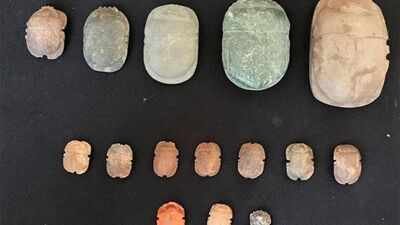
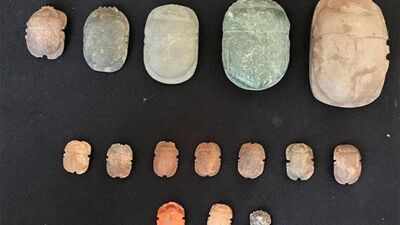
Among everything recovered, one group immediately stood apart. Archaeologists discovered 560 faience ushabti figurines gathered inside one burial chamber. Produced in different sizes but sharing the familiar Osirian form, several carried inscriptions derived from the Book of the Dead.These figures were never intended as decoration. Ancient Egyptians believed ushabtis would answer labour demands placed upon the deceased in the afterlife, performing agricultural or other duties in place of their owner. Their presence inside tombs reflected an expectation that life beyond death would continue with responsibilities similar to those of earthly existence.The large number recovered at Tell Quesna suggests careful planning rather than a random accumulation of burial goods. Each figurine formed part of a wider funerary arrangement intended to accompany and protect the tomb’s occupant long after burial.
Rare burial treasures discovered inside the ancient tomb
The excavation produced far more than the miniature “servants.” Archaeologists also recovered protective amulets carved from semi-precious stones, including Wedjat or Eye of Horus amulets, Tyet amulets associated with Isis, finger amulets and representations of Egyptian deities.Mohamed Abdel Badie, head of the Ancient Egyptian Antiquities Sector at the Supreme Council of Antiquities, said these objects symbolised protection, strength and rebirth within ancient Egyptian religious belief.Elsewhere inside the funerary complex, researchers documented pottery vessels, lamps and a ceramic container still holding residues believed to be connected with mummification or funerary ceremonies. Large quantities of blue and green faience beads were also found, thought to have formed part of a decorative funerary net placed over one of the deceased.Some discoveries remain difficult to explain. Archaeologists recorded pottery plates deliberately positioned beneath an individual’s arms, while another vessel had been placed between the thighs. Scientists are continuing to investigate whether these unusual arrangements reflect a local burial tradition or a ritual that has rarely survived in the archaeological record.
Tell Quesna discovery reveals Egypt’s ancient trade links
Tell Quesna is revealing more than burial customs. The mission uncovered imported pottery from the Greek island of Rhodes, including the stamped handle of an amphora bearing its maker’s name. The imported ceramics point to commercial links between Egypt and Mediterranean trading networks during the Late and Graeco-Roman periods.The latest discoveries arrive as Egypt continues investing in the presentation of its archaeological heritage. According to Arab News, the Ministry of Tourism and Antiquities recently completed the restoration of Luxor Museum’s Cache Hall, expanding its display of statues recovered from the famous Luxor Cache while introducing updated lighting, interpretive panels and interactive displays for visitors.Together, the museum improvements in Luxor and the continuing excavations at Tell Quesna highlight two sides of the same effort. One preserves remarkable discoveries already known to the public. The other continues uncovering forgotten evidence that deepens understanding of how ancient Egyptians prepared for death, honoured their beliefs and imagined life beyond the sealed walls of a tomb.