








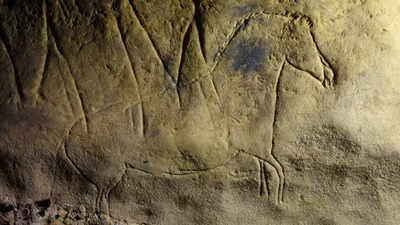
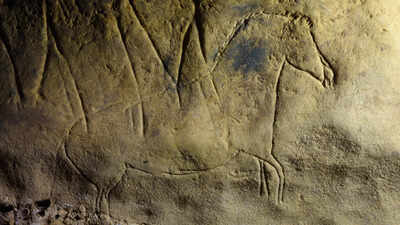
Not all art is exhibited or put on display. Some of it remains hidden in plain sight, etched into rock and can go unnoticed for centuries, even when people have been walking past them for decades. In a cave in Spain, hundreds of such engravings has now opened up new avenues of research, offering archaeologists a fresh understanding of the prehistoric artistic traditions of the Iberian Peninsula.A research conducted by Josep Maria Vergès Bosch and Míriam Salas-Altès of the Catalan Institute of Human Paleoecology and Social Evolution (IPHES-CERCA), was published in Antiquity on 5 November 2026. This report notes the cave to now be the 3rd largest known Palaeolithic cave art assemblage along the Mediterranean side of the Iberian Peninsula.The discovery has brought close attention to the Cova de la Font Major in Catalonia, northeastern Spain, where archaeologists have identified 280 Palaeolithic motifs, including motifs of animals and several non-figurative designs. Interestingly, people were aware of this cave before, and it was open to visitors as well. People have been visiting Cova de la Font Major since at least the 12th century, while its entrance became widely frequented by visitors, speleologists and treasure hunters from 1957 onwards.Despite the number of people who had entered the cave over the years, its prehistoric engravings had not come to light. According to research in Antiquity, the discovery was made on 30 October 2019, during an archaeological visit to a section known as the Gatoneres de Cal Palletes. One of the researchers noticed that some marks on the walls appeared different from the more recent inscriptions and graffiti that spread across the surrounding surface.When examined closely, it was deduced that these markings belonged to the Palaeolithic period, opening up to us a whole new world of meaning and art that predates us.The researchers had not expected to find a plethora of such artworks here, given that the cave been previously considered an unlikely space for palaeolithic engravings, given the uneven surface of the rocks. However, the discovery has now confirmed that certain sections of the walls, particularly their marl layers, had provided suitable surfaces for engraving.But the cave doesn’t go on to reveal the world of the prehistoric people to us, but also the markings made by visitors in the last few decades. As alongside the geometric markings, the parallel lines, and representation of animals including a bear, are names and dates of the visitors on the wall, where these artistic traditions were liely missed.
What do the engravings reveal?
The artistic engravings were reportedly, produced through incisions made into the rock, with scraping also used in some instances. The marks are not all alike, and their different forms provide researchers with material to examine the ways prehistoric communities expressed themselves through images and symbols.The collection identified so far comprises 280 motifs, of which 55 are zoomorphic representations, meaning figures depicting animals. The remaining motifs include non-figurative engravings, such as lines and geometric forms, which do not necessarily represent recognisable living beings.An important aspect of the discovery is that the collection is not limited to a handful of isolated animal figures. The researchers point out that around 75% of known Palaeolithic art assemblages along the Iberian Mediterranean coast contain no more than five animal figures, while more than 90% have no more than 20. With 55 zoomorphic representations, Cova de la Font Major therefore stands out in comparison with many other known sites.
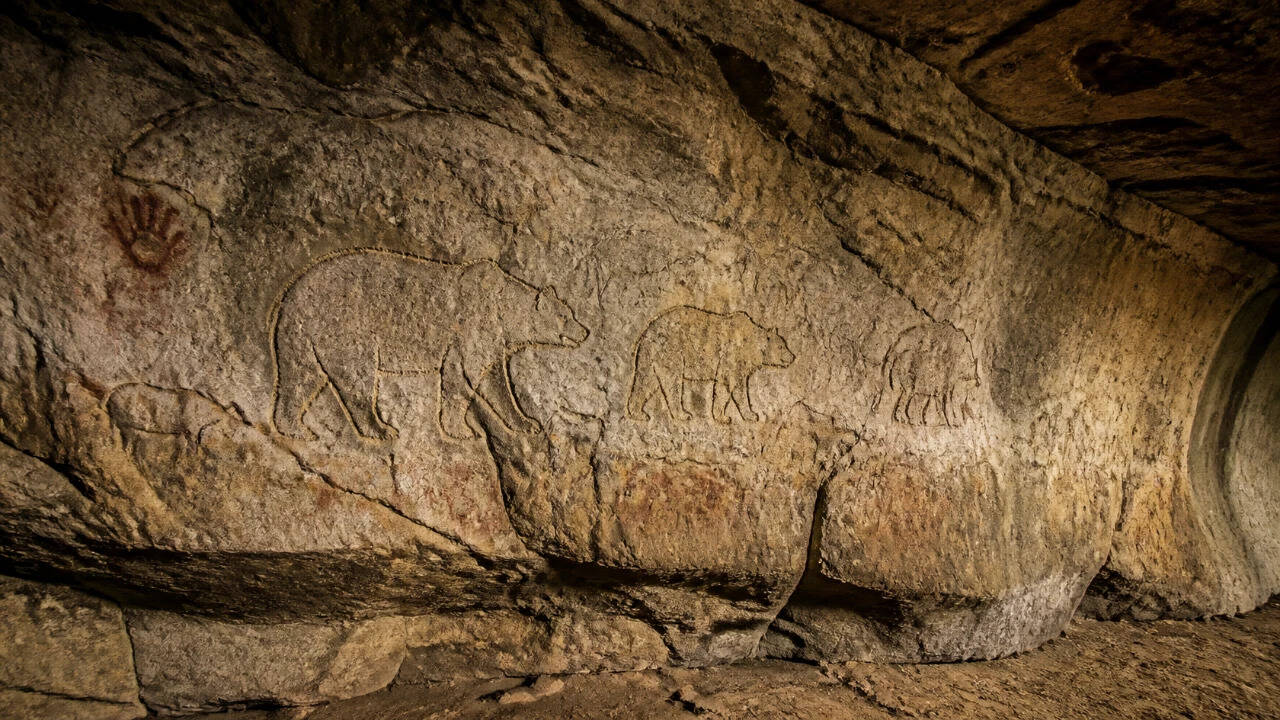
A representative image (Image credit: Canva AI)
Reconsidering prehistoric art in northeastern Spain
Beyond the number of engravings, this discovery also challenges an established understanding that Palaeolithic art was concentrated in the Iberian Peninsula. The Iberian Peninsula, which comprises present-day Spain and Portugal, contains more than 50% of all documented Upper Palaeolithic cave art in Europe. Its distribution, however, is far from even.A large concentration has traditionally been found in the Franco-Cantabrian region, an area spanning parts of modern-day France and northern Spain. But, North-eastern Iberia, particularly Catalonia, was considered relatively poor in Palaeolithic cave art. So much so that before this discovery, only 2 representations had been identified across the region.However, this newly documented engraving suggests that this apparent absence may not have reflected the actual artistic practices of the people who lived there. Moreover, the sheer quantity of engravings now discovered suggests that it may have supported much more substantial human activity than previously understood. Instead, the researchers also found that the motifs at Cova de la Font Major differ from those associated with the neighbouring Franco-Cantabrian tradition, suggesting that northeastern Iberia could have its own distinct artistic traditions.Archaeologists have not merely discovered ancient drawings but have recovered evidence of a previously under-recognised prehistoric artistic tradition, transforming how researchers now understand the cultural landscape of Ice Age Europe. This finding informs not only about the art produced but also raises questions about how densely populated this region may have been during the Paleolithic era. A previously marginal area in discussions of artistic activity has revealed a whole new artistic history to the world.