







Headlines

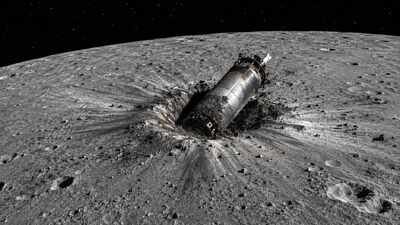
Nasa says SpaceX Falcon 9 upper stage hit the Moon exactly as predicted, revealing new clues about lunar impacts |

The Moon has absorbed billions of impacts over roughly four billion years, most from meteoroids whose origin, mass and impact velocity remain permanently unknown. The object expected to strike near the Einstein and Bell craters on Wednesday, 5 August, breaks that pattern entirely. According to Nasa, a spent Falcon 9 upper stage from a January…

Read More

Antarctica study reveals how 10 months of isolation changed crew psychology before future Mars missions |

For ten months, twelve crew members lived and worked at Concordia Station, one of the most remote research outposts on Earth. Cut off from rescue, sunlight and the outside world for much of the year, the team wore sensors that quietly recorded every close encounter between them. Researchers paired this data with regular psychological check-ins…

Read More

The asteroid that killed the dinosaurs nearly wiped out birds too, leaving only a few ground-dwelling survivors |

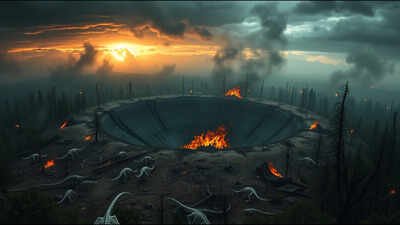
Representative Image of the Chicxulub asteroid striking Earth amid devastated prehistoric landscapes (AI-generated image) Sixty-six million years ago, an asteroid roughly 10 kilometres wide slammed into what is now Mexico’s Yucatan Peninsula, gouging out the Chicxulub crater and triggering the most devastating mass extinction event in the history of complex life on Earth. Non-avian dinosaurs,…

Read More

Scientists explain how the ancient Greek Antikythera Mechanism copied the Moon’s changing speed without modern technology |

The Moon does not travel across the sky at a constant pace. Its speed changes throughout each orbit, a detail ancient astronomers noticed long before they had the mathematics to explain it fully. More than two thousand years ago, the makers of the Antikythera Mechanism found a way to reproduce this unevenness using bronze gears…

Read More

Researchers mapped more than 100 lakes across 1,000 kilometres of Brazil and Uruguay; the network could detect ecosystem stress before irreversible damage

Published in the journal One Ecosystem, the research provides the first systematic assessment of the Southern American Coastal Shallow Subtropical Lakes What if lakes could warn us about an environmental disaster? These freshwater systems may be giving off subtle biological signals long before the fish start dying off, the algae bloom on the water, or…

Read More

Newton: Quote of the day by Isaac Newton: “If I have done the public any service, it is due to my patient thought” |

In a world that often celebrates quick answers, instant success and sudden flashes of brilliance, Isaac Newton’s words offer a very different view of achievement. “If I have done the public any service, it is due to my patient thought,” Newton wrote in a 1692 letter to the English theologian Richard Bentley. The remark reflects…

Read More

Texas A&M researchers built a 17-foot fire whirl over crude oil on water; it burned 40% faster, cut soot 40% and consumed up to 95% of the fuel

A giant, tornado-like flame may offer a cleaner and faster way to respond to oil spills at sea. In a large-scale experiment, researchersfrom Texas A&M University and the University of California, Berkeley created a nearly 17-foot-tall fire whirl over crude oil floating on water. The spinning flame burned the oil about 40% faster than a…

Read More

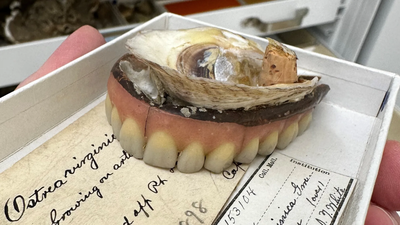
In 1898, Chesapeake Bay was so full of oysters that one grew on a lost set of dentures; today, more than 99% of the historic native population has disappeared

An eastern oyster (Crassostrea virginica) attached to an upper set of artificial teeth (Source: Smithsonian Institution) In 1898, a dredging boat pulling debris from the floor of the Chesapeake Bay made a discovery that looked like something from a biological nightmare: a set of human dentures with a live oyster firmly attached to them.The unusual…

Read More

In 1934, scientists heard reports of mushrooms causing visions of tiny people; in 2026, DNA linked the phenomenon to one species in China and the Philippines

Lanmaoa asiatica is a popular edible mushroom species sold in Yunnan that induces Lilliputian hallucinations when undercooked. In 1934, Western scientists first heard reports from Papua New Guinea of wild mushrooms causing visions of tiny people, a phenomenon called “mushroom madness.” Nearly a century later, DNA sequencing has confirmed that a single, identical mushroom species…

Read More

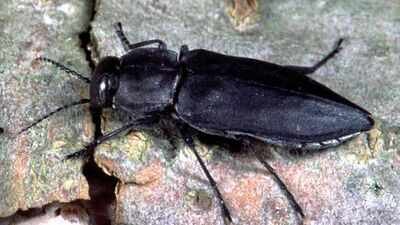
Scientists discover Black pine jewel beetles use heat, smoke and infrared organs to find wildfires using nature’s most sophisticated sensory system |

Black fire beetle, Melanophila acuminata. Image Credit: Prof. Schmitz/Wikipedia Black pine jewel beetles, scientifically named Melanophila acuminata, belong to a unique group of insects that exhibit pyrophilous behaviour, which means they are naturally attracted to forest fires. These beetles are primarily found across boreal and temperate forests of the north, where they play a vital…

Read More