







If New York’s worst recorded rainfall is 200 mm, what could a plausible 300-mm storm look like? MIT built an AI system to map extreme events that have never happened before

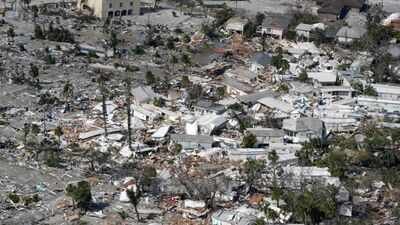
The method, called Extreme Event Aware, or “η-learning”, does not need previous extreme events to create these scenarios. (Representational AP photo) What would a once-in-a-century storm look like if it was stronger than anything recorded before? Researchers at the Massachusetts Institute of Technology (MIT) have developed a machine-learning method that can generate realistic scenarios for…
Read More

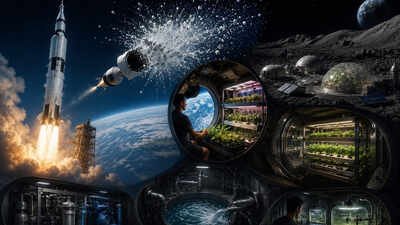
In 1962, NASA loaded 22,900 gallons of water onto a Saturn I rocket and deliberately blew the container apart 65 miles above Earth to study what water would do in the upper atmosphere

Representative Image (AI-generated) For humans to travel deeper into space and remain there for months or even years, they will need much more than powerful rockets. Astronauts must have a continuous supply of oxygen, water and food, while waste and carbon dioxide must be carefully managed. On short missions, these needs can largely be met…

Read More

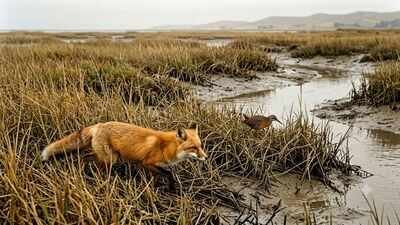
In the 1800s, red foxes were brought to California for hunting. Decades later, the light-footed Ridgway’s rail declined to just 5 breeding pairs |

A red fox introduced to California more than a century ago might seem far removed from the fate of a small marsh bird. Yet the two became linked in the coastal wetlands of Southern California, where the light-footed Ridgway’s rail has struggled to survive. The bird spends much of its time concealed among cordgrass and…

Read More

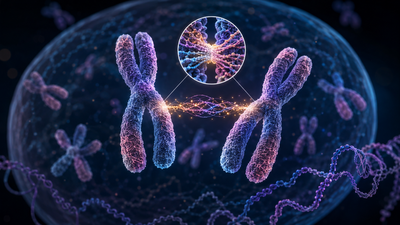
Scientists found that DNA once dismissed as “junk” helps chromosomes find their partners |

For years, the dense loops of repetitive DNA clustered near the middle of chromosomes were treated as evolutionary clutter. According to the new study published in Nature, titled ‘Meiotic pairing through barcode-like satellite DNA repeats‘, researchers working with fruit flies have shown that this so-called satellite DNA forms a kind of barcode: a unique combination…

Read More

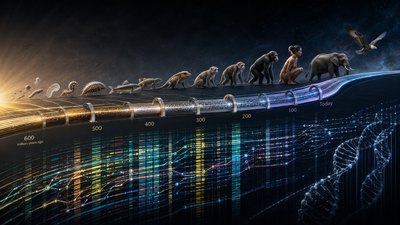
Scientists analysed thousands of animal genomes and found hidden “evolutionary highways” stretching back 600 million years |

Scientists have traced hidden pathways through animal evolution by comparing thousands of genomes and following pieces of chromosomes that have survived for hundreds of millions of years. The study examined 5,821 chromosome-scale genomes from 4,454 species across 19 animal phyla, using 29 ancient linkage groups as markers of chromosome history. Every one of the 406…

Read More

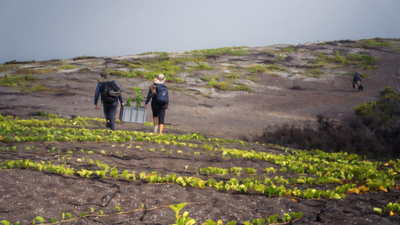
In 2007, only 6 Galápagos snapdragons were known to survive on remote lava fields; after conservationists planted 94 nursery-grown shrubs, the wild adult population has grown to 28

Researchers transporting Galvezia leucantha subsp. Leucantha at the restoration site, preparing for its planting A critically endangered shrub that once came close to disappearing from the Galápagos Islands is showing signs of a slow but important recovery after a careful conservation effort lasting nearly three decades. According to findings published in the journal Nature Conservation…

Read More

MIT scientists watched electrons rebuild inside a quantum material; one phase grew like an ice crystal |

Deep inside a crystal cooled to nearly -230°C, MIT physicists have caught something rarely seen in quantum materials: two populations of electrons rebuilding themselves into wave-like order after being scattered apart by laser light, and doing so in two completely different ways. Working with erbium tritelluride, a rare-earth material known for hosting a pair of…

Read More

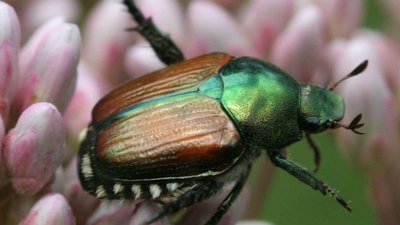
An invasive beetle wiped out black ash trees across parts of North America; scientists germinated 22,000 seeds, including genetic material from tree populations that no longer survive in the wild

An invasive beetle wiped out black ash trees across parts of North America Researchers have created a living seed bank to protect North America’s endangered black ash trees from extinction after decades of damage from an invasive insect. Led by scientists at Pennsylvania State University, the conservation project has successfully germinated 22,000 black ash seeds…

Read More

In 2002, a NASA intern stole a 600-pound safe containing $21 million in Moon rocks to give his girlfriend, then an online sale led him into an FBI trap |

The Moon has been romanticised for centuries, but few people have ever tried to give someone a piece of it. In 2002, that idea became part of an extraordinary theft at Nasa’s Johnson Space Center, where an intern helped remove a safe containing Apollo lunar samples and other irreplaceable scientific material. The stolen collection included…

Read More

Meet Aashritha Penumudi, the 17-year-old Virginia student who created stalled ribosomes in the lab and trained AI on breast-cancer data; its predictions matched what she saw under the microscope

Aashritha Penumudi (Thomas Jefferson High School for Science and Technology, Alexandria, VA) By combining laboratory biology with machine learning, a 17-year-old student from Virginia has gained new insights into how protein production can go wrong in cancer cells. Aashritha Penumudi, a senior at Thomas Jefferson High School for Science and Technology in Alexandria, studied a…

Read More