









Imagine Texas and California pushed together into one patch of land. Now picture all of it cut down, burned or otherwise gone. That is roughly the amount of original primary forest the Amazon has lost, according to a new report from Amazon Conservation’s Monitoring of the Andes Amazon Program (MAAP). The latest analysis found that 97 million hectares (240 million acres) of primary forest had been lost across the Amazon biome’s nine countries by the end of 2025. It also found that the routes carrying moisture during the dry and transition seasons had been the most disrupted. Most of that loss came from people clearing land, with fire accounting for a large share. About 15% of the basin’s original forest is now gone.The numbers come from MAAP #250, a 2026 update to the group’s earlier tracking. In 2021, the same group put the figure at 13.2%. The jump may look small on paper, but it covers a huge amount of ground.
The Amazon’s vanishing forest
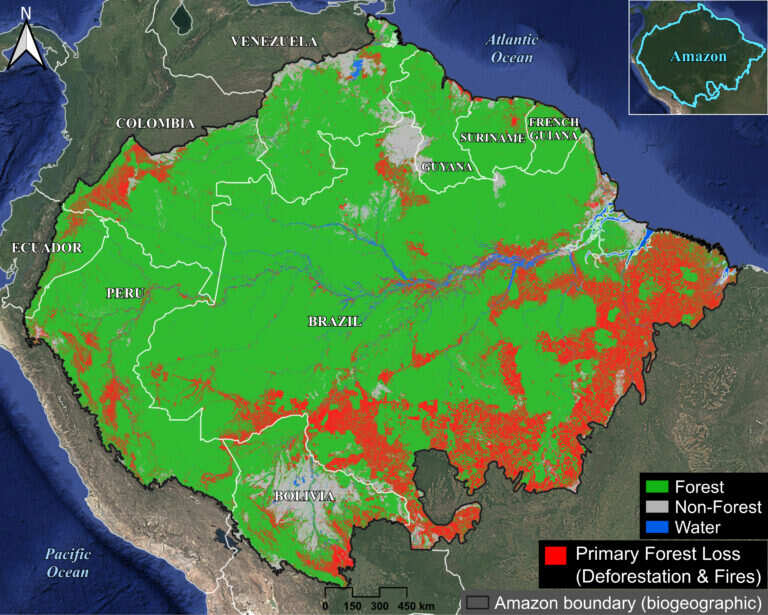
Amazon primary forest loss. Data: Amazon Conservation/MAAP, UMD.
Between 2022 and 2025 alone, another 13.04 million hectares (32.2 million acres) disappeared, the analysis found. That is nearly 15 times the size of Yellowstone National Park! According to the report, fire did much of the damage. The record fire losses of 2024 came after a strong El Niño season in 2023.This forest loss brings the Amazon closer to a tipping point which, according to scientific literature, could occur when about 25% of its forest is lost, alongside the effects of climate change. The pace of loss is crucial. A forest can take decades to recover, if it recovers at all, and every lost season pushes the basin closer to a point of no return.
Rivers in the sky
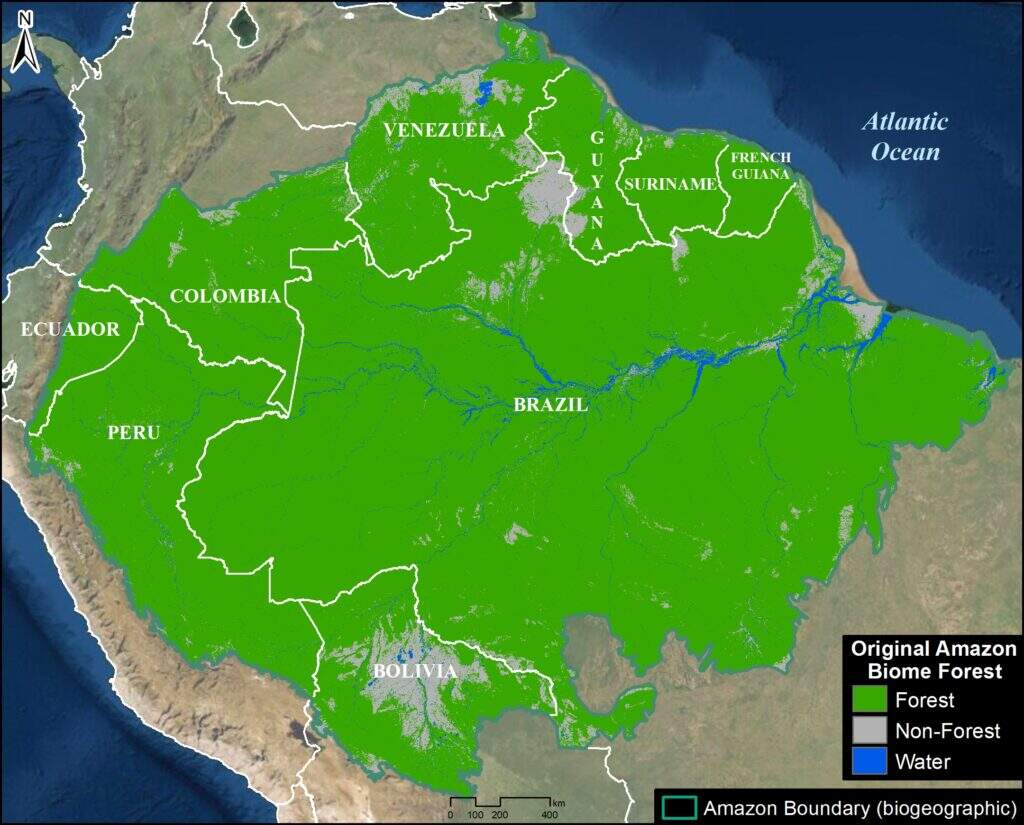
Original Amazon biome forest. Data: Amazon Conservation/MAAP. Source MAAP#164.
Most people never see the Amazon’s most important water system because it flies overhead. That’s right! Trees pull water up from the soil and release it into the air as vapour. Winds carry that moisture across the continent, and the forest recycles it again and again. The rainforest produces roughly half of its own rainfall, and that moisture may be reused up to six times as it moves. Scientists call these moving bands of moisture flying rivers.The MAAP analysis also broke down forest loss along the Amazon’s seasonal flying rivers. It found that some of these routes are weakening faster than others. The report found that moisture pathways during the dry and transition seasons have lost nearly three times as much forest as those during the wet season. These pathways are vital to forests in southwestern Amazonia, particularly in Peru and Bolivia, where forests recycle moisture that supplies more than 70% of rainfall across the basin. The wet-season route crosses thick, well-protected forest in the north and has lost only 3.2% of its forest connection. The routes active during the transition and dry seasons have lost nearly three times as much, at 9.1% and 8.6%, respectively. Brazil accounts for 79.4% of total forest loss. Bolivia comes next at 6.2%, followed by Peru at 5.8% and Colombia at 4.5%. Bolivia has climbed to second place from fourth in the 2022 assessment.These findings are especially concerning as a strong El Niño is forecast for late 2026. It could disrupt moisture flows during the wet season, extend dry periods and increase the risk of forest fires. The areas at greatest risk are the same regions where the report found the most damage to moisture pathways.“Media reports often indicate in general terms that the Amazon is approaching a tipping point, but this is the actual data indicating the magnitude of the problem. With 15% of the original Amazon lost to deforestation and fires, we are approaching the point at which the hydrological cycle that sustains rainforests may be permanently disrupted,” said Matt Finer, director of MAAP and senior research specialist at Amazon Conservation.
Why the Amazon’s tipping point matters
The Amazon’s tipping point hypothesis suggests that parts of the rainforest could shift towards drier savannah once about 25% of the forest is lost, especially if climate change disrupts rainfall and stretches the dry season. The Amazon is at roughly 15% now. That gap looks comfortable until you check how quickly the losses have piled up. Scientists believe this threshold is not a hard line. These changes may come gradually, in patches and unevenly across the basin. Some regions could feel the effects long before others.
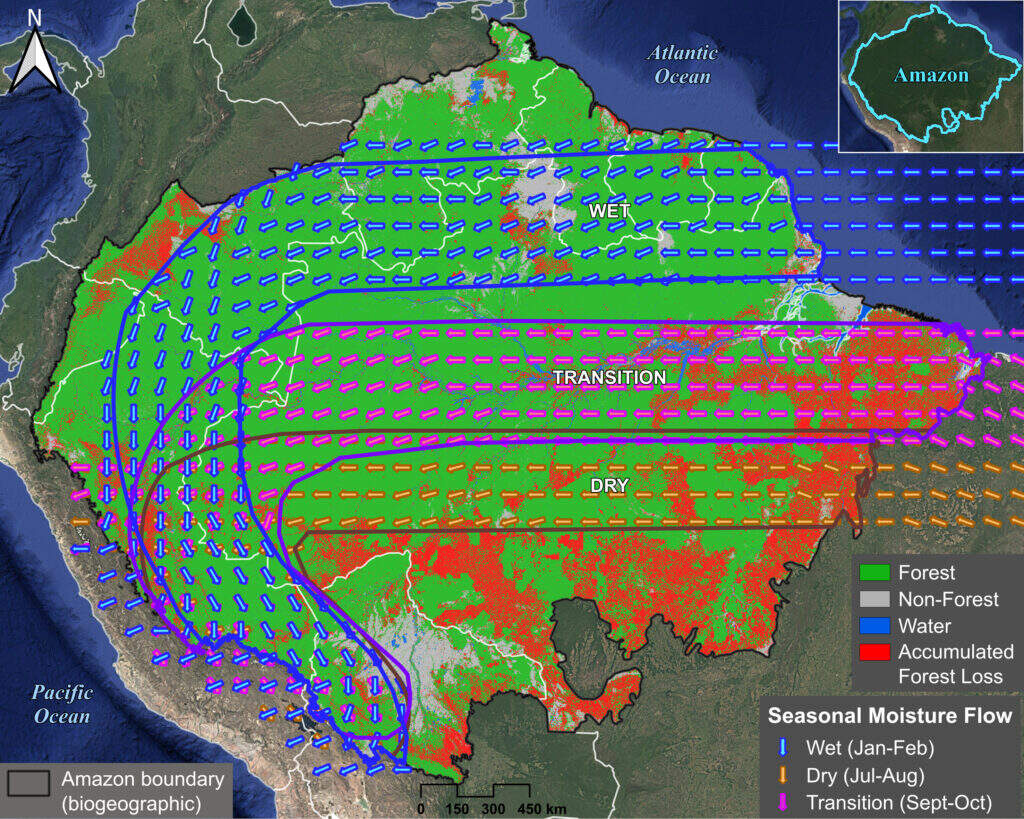
Amazon forest loss in flying rivers pathways. Data: Amazon Conservation/MAAP
Meanwhile, a very strong El Niño is forecast to develop in late 2026. It could disrupt wet-season moisture flows, extend the dry season and raise the risk of fire, the researchers said. Those risks are greatest in the southwest, where the moisture routes have already suffered the most damage.For farmers and families in Peru and Bolivia who depend on that rain, the question is no longer about a distant tipping point. It is about whether the clouds keep coming.