








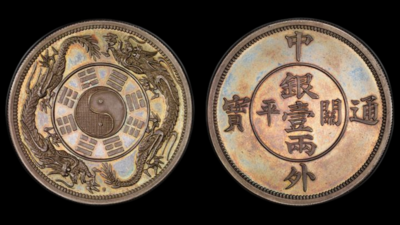
A silver coin designed more than 150 years ago for a proposed international trading currency has fetched $4.758 million at an auction in Hong Kong, despite never becoming part of regular circulation. Made in London around 1867-68, the rare Kwan Ping Trade Coinage pattern was intended to be part of a proposed Chinese-Foreign Circulating Coin series. The coin had remained out of public view for decades after entering a private collection in the mid-20th century. According to auction house Stack’s Bowers Galleries, it became the highest-selling lot at its October 2026 Hong Kong auction, which generated nearly $32 million in total sales.The coin, officially catalogued as the silver ‘Chinese-Foreign Circulating Coin’ Tael Pattern, was sold as Lot 41023. It was graded PCGS Specimen-66, a designation reflecting its exceptional preservation and specimen-quality striking. The auction concluded on October 26, with the results announced on November 3. The final price of $4,758,000 included the buyer’s premium.
A proposed currency that never reached circulation
The story of the coin goes back to a period when international trade involving China faced difficulties because different regions and trading communities used varying monetary systems and standards. Foreign merchants operating through Chinese treaty ports had to navigate a complicated monetary environment, creating interest in a more uniform silver currency that could be recognised across trading markets.The proposed Kwan Ping series was part of efforts to develop such a standard. Its design was proposed by W. F. Wade, the Chinese Secretary of the British Legation in Peking. According to the original auction catalogue, Wade’s proposal was communicated on October 19, 1867, through Captain Kinder to the Governor of Hong Kong.The plan involved producing coins according to the Maritime Customs weight scale, with five denominations: one tael, five mace, two mace, one mace and five candareens. These denominations were intended to make the coins useful for wider commercial transactions rather than limiting them to a single local market.Although the designs were produced in England, the intention was for the coins to be manufactured for circulation through the Hong Kong Mint. However, the project did not progress as planned. The Hong Kong Mint closed in April 1868, and its machinery was subsequently sold to the Osaka Mint in Japan. The proposed currency never developed into a regular circulating coinage.
Why the coin remained a mystery for decades
One reason the Kwan Ping pattern is particularly valuable to collectors is the uncertainty that surrounded its origins and intended use. For years, numismatic researchers debated whether the coins had been manufactured in Berlin, London or Osaka. Their unusual designs also led to suggestions that they might have been intended for trade with Korea.The original auction catalogue credits research by numismatic scholar Joe Cribb, particularly his reference work Money in the Bank, with establishing the English origin of the dies and patterns. The dies were deposited at the Royal Mint in London in 1888 by the heirs of Captain Kinder. Original design drawings and correspondence relating to the proposed coinage also survive in London.The catalogue further refers to archival documents and correspondence discovered in 2017-18 that helped establish the production and shipment history of the series. A letter dated December 31, 1875, from Peter Campbell to Sir Robert Hart, Inspector-General of China’s Imperial Maritime Customs Service, recorded that sample coins had been dispatched to banking agents in Shanghai and Yokohama on December 17. A separate box containing 100 samples of each denomination was sent from Southampton, England, on December 30.The records suggest that only 102 examples of each denomination were produced, making the series exceptionally scarce. The discovery also helped clarify that the coins were likely intended for wider international trade rather than exclusively for commerce with Korea.The design itself reflects the cultural influences behind the proposed currency. The coin features two intertwined Chinese-style dragons surrounding a yin-yang symbol on one side. The opposite side carries inscriptions indicating its denomination, accompanied by decorative branches. A small anchor appears in the outer border of the dragon side, serving as a mintmark.The name Kwan Ping is associated with the weight standard used for the proposed trade coinage. The auction catalogue identifies the particular specimen as a one-tael pattern. Its unusual combination of Chinese imagery and British production history makes it an important piece for collectors studying the development of Asian currency.
A coin kept away from the market for 76 years
The specimen that recently sold belonged to the Liu Mung Wang Collection, a private collection that had remained largely unavailable to the market for more than half a century. According to the auction catalogue, the coin was acquired by Liu Mung Wang directly from his longtime friend and fellow high-school classmate, H. Chang, a noted Chinese numismatist of the early and mid-20th century. The transaction took place before the coin disappeared from the public auction market in 1950.It had remained outside the market for approximately 76 years before being offered at the October 2026 sale. The auction house described the specimen as previously unrecorded, adding to its significance among surviving examples of the series. The coin’s PCGS Specimen-66 grade also reflects its remarkable state of preservation.
Rare Chinese coins lead nearly $32 million auction
The Kwan Ping pattern was not the only Chinese coin to attract significant attention at the Hong Kong auction. Five coins crossed the million-dollar mark, with several other historical silver patterns also achieving substantial prices.According to Stack’s Bowers, the second-highest-selling lot was a 1929 Chinese silver dollar pattern from the Tientsin Mint, graded PCGS Specimen-63, which fetched $2.074 million. A 1927 silver dollar pattern from the same mint sold for $1.891 million.Two other notable results included a 1911 silver Large-Tailed Dragon dollar pattern, which realised $1.22 million, and a 1903 silver tael pattern, struck using Osaka Mint dies, which sold for $1.098 million. All five million-dollar coins belonged to the Chinese numismatic category.The auction featured more than 7,400 lots and recorded a sell-through rate exceeding 94%, generating nearly $32 million in total realised prices. More than $2 million worth of banknotes also changed hands, including historical Chinese currency and notes from other countries.