










Everybody is aware of the story of Cain and Abel, the biblical tale of the world’s first murder. But what if I tell you that the story of human anger and violence goes way beyond what we can imagine? Everyone hears from their grandfathers and grandmothers how good and lovely the world was before, and they too have heard the same story, almost making early humans seem like they lived in an actual heaven.Factually, long before modern civilisation, our ancestors lived in caves and depended on hunting and gathering for survival, but what if their psychology was not very different from ours? Anger, greed and a thirst for possession grasped them as much as we deal with them. That might be one of the reasons why people find their life’s solutions in a book written thousands of years ago. Maybe we have not changed as much as we think. A recent discovery in Iraqi Kurdistan has offered rare evidence of what could be one of the earliest known cases of deliberate lethal violence involving a wooden spear.According to a study published in the journal Scientific Reports, researchers from the University of Cambridge have discovered a 75,000-year-old Neanderthal skeleton with a small, circular hole in its left shoulder blade. The injury suggests that a sharpened wooden spear may have passed through the individual’s chest, potentially in an attack deliberately aimed at the heart. The remains, named Shanidar A, were discovered in Shanidar Cave in Iraqi Kurdistan and could represent the oldest known evidence of fatal interpersonal violence involving a wooden spear in the hominin fossil record.
A 15 mm hole that may reveal a deadly attack
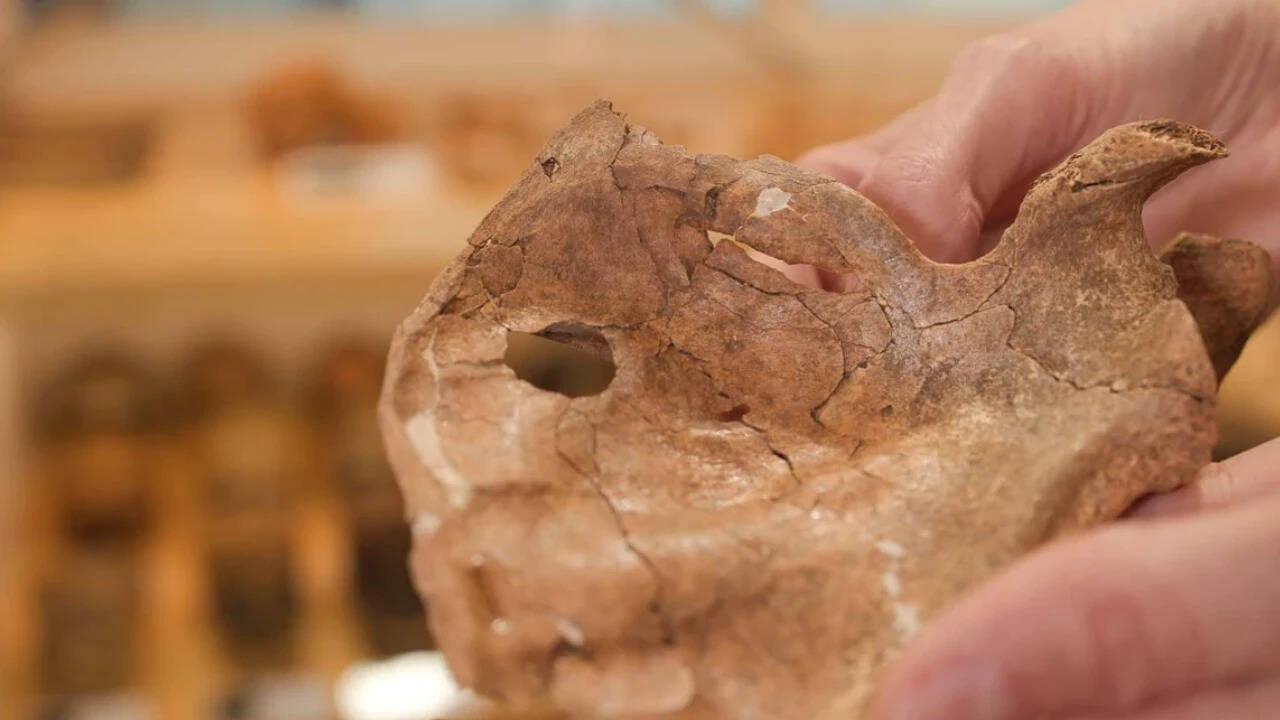
The 75,000-year-old Neanderthal’s left shoulder blade shows the fractures. (Image courtesy: University of Cambridge)
One of the most interesting aspects of the discovery is the condition of the shoulder blade, also known as a scapula. The bone is extremely delicate, with some parts so thin that light can pass through them. Yet, it remained almost completely intact after spending around 75,000 years beneath approximately 7.5 metres of rock and sediment.The only major damage was a remarkably circular opening measuring around 15 millimetres across. According to the researchers, the shape of the hole provides an important clue about the weapon that may have caused it. Spears with flint or stone tips generally leave flatter or more angular openings, while the rounded shape of this injury is consistent with a sharpened wooden point.Based on their reconstruction, the researchers believe the spear entered the front of the individual’s left chest, passed through a lung and probably major blood vessels before piercing the shoulder blade from behind. The force and position of the injury suggest that the weapon may have been deliberately directed towards the heart, causing a rapidly fatal wound.The researchers also identified small fragments of bone displaced during the impact. Their position and the bevelled edges around the opening helped the team reconstruct the direction in which the weapon travelled. The evidence suggests that the spear entered from above and moved downwards through the body.
Was it a deliberate murder or a hunting accident?
The question we all have been thinking about. Although the injury appears consistent with a targeted attack, researchers have not been able to establish with certainty what actually happened to Shanidar A. One possibility is that the individual was attacked by another Neanderthal, while another is that the injury was just a tragic incident during hunting.Neanderthals were another human species that coexisted with Homo sapiens and hunted large and dangerous animals, sometimes at close range using thrusting spears. An accident involving such a weapon could also have caused a fatal injury. Dr Emma Pomeroy, the lead author of the study from the University of Cambridge’s Department of Archaeology, acknowledged that hunting large animals such as mammoths could have resulted in similar injuries.
The other side of Neanderthal life: care and survival
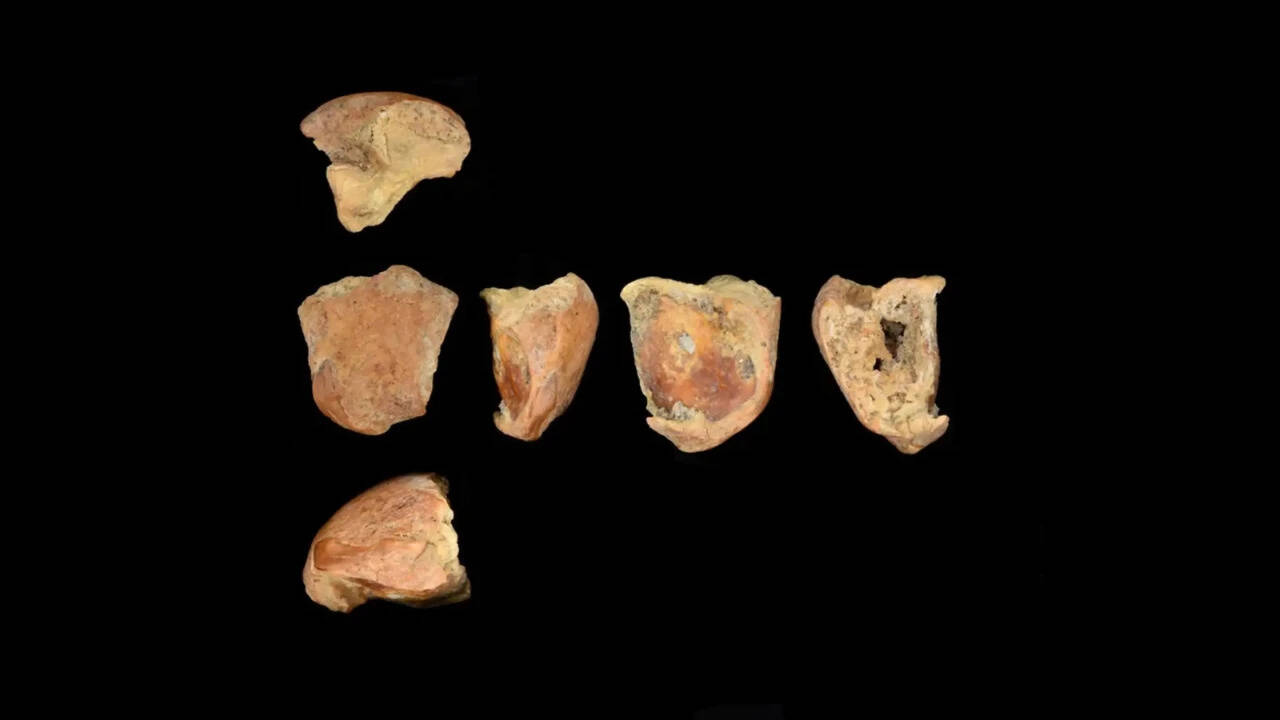
The Neanderthal’s left lateral incisor, showing a longitudinal split from different angles. (Image courtesy: University of Cambridghe/Dr Emma Pomeroy)
Interestingly, the possible violent death of Shanidar A was not the only thing researchers discovered from his remains. His teeth showed evidence of an earlier severe facial injury, which had damaged one of his front teeth and pushed neighbouring teeth inward. However, the individual appears to have survived this injury for at least a year, possibly longer.Researchers believe that such an injury would have made eating difficult, meaning that Shanidar A may have depended on other members of his group for support. According to Dr Emma Pomeroy, surviving with such damage would likely have required some form of care from others, possibly through softer foods that were easier to eat.The discovery not only opens up our understanding of the physical aspects of Neanderthals but also their social behaviour, how the inability of one member brings care from the community. This shows the two aspects of human civilisation itself: love and care, and anger and greed, with Cain and Abel represented in a single finding.