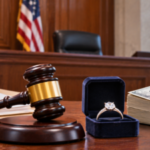











A New York court has rejected a man’s demand for the return of his engagement ring and $120,000 in damages after his eight-year relationship with his former fiancée ended following a domestic dispute. Jason Dieterle sued Heather M. Lynch, seeking compensation for alleged home improvements and money from a joint bank account, along with the ring or $5,300 to cover its cost. However, in a January 30, 2026, ruling, the Supreme Court of Erie County dismissed his claims, finding insufficient evidence for the financial demands and ruling that his own conduct barred him from recovering the engagement ring.
Why did the man demand his engagement ring and $120,000
According to the court’s decision, Dieterle and Heather M. Lynch had been together and engaged for approximately eight years. During the relationship, the couple moved into Lynch’s recently purchased house in Akron, New York, along with Dieterle’s two children. The property was registered in Lynch’s name, and she was responsible for paying the mortgage. Around the same time, Dieterle added Lynch as a joint account holder to his bank account, which contained approximately $40,000 from the recent sale of his home.Both parties used the account for different expenses. Dieterle used the money to pay personal debts, loans from his parents and child support, while Lynch used it for household groceries, petrol and holiday gifts. Although both knew about each other’s withdrawals, they later disagreed over whether either party had withdrawn more than their fair share.The relationship ended on October 8, 2023, following a domestic dispute. According to the Village of Akron police report, officers arrived at the property and found Lynch standing in the driveway with blood on her shirt. Dieterle’s 74-year-old father was also present, with several facial lacerations. The report stated that Lynch and Dieterle’s father alleged that Dieterle had been in an uncontrolled rage, which they attributed to alcohol and drug use earlier that day. Following an altercation, police arrested Dieterle and transported him to the Erie County Medical Centre.The court also recorded that Dieterle had been convicted of various charges in Newstead Town Court and that Lynch subsequently obtained an order of protection against him for two years. The engagement ended on the day of the incident. Dieterle removed his belongings from the property and purchased another house in the same town.
Why did Dieterle demand $120,000 from his former fiancée
Less than a year after the engagement ended, Dieterle filed a lawsuit seeking financial compensation from Lynch. According to the judgment, his claims included $80,000 for repairs and improvements he said he had carried out on her property over the preceding four years, approximately $40,000 that had previously been held in their joint bank account, and the return of his engagement ring or $5,300 to cover its cost.In his affidavit, Dieterle listed several services he claimed to have performed while living at the property. These included landscaping, seeding, removing trees and stumps, garden maintenance, window restoration, garage restoration, painting and fireplace restoration. He also claimed to have repaired the living room and kitchen ceilings, installed lighting and dining room flooring, restored the staircase and carried out bathroom, plumbing and wardrobe repairs.However, the court found that he had not provided supporting documentation for these claims. Justice Weinmann noted that Dieterle had submitted no receipts, invoices, timesheets or other records establishing the work performed or its value. The judgment specifically questioned the basis of his financial demands, stating that “The claim for $60,000 appears to be pulled out of thin air.” The court also noted that there was no evidence that Dieterle had been a general contractor, repairman or handyman.
Why did the court reject Dieterle’s $40,000 bank account claim
The dispute over the joint bank account was another important part of the case. Dieterle sought to recover approximately $40,000 that had originally come from the sale of his previous home. However, the court examined the bank documentation and found that Lynch had been added as a joint owner with a right of survivorship.The judgment referred to Section 675 of New York Banking Law, which provides that funds in a joint account with a right of survivorship belong to both account holders as joint tenants. Under this arrangement, either account holder can access the funds during their lifetimes. The court distinguished this from a convenience account, in which the additional account holder does not acquire ownership of the deposited funds.Justice Weinmann concluded that Lynch had every legal right to use the account, including for her own expenses, because Dieterle had voluntarily added her as a joint owner. The court also observed that both parties had used the account individually and jointly. It therefore found that Dieterle had no valid claim of unjust enrichment based on the alleged imbalance in their withdrawals.The court also rejected his claims for unjust enrichment and quantum meruit concerning the home improvements. To establish unjust enrichment, a claimant must show that the other party received a benefit at their expense and that allowing the other party to retain it would be against equity and good conscience. For quantum meruit, a claimant must establish that services were performed in good faith, accepted by the other party, provided with an expectation of payment and had a reasonable value. The court found that Dieterle had failed to establish the necessary elements of these claims.
What does New York law say about returning engagement rings
The engagement ring was the final issue considered in the judgment. Under Section 80-b of New York Civil Rights Law, a person who gives property, including an engagement ring, in contemplation of marriage may generally seek its return if the marriage does not take place. The law was revised in 1965 to address disputes involving broken engagements.The court referred to the 1971 Court of Appeals decision in Gaden v. Gaden, which established that the return of engagement gifts should not depend on determining which party was at fault for the failed relationship. The purpose of the legislation, as explained in that earlier ruling, was to return the parties to their positions before the engagement without rewarding or punishing either person for the marriage not taking place.However, Justice Weinmann also considered the legal doctrine of unclean hands. This equitable principle can prevent a person from obtaining relief from a court when their own wrongful or unconscionable conduct is directly connected to the matter being disputed and has injured the other party. The judgment referred to earlier decisions, including Lowe v. Quinn and Levy v. Braverman, while examining how the principle applied to the engagement ring dispute.Applying the doctrine, the judge found that Dieterle’s actions had brought the engagement to an end. The decision stated that his assault on his former fiancée constituted “immoral and unconscionable conduct”. It further concluded that he could not seek an equitable remedy for the return of the ring after his own actions had caused the engagement to end.The judge wrote: “He alone was responsible.” The decision concluded that Dieterle had “both figuratively and literally—unclean hands” and should not be allowed to profit from his own actions. The court consequently ruled that the engagement ring did not have to be returned to him.The January 30, 2026, decision rejected Dieterle’s claims, and defence counsel was directed to submit an order to the court within 30 days of the decision’s entry.