









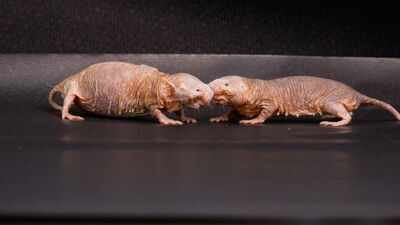
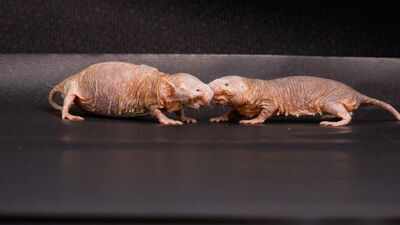
Naked mole-rat queens appear to maintain their social order with the help of a chemical signal that keeps other females from reproducing. A study published in Nature has identified isopropyl myristate, or IPM, as a compound found in much higher amounts in queens than in non-breeding colony members. The researchers found that the chemical affects the reproductive system of other naked mole-rats and can also help keep the colony peaceful. When the signal was withdrawn after a queen was removed, females began competing for reproductive control.
The queen’s chemical signal control reproduction
Naked mole-rats have a unique social system for mammals. A colony normally has a single breeding female, known as the queen, while the other females remain unable to reproduce. The precise mechanism behind this arrangement had remained unclear, even though researchers knew that removing or losing the queen could quickly release reproductive activity in other females.The Nature study found that smell plays an important part in this system. Researchers analysed hundreds of odour samples from naked mole-rats of different ranks, ages and reproductive states. Among the compounds they identified, IPM stood out because it was consistently abundant in queens but almost absent from non-breeding males and females.The compound was particularly concentrated in the queen’s vaginal, anal and mouth secretions. Its levels also changed with her reproductive state, reaching their highest point around ovulation before falling during pregnancy and lactation. This pattern suggested that IPM could provide the rest of the colony with information about the queen’s reproductive condition.
What happens when naked mole-rats detect IPM
The researchers then tested whether the animals could detect the compound and respond to it. Experiments showed that IPM activated the naked mole-rats’ smell-sensing system and produced activity in parts of the brain involved in processing odours. Higher-ranking animals avoided areas carrying the chemical, while lower-ranking animals showed no clear preference.The study also connected the chemical signal to changes in hormones involved in reproduction. Non-breeding females had higher levels of the hormone prolactin when the queen was ovulating or pregnant, periods that also coincided with greater IPM levels in the colony. When animals were separated from the colony, prolactin fell, providing further evidence that the queen-associated signal was influencing their reproductive state.The findings offered a more direct test when the researchers placed non-breeding males and females in pairs and exposed some of them to IPM. Over 18 weeks, five of six control pairs became pregnant. None of the six pairs kept with their original colony bedding and none of the seven pairs exposed to IPM became pregnant. The chemical therefore appeared sufficient to prevent reproductive activation under the experimental conditions.

Model of naked mole-rat soldiers, workers, and queen, a social structure similar to the castes of the eusocial insects. Image Credit: Wikipedia
Removing the chemical triggered a power struggle
The most striking result came from an experiment involving an entire colony. Researchers removed the queen and then continued adding IPM to the colony bedding each day. Normally, queen removal can lead high-ranking females to become aggressive as reproductive competition begins.With the chemical signal maintained, however, the colony remained socially stable for 12 weeks. No dominance contests or aggression were observed, while hormone measurements indicated that reproduction remained suppressed. The experiment suggested that the chemical could temporarily reproduce some of the effects normally associated with having a queen present.The situation changed quickly after the researchers stopped adding IPM. Prolactin levels declined, progesterone levels rose and several females began showing sexual behaviour. Within a week, high-ranking individuals started fighting, and one female was killed in an aggressive attack. By week 19, a surviving dominant female had gained weight, became pregnant and eventually gave birth.
What does the discovery reveal about naked mole-rat society
The findings suggest that the queen’s presence is partly communicated through a chemical signal that can affect both the bodies and behaviour of other colony members. The researchers propose that detecting the compound raises prolactin in non-breeding animals, helping keep them infertile while also reducing the conditions that could lead to reproductive competition.