







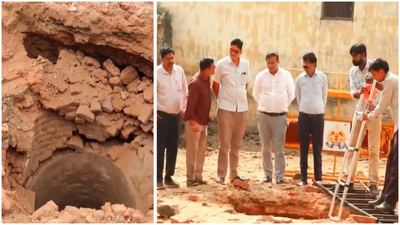
NEW DELHI: An Archaeological Survey of India (ASI) team on Monday examined a nearly 20-foot-deep well discovered during debris removal at the site of a mosque demolished inside the Saharanpur Collectorate premises, officials said.The inspection was aimed at determining the age, nature and historical relevance of the structure, which was found beneath the rubble on Sunday.Heavy police security was deployed around the site and the well was barricaded to prevent access.
ASI examines well’s structure and construction
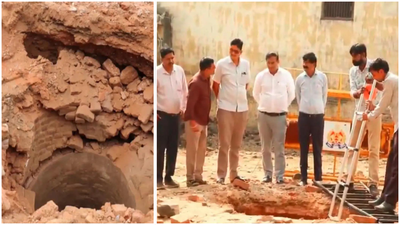
Manoj Kumar Yadav of the Uttar Pradesh State Archaeology Department said the inspection was intended to establish the antiquity of the structure and understand its possible historical context.“Our primary objective in visiting here was to determine the antiquity of the structure found there. Secondly, we wanted to understand the nature of the structure itself. We also aimed to correlate it with history to understand what it relates to,” Yadav told news agency ANI.According to Yadav, the structure appeared to be a well filled with debris that had fallen inside. It was around 20 feet in height from the surface level and had a diameter of nearly three feet.“The structure is made using Lakhori bricks. The binding mortar used is a lime-surkhi mixture, and at a depth of three feet from the top surface, there is a thin layer of lime plaster,” he said.Yadav added that structures made using similar techniques are commonly found in the Upper and Middle Ganga Valley regions and are generally associated with the later mediaeval period.Three ASI officials reached the site on Monday afternoon and examined the well in the presence of local administration officials. The officials measured its depth after placing a ladder inside and carried out photography and videography.Soil and brick-remnant samples were also collected from inside the well, sadar sub-divisional magistrate Subodh Kumar said.The discovery was made during debris-removal work on Sunday, when workers came across a concrete slab beneath the rubble.The slab was unusually strong. A Pokland machine failed to make a significant impact, after which workers used a cutter and found the brick-lined well.The well was approximately 20 feet deep and around 1.5 metres wide. Its exact age, purpose and historical background were not immediately established.
Mosque demolition followed court proceedings
The well was discovered a day after the demolition of a mosque located inside the Saharanpur Collectorate premises.The district administration demolished the structure in the early hours of September 5 after the mosque committee’s appeal against the demolition order was rejected by the district judge’s court.The City Magistrate’s court had on July 17 declared the structure an illegal encroachment on government land and ordered its demolition. It also imposed compensation of approximately Rs 6.41 crore in connection with the alleged encroachment and misuse of government land.The mosque management committee had challenged the City Magistrate’s order in the district court, which rejected its appeal on September 2. Authorities subsequently proceeded with the demolition amid heavy police deployment.Authorities have maintained that the demolition was carried out in accordance with court directions and legal procedures.
Claims emerge over well’s historical significance
The discovery has led to differing claims about the possible history of the site.
Share your thoughts in the comments
Be respectful · TOI community guidelines
Vikas Tyagi, the complainant in the matter and a former Bajrang Dal convenor, claimed that a temple might have existed at the site before the mosque was built.Saharanpur Congress MP Imran Masood, however, said the well was part of the mosque and had been used in earlier times to meet the requirement for water for wuzu, or ablution before prayers.The ASI examination is expected to help establish the well’s antiquity and historical background. Officials have not announced any conclusion about its origin or earlier use.