









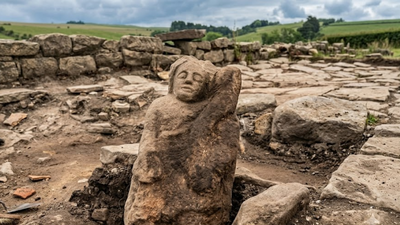
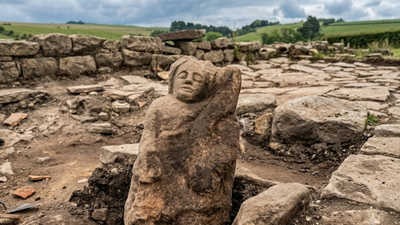
Archaeologists excavating the remains of a Roman fort in northern England have uncovered a remarkable sandstone carving believed to depict a protective deity that watched over the military outpost around 1,600 years ago. Buried beneath the fort’s defensive ramparts for centuries, the carved figure is offering fresh insights into the spiritual lives of Roman soldiers stationed on the empire’s distant frontier. Experts believe the sculpture represents a genius, a guardian spirit associated with a specific place, highlighting how religion, military life and local traditions blended along Hadrian’s Wall during the final centuries of Roman Britain. The rare discovery not only sheds light on Roman religious practices but also raises new questions about why the carving was deliberately buried beneath the fort’s defences.
Archaeologists uncover a rare Roman guardian spirit beneath the ramparts of an ancient fort
The discovery was made during excavations at Vindolanda, one of Britain’s best-preserved Roman forts located just south of Hadrian’s Wall in Northumberland.According to the Vindolanda Charitable Trust, archaeologists unearthed a finely carved sandstone relief while investigating the fort’s defensive earthworks. Measuring roughly 47 centimetres (18.5 inches) high, the sculpture depicts a draped human figure standing within a niche, with details that suggest it once held symbolic objects now lost through centuries of weathering.Dr Andrew Birley, Director of Excavations at Vindolanda, described the moment as one of those exceptionally rare discoveries that archaeologists dream of making.“As archaeologists, moments like these are incredibly rare, and we feel privileged to have uncovered and preserved such an important part of the site’s story,” he told the BBC. He later added that it felt “almost as though Vindolanda itself had reached out to the team and quietly said that they approve of what we were doing.”
What is a Roman ‘guardian spirit’ and why was it important
Researchers believe the carving represents a genius, a protective spirit believed by the Romans to inhabit and safeguard a particular place.In Roman religion, guardian spirits were thought to watch over everything from households and rivers to towns, temples and military forts. Soldiers often honoured these deities with offerings and dedications, seeking protection, prosperity and success while stationed far from home.The figure discovered at Vindolanda appears to have been positioned in a location that symbolically protected the fort itself, suggesting it may have formed part of a ritual associated with the construction or renewal of the site’s defensive walls.Although similar depictions have been found elsewhere across the Roman world, examples discovered in their original archaeological context are exceptionally uncommon, making the find particularly valuable for understanding religious practices on Rome’s northern frontier.
Why the discovery matters for understanding Roman Britain
Vindolanda has long been one of Britain’s richest archaeological sites, famous for its remarkably preserved wooden writing tablets, leather shoes, textiles and military artefacts that provide an unparalleled glimpse into everyday life along Hadrian’s Wall.The newly discovered guardian spirit adds another dimension to that picture by revealing the importance of belief and ritual within Roman military communities. Rather than relying solely on engineering and military strength, Roman soldiers also sought divine protection for the places where they lived and served.Archaeologists say the carving demonstrates how religion remained deeply woven into daily life, even at one of the empire’s most remote frontier forts.
A hidden relic that survived beneath the fort for centuries
The fact that the sculpture remained concealed beneath the ramparts for around 1,600 years makes the discovery particularly significant. Protected by layers of earth and later construction, the relief survived remarkably well despite the passage of time.Researchers are now studying the carving to better understand its original appearance, whether it was painted, and the exact role it played in rituals carried out at the fort. The discovery also offers fresh evidence that important religious objects were sometimes deliberately incorporated into military architecture rather than simply displayed in temples or shrines.As excavations continue at Vindolanda, archaeologists hope further discoveries will help piece together how Roman soldiers balanced military duty with spiritual beliefs on one of the empire’s most distant frontiers.