









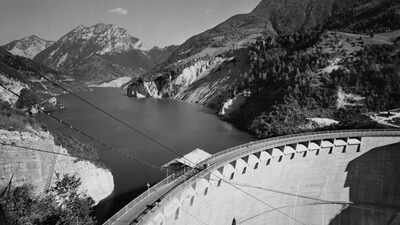
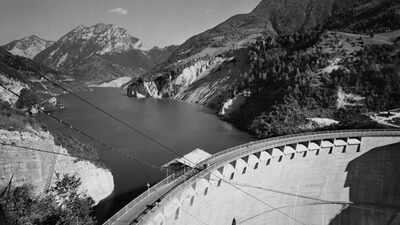
On October 9, 1963, a colossal engineering marvel became a monument to human overconfidence. High in the Italian Alps, the Vajont Dam- then the world’s tallest- withstood the unthinkable: a massive 260 million-cubic-meter landslide from Monte Toc. In just 45 seconds, the mountain collapsed into the reservoir, displacing a 50-million-cubic-meter wall of water. This 250-meter megatsunami surged over the dam’s crest, hurtling into the valley below with the force of two Hiroshima bombs. According to the Association of State Dam Safety Officials (ASDSO), the town of Longarone was erased in minutes, claiming nearly 2,000 lives. Despite visible geological warnings, the pursuit of progress ignored the mountain’s fragility, leaving behind a dry reservoir and a chilling lesson in environmental hubris.
Design and ambition of one of the world’s tallest dams, Vajont Dam
The Vajont Dam was constructed as a thin-arch concrete dam that reaches a height of 262 meters (860 feet). At its completion in 1959, it was the highest dam of this type in the world. Located across the deep, narrow gorge created by the Vajont River, the dam was seen as a key part of Italy’s post-war industrial revival. The dam was conceptually an engineering marvel; however, the excellence of its engineering was undermined by a failure to consider the geological instability of the canyon walls around the dam, particularly the side of Monte Toc adjacent to the reservoir.
Geological warnings and the ‘M’ fracture
In 1960, as the reservoir began filling, Monte Toc ‘moved’. A massive (M) shaped crack developed on the side of Monte Toc that extended over 2 kilometres, indicating that a large block of earth was moving away from the mountain. As engineers observed the behaviour of the mountain, it became clear that the rates of its displacement were directly related to the reservoir’s water level; the higher the reservoir’s water level, the more rapidly the mountain moved. The decision-making process tried to ‘control’ the slide through gradual reservoir water level changes, rather than recognising the very real risk of an instantaneous collapse of the earth from the upper part of Monte Toc in excess of the capacity of the dam.
45 seconds of destruction
The slope completely collapsed on the night of 9 October 1963. In 45 seconds, approximately 260 million cubic metres of rock slide off the slope (almost twice the volume of the water in the reservoir) into the lake. The speed at which this occurred caused the rock to not only displace the water but also act as a piston, causing the water in the lake to be pushed out and to create a megatsunami that reached heights of 250 metres. The wave bifurcated, and one segment struck the villages that were upstream while the other segment rushed over the top of the dam and with tremendous force into the valley below.