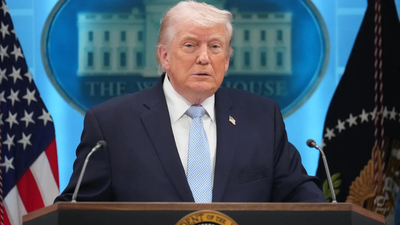











File photo: US President Donald Trump (Picture credit: AP)
TOI correspondent from Washington: US President Donald Trump on Monday warned Iran that he is ready to go beyond destroying its power plants and bridges if it does not “cry uncle” before his Tuesday evening deadline. “We have obliterated the country…they don’t want to say uncle (capitulate)….they should. Otherwise they will not have much left,” Trump told reporters as he strolled on the White House grounds mingling with children for the Easter egg hunt the First Lady was hosting. Trump also maintained that his administration was talking to a third tier Iranian leadership (having eliminated the first two) whom he found much more reasonable even though they have refused to bow to US terms. “We could leave right now and it would take them 15 years to rebuild what they have, but I want to finish it up,” Trump said, amid growing disquiet across America, including in MAGA circles, that he is driving the US into a quagmire in the Middle East and maybe crossing a war crimes red line. Asked what he wanted to tell the American people who were against the war (a clear majority), Trump said they are “foolish” because the objective was to deny Iran nuclear weapons, which he claims they would have had if he had not interceded. Independent experts have challenged the Trump and Netanyahu assertion that Iran was close to producing a nuclear weapon. Trump’s threat to bomb Iran into the “stone age” by destroying its infrastructure has alarmed many Americans who say such an action could amount to a war crime. Asked about this view, Trump justified his stand saying the Iranian regime had killed 45,000 people and while claiming the Iranian people “want to hear bombs go off because they want to be free.”Trump is scheduled to speak about the US mission that rescued an American airman stranded in Iran later in the afternoon, providing details of an operation that while achieving the primary objective, is still enveloped in the fog of war and disputed claims. Two MC-130J transport aircraft, serving as the mission’s logistical backbone at a clandestine desert staging site, suffered what the Pentagon termed “cascading mechanical failures.” To prevent the seizure of advanced communications and navigation arrays, US forces are reported to have executed a standard scuttling procedure, reducing the planes to burnt out shells before the final extraction team departed Iranian airspace. The destruction of these assets denied Teheran a potent, outright propaganda victory – although Iran tried to make the best of it – but it also raised questions about the Pentagon’s efficacy in terms of deployment of men and material. US military analysts meanwhile talked up the heroic feat of the stranded airman (who used the call sign “Dude 44”) who is said to have hidden in a mountain ridge 7000 feet high after ejecting from a F-15 fighter jet brought down by Iran. Early Monday, Iran issued a statement claiming their Revolutionary Guard (IRGC) “repelled a desperate American incursion,” asserting they had shot down the aircraft and captured several “mercenaries.” However, forensic satellite imagery and administration briefings suggest a more nuanced reality: the US aircraft were destroyed by their own crews, and all American personnel, including the rescued Colonel and several wounded commandos, were reported to have been successfully evacuated to a military medical facility in Kuwait. Iran has not produced any personnel it claims to have captured. Meanwhile, the US rhetoric masks the staggering financial cost of the operation. With the loss of two MC-130Js and the F-15E, the hardware cost of this single rescue mission is estimated to exceed $400 million—a figure that does not account for fuel, munitions, or the massive carrier-based support required to maintain air superiority in the region. Political pressure is also mounting domestically as well, with the administration facing a dual-front battle: justifying the high costs of a “limited” engagement and managing the optics of a war that is increasingly fought with AI and on social media, where there is growing unease about the motives for the war. The Pentagon’s reliance on high-end AI infrastructure for real-time battlefield management was on full display during the rescue, as a CIA-led deception campaign is said to have flooded Iranian social media with false reports of the airman’s location. This digital “chaff” reportedly confused IRGC command-and-control for a critical four-hour window, allowing the extraction helicopters to enter and exit without being targeted by Iranian countermeasures.