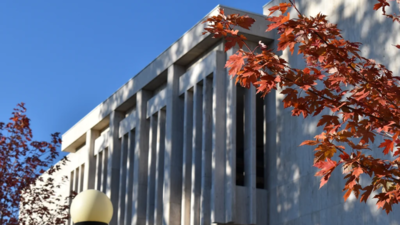











Poland’s long-running battle over judicial independence has escalated into a confrontation between prime minister Donald Tusk and president Karol Nawrocki, after the suspension of the Constitutional Tribunal’s leadership triggered protests and a police deployment outside the court in Warsaw.The latest flashpoint came on Friday, when Judge Anna Korwin-Piotrowska announced the one-month suspension of Tribunal president Bogdan Święczkowski and his deputy, Bartłomiej Sochański, and said she would take charge of the institution. The move followed a dispute over the appointment of new judges, whom Święczkowski had refused to allow to take their seats.Nawrocki, an ally of the nationalist Law and Justice party (PiS) and a vocal supporter of US President Donald Trump, abandoned a visit to Senegal and returned to Warsaw. He described the suspension of the Tribunal’s leadership as a “forcible takeover of a constitutional institution”. PiS leaders also condemned the move, accusing Tusk’s government of attempting a coup.Police were deployed outside the court as hundreds of protesters gathered. Officers said their presence followed concerns about possible threats to judges and staff and risks to public order. Police also reported three arrests after people tried to enter the court complex.Tusk defended his government’s actions, saying it was seeking to restore the rule of law after years of political interference in the judiciary under PiS, which governed Poland for eight years until 2023.“This process is difficult, at times even painful, and requires decisive action. There is no other way,” Tusk said in a post on X on Saturday. In a televised address, he said that “shouting, lies, and brawling cannot be the source of law in Poland”.
A decade-long dispute over the judiciary
The Constitutional Tribunal rules on whether legislation complies with Poland’s constitution, giving control over its composition significant political and legal consequences.The current dispute has roots in 2015, when PiS came to power and challenged judicial appointments made by the outgoing government. Poland’s Constitutional Tribunal subsequently found that only three of five appointments made by the outgoing parliament had a valid legal basis. The incoming PiS majority appointed replacements, including for seats that had already been lawfully filled, while then-president Andrzej Duda refused to swear in the three validly elected judges.During its eight years in office, PiS introduced wider judicial changes that critics said increased political influence over the courts. In 2021, the European Commission warned that the party’s actions posed a “systemic risk to the rule of law in Poland” and froze EU funding over concerns about judicial independence.The European Court of Human Rights ruled in 2021 that the participation of an improperly appointed judge had deprived a company of its right to a tribunal established by law. In December 2025, the European Union’s top court also ruled that Poland’s Constitutional Tribunal did not meet the requirements of an independent court.Tusk returned to office in December 2023 promising to restore judicial independence. But efforts to reverse the changes have been complicated by the continued presence of PiS-appointed judges and Nawrocki’s role in the appointment process.This year, parliament elected eight judges to the Tribunal’s 15-member bench. Nawrocki administered the oath to three but withheld it from five others, who took their oaths without his presence. Święczkowski subsequently refused to allow the five to begin their work.The latest confrontation followed the appointment of Maciej Berek, a former minister in Tusk’s cabinet, who was prevented from taking his seat last week. The choice has also drawn criticism from within the governing camp, with some questioning whether appointing a former government minister is consistent with promises to depoliticise the judiciary.Legal experts have raised questions about the latest intervention, too. Korwin-Piotrowska’s authority to suspend the Tribunal’s president and deputy has been disputed, with her claim based on her length of service as a judge overall rather than seniority within the Tribunal.
A standoff with no clear resolution
The confrontation has exposed a difficult question for Tusk’s government: how to restore the Tribunal’s independence without creating new doubts about the legality of its actions.Marcin Matczak, a Polish lawyer, told Al Jazeera that PiS was seeking to retain control of what he described as its remaining institutional stronghold, while the government wanted to restore balance to the Tribunal. He warned that the use of police in a dispute involving the court could set a precedent for future governments.The US ambassador to Poland, Tom Rose, urged all sides to avoid escalation, warning that large crowds outside the Tribunal could make an already dangerous situation more combustible.The standoff comes as Poland faces security concerns linked to Russia’s war in neighbouring Ukraine and sabotage attacks that Tusk has attributed to Moscow. Tusk has accused his opponents of finding support among pro-Russian forces, an allegation that further sharpens the political divide.With parliamentary elections due next year, the dispute over the Tribunal is likely to remain central to the debate over Poland’s political direction and its relationship with the European Union.