







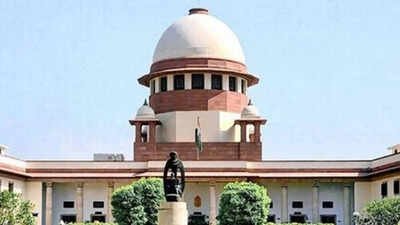
MUMBAI: “The legitimacy of public authority ultimately rests not upon the power to command, but upon the obligation to remain within the bounds of law and serve the nation. It is this distinction that must remain inviolable in a constitutional democracy,” the Supreme Court said in its reasoned order by which it had on Sept 28 set aside the Bombay HC order of bail to Ramesh Mhatre, the 73 year old municipal corporator in the July 6 Kalyan Dombivli Municipal Corporation doctors’ assault case in a Dombivli hospital.The SC order available on Thursday extended the deadline to complete the trial. The HC had set a 3 month deadline to complete the trial for the magistrate in Kalyan.The SC made it six months from the date of presentation of its order and while cancelling Mhatre’s bail in the State’s plea said he is at liberty to apply for it in case of any change of circumstances.The SC noted that assaults on doctors was being reported across states and said, “While each such incident must necessarily be examined on its own facts and in accordance with law, the recurrence of allegations involving elected representatives assuming, or seeking to assume, authority beyond that conferred by law is a matter which cannot be viewed with indifference.”SC bench of justices Vikram Nath and Sandeep Mehta observed that an elected office carries with it a corresponding obligation to respect the rule of law and the institutions through which grievances are to be addressed.“The authority derived from the electoral mandate cannot be permitted to become a substitute for the authority of law,” the bench stressed.The state had filed an appeal and through advocate Shreerang Varma argued for cancellation of Mhatre’s bail. Senior counsel Siddharth Dave for Mhtatre had opposed.The SC accepted the State’s plea and disposing it off invoked a verse from the Suśruta Saṃhitā which it said eloquently expressed an enduring truth of how “efficacy of medical care is inseparable from the trust and respect reposed in the doctors and nurses.”“Its literal sense, the verse conveys that a physician does not succeed in a house where he is not respected; where the physician is respected, his treatment succeeds. Though expressed in the language of an ancient medical tradition, the principle underlying the verse retains undiminished relevance even today,” said the 36 page judgment authored by Justice Mehta.“Few responsibilities in a civilised society are as profound as that entrusted to a doctor,” the judgment underscored.“The special place accorded to the medical profession flows from the very nature of the service it renders to humanity. It concerns human life, human dignity and the alleviation of human suffering. A doctor is, therefore, required to bring to the discharge of his or her duties not merely knowledge and technical competence, but also sound judgment, patience, composure and compassion. The responsibility is consequently of a character that extends beyond the mere provision of a professional service.”The SC said, “It is this unique character of the profession that distinguishes the relationship between a doctor and a patient from an ordinary commercial or service relationship. A patient does not merely engage a professional for the performance of a task; he places his health and, in serious cases, his very life in the hands of the doctor. The relationship is thus founded upon a degree of trust that cannot be measured merely by the professional service rendered or the remuneration received.““The ancient Roman Stoic philosopher Lucius Annaeus Seneca aptly expressed the thought, while the physician is paid for his professional service, gratitude remains owed for the kindness and care that transcend the service itself. The observation aptly recognises that the confidence, reassurance and humanity accompanying medical care form an integral part of the relationship between the doctor and the patient,” it added.“A doctor cannot reasonably be expected to exercise sound and independent judgement while labouring under the apprehension of physical violence, intimidation or coercion,” the SC observed and added, “The safety and dignity of the medical professional are consequently not matters of personal privilege. They are the safeguards which serve the larger public interest in ensuring that medical care is rendered with the concentration, composure and judgement that the profession demands.“But, it also noted that it “does not place medical professionals beyond scrutiny or accountability. A patient or his family remains entitled to question the treatment provided, complain of negligence or delay, seek investigation into an adverse outcome and pursue such remedies as are available in law. Indeed, the availability of these lawful avenues is essential to ensuring accountability within the medical profession.“The SC also said, “What the law cannot countenance is the substitution of these remedies by threat, violence and coercion. Physical violence, intimidation or coercion cannot become a means of expressing dissatisfaction with medical treatment, securing compliance with a demand or raising grievance for an adverse medical outcome. A grievance, however genuine, does not confer a licence to resort to violence.”“To permit such conduct would not merely imperil the individual doctor. It would undermine the very conditions in which medical professionals are required to make decisions upon which the life and health of patients may depend. Any patronage to such activities would alter the civil society in one run by outlaws,” it further said.Police arrested Mhatre on July 8 for allegedly slapping and punching a doctor and assaulting a resident medical officer. A local court granted him bail on July 14, while he was in a hospital.He was released but on July 18 the HC acting chief justice RV Ghuge led bench took up the matter suo motu and staying the bail order for all four, directed Mhatre to surrender. He did on July 19.The HC eventually granted him bail on August 7 and the ACJ had also said, “In a democracy an elected representative is by the people and for the people. If the elected representative is accused of assaulting his own voters, such a situation is bound to dent the fabric of democracy in this country and erode public confidence.’’The SC gave Mhatre till October 5 to surrender.Before the SC, the maximum sentence under the law is five years’ imprisonment for the main offence in the case and there was no obstruction caused in the trial caused, Mhatre’s counsel also submitted.While acknowledging the concerns raised by the bench, the counsel submitted that as a “criminal case” evidence had to form the basis of the outcome.The SC said, “We direct the Special Fast Track Court, constituted pursuant to the directions of the high court, shall endeavour to conclude the trial as expeditiously as possible and, in any event, not later than six months from the date of presentation of the present order.”And added, “We also direct the prosecution to carefully assess the list of witnesses proposed to be examined and, wherever permissible in law, to curtail or dispense with the examination of such witnesses whose evidence may not be essential for the just adjudication of the case, so as to ensure that the trial proceeds expeditiously without compromising the fairness of the proceedings.”