











BENGALURU: Space regulator-cum-promoter IN-SPACe has issued new guidelines for hosted payloads, requiring authorisation for Indian payloads hosted on foreign satellites while exempting foreign payload owners from separate authorisation when their payloads are hosted on Indian satellites.The framework recognises a “Satellite as a Service” (SaaS) model, letting Indian entities offer satellite capacity to Indian or overseas customers by providing the bus and associated systems, with or without ITU filings, ground stations or payload operations support. Such satellites may be considered for National Registry of Space Objects.The guidelines, dated Sept 17 under Indian Space Policy-2023, cover instruments, transponders and other systems owned by one entity but housed in another’s satellite bus, or on a launch vehicle’s orbital stage such as the PSLV Orbital Experimental Module (POEM).They classify payloads into three categories: Indian-owned payloads on non-Indian satellites; Indian or non-Indian payloads on Indian satellites; and payloads on POEM or similar platforms. Uses include remote sensing, communications, science, meteorology, navigation, technology demonstrations, in-orbit experiments and space situational awareness.
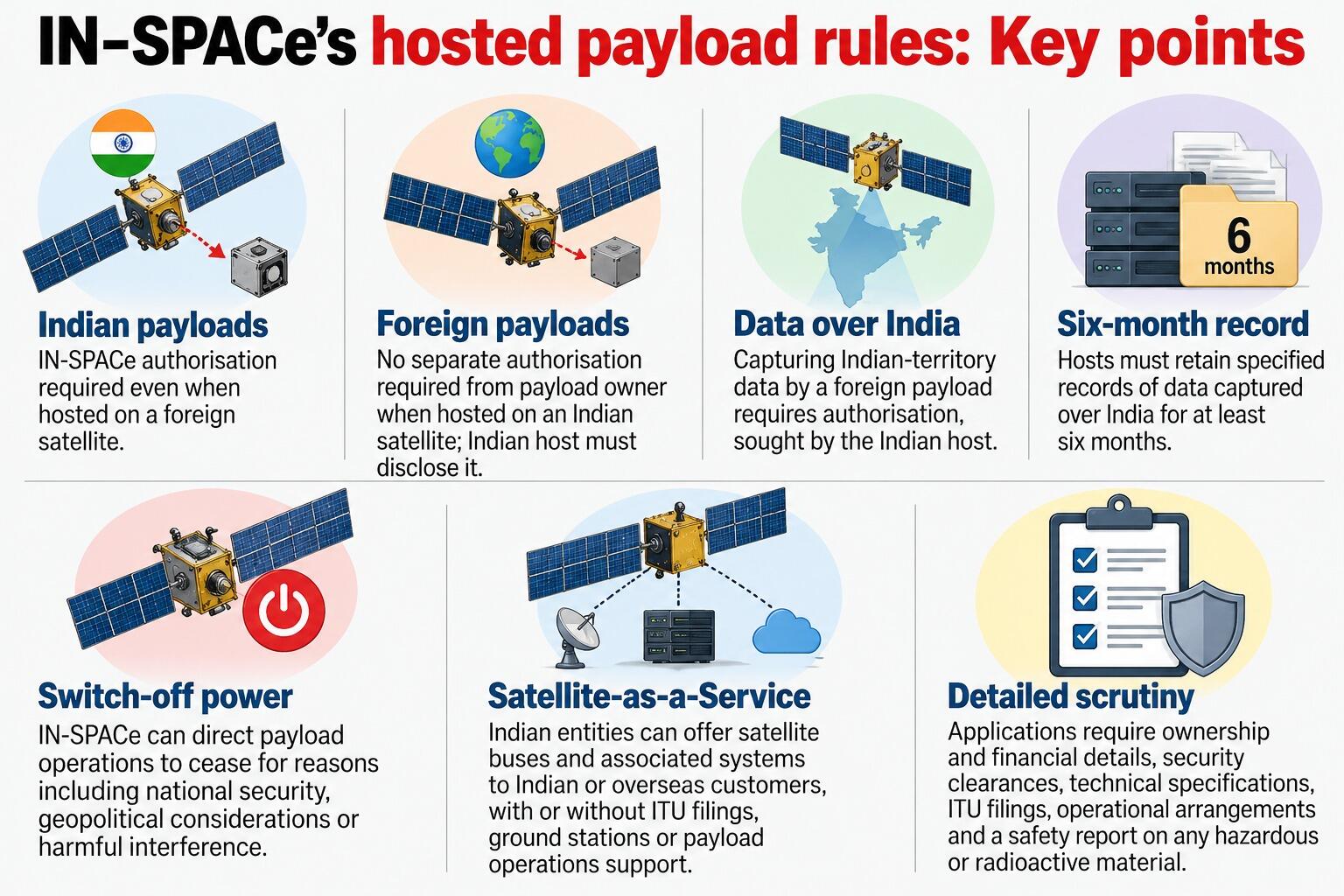
New rules set authorisation and liability norms for hosted satellite payloads
Indian entities placing payloads on Indian or foreign satellites need mandatory IN-SPACe authorisation, for single or multiple payloads including constellations. Authorisation ends with the host agreement or the host satellite’s operational life, whichever is earlier.For Indian payloads on foreign satellites, the owner retains absolute decision-making powers over operations, and the foreign host bears all liability risks and must indemnify the owner and GoI.Foreign payloads on Indian satellites are treated differently. The owner need not separately seek IN-SPACe authorisation. Instead, the Indian host must disclose the payload while applying for authorisation of the host satellite and submit its agreement with the owner. The foreign owner must hold approvals from its own administration and indemnify the host and govt for third-party claims.The host retains control of the satellite and must be able to switch off the hosted payload or cease its emissions if directed by IN-SPACe or govt for reasons including national security, radio-frequency interference or other critical concerns. It must prevent unauthorised access to a payload by itself or other hosted payloads.For foreign payloads capturing data over Indian territory, IN-SPACe authorisation will be required, to be sought by the Indian host. Hosts must maintain records of such data for at least six months, including the area captured (in .kml format), satellite orbit row and path number, and date and time of capture, and provide the information to IN-SPACe when sought.Dissemination of such data must comply with the applicable data-dissemination guidelines, and IN-SPACe can direct the host to switch off the payload if those rules are violated.The framework allows IN-SPACe, in consultation with other departments or ministries, to regulate hosted-payload operations for reasons involving national security, geopolitical considerations or harmful interference with other satellite networks.Applications require disclosures covering ownership and control, foreign investment, financial credentials, security clearances, payload specifications, ITU filings and operational arrangements, plus a safety report on any hazardous or radioactive material. Host-owner agreements must specify how the payload and host will be operated and controlled.