








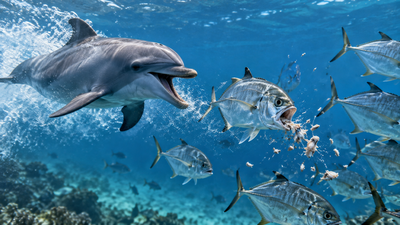
A dolphin named Bubbles has surprised researchers with an unusual way of getting a meal near Lady Elliot Island in Australia’s Great Barrier Reef. Seen in the area since at least 2017, the adult male common bottlenose dolphin has been filmed repeatedly chasing Bigeye Trevally until the fish regurgitate food, which Bubbles then eats. Researchers documented 11 such feeding events between 2021 and 2025, identifying the same dolphin through distinctive markings. The behaviour has been described as kleptoparasitism, in which one animal takes food obtained by another. Scientists say the observations may reveal a specialised and potentially energy-saving feeding tactic in dolphins.
Why does Bubbles chase Bigeye Trevally for food
According to the new study published in Ecology and Evolution, titled ‘Repeated Observations Suggesting Kleptoparasitism by a Common Bottlenose Dolphin (Tursiops truncatus) on the Great Barrier Reef’, the pursuit ends when the trevally regurgitates. Bubbles then stops chasing and eats what was expelled while the fish swims away. According to the researchers, the pursuit ends when the trevally regurgitates food, after Bubbles stops chasing the fish and consumes what it has expelled. The fish then swims away.The behaviour was not observed as a general attack on the trevally. Researchers noted that Bubbles did not feed on the fish themselves and only observed targeting Bigeye Trevally during these interactions. In some cases, the sequence was repeated several times, with the paper recording that it could occur up to 10 times within 30 minutes. The University of the Sunshine Coast reported that Bubbles was observed repeating the tactic over several years.
Why does Bubbles use this strange feeding tactic
According to the University of the Sunshine Coast, the researchers describe the behaviour as kleptoparasitism, meaning the dolphin is taking advantage of food obtained by another animal rather than catching that food directly. Their observations suggest that the repeated pattern may represent a specialised tactic developed by Bubbles. The paper says the behaviour could provide an energetically efficient alternative to independent predation, although the researchers stress that the actual energetic benefit cannot yet be established without further information about the dolphin’s normal foraging behaviour.The researchers also considered whether Bubbles might be selecting trevally that provide a greater food reward. His repeated use of the same tactic over several years supports the possibility that the behaviour was learned rather than simply an opportunistic response during individual hunts. Dr Asia Haines said the repeated behaviour suggested that Bubbles “may have learnt to target the fish with the fullest bellies”, although this remains an interpretation rather than something directly demonstrated by the observations.
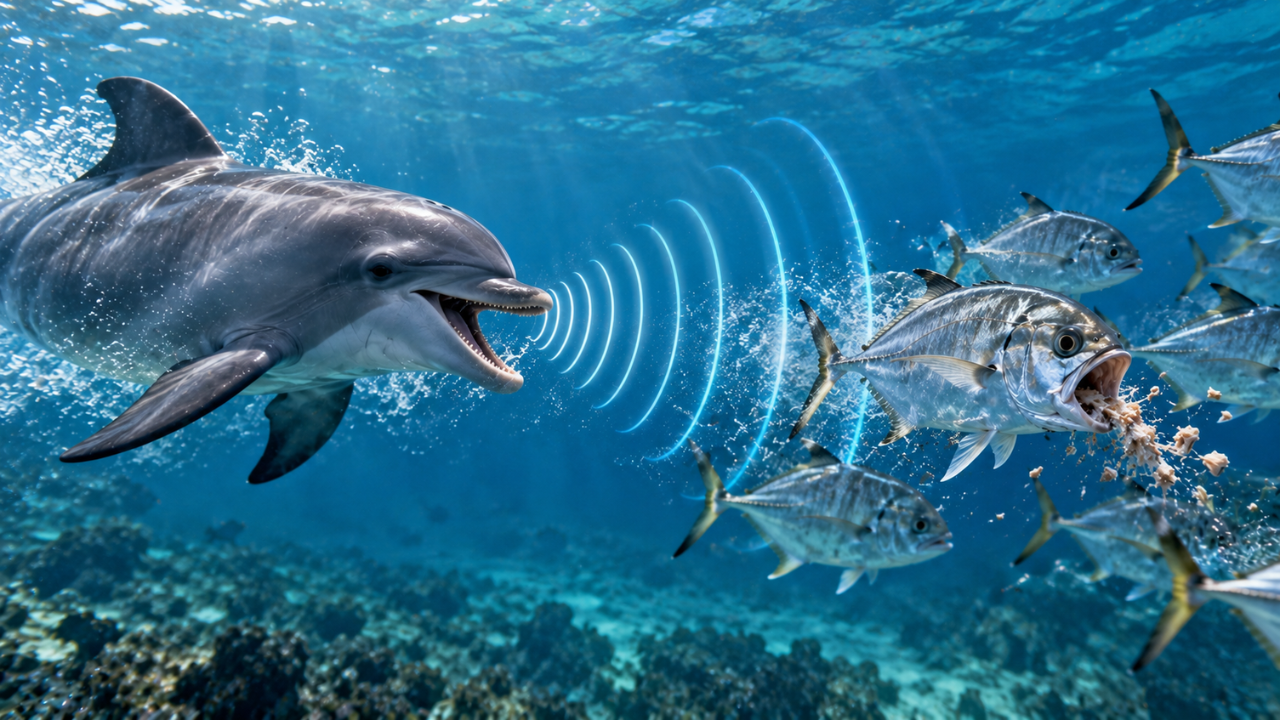
Image AI generated
How does Bubbles use sounds while chasing fish
The researchers also recorded Bubbles producing intense echolocation click trains and low-frequency tonal sounds while pursuing the trevally. They hypothesised that these sounds could contribute to the stress experienced by the pursued fish and potentially help trigger regurgitation. However, the study is careful to describe this as a possibility rather than a confirmed explanation. The authors state that the dataset is limited and that additional observations are needed to determine the function of the low-frequency sounds.The study’s authors say the observations provide the first direct evidence of kleptoparasitism as a foraging tactic in a delphinid. They also caution that similar behaviour could be going unnoticed because underwater hunting is difficult to observe from the surface. The researchers suggest that technologies such as animal-borne cameras and drones could help reveal whether other dolphins use comparable tactics. Romney Edwards-Francis, a UniSC PhD student and study co-author, said the behaviour demonstrates the species’ “adaptability and flexibility” when it comes to foraging.