





An Ontario couple who paid just C$200 for a landscape painting at a rural yard sale in 2001 later discovered that they had bought a work by renowned Canadian artist E J Hughes, literary weboste BC Booklook reported. Six years after the purchase, the painting, Lake Okanagan, was identified as a Hughes work and sold at auction for C$402,500.Hughes, a British Columbia painter’s detailed landscapes have gained major value over the years. His work, once bought for a few hundred Canadian dollars, sells for hundreds of thousands and even millions at auction.Hughes is also the focus of a new documentary by Coquitlam filmmaker Jenn Strom. The Painted Life of E J Hughes looks at the artist’s life, his connection with British Columbia and the quiet way in which he worked. The documentary screened at the VIFF Centre in Vancouver in February.Strom became interested in Hughes while researching British Columbia’s history about seven years ago. Her research led her to the work of author Robert Amos, who wrote about Hughes and his life on Vancouver Island.Strom said she was drawn to the artist because his personality was very different from the public image often associated with artists. “He was humble and painfully shy. He didn’t have it in him to be out there promoting his own work,” Strom told Freshet News.
Hughes’ as a war artist
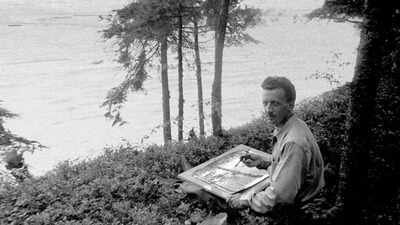
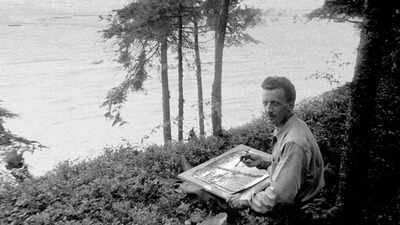
Edward John Hughes was born in North Vancouver on February 17, 1913, and grew up in Nanaimo and North Vancouver. During the Depression, he worked on fishing boats before studying at the Vancouver School of Decorative and Applied Art.One of his teachers was Frederick Varley, a member of Canada’s famous Group of Seven artists. Hughes also later co-founded a commercial art company with muralists Paul Goranson and Orville Fisher in 1934.When the Second World War began, Hughes enlisted with the Royal Canadian Artillery in 1939 and was posted to England. From 1943 to 1946, he worked as one of Canada’s official war artists.His wartime work included detailed drawings and paintings of military life. According to literary webiste BC BookLook, Hughes produced about 1,000 drawings and almost 30 complete paintings during his time as a war artist. Around 1,600 of his works are now held by the Canadian War Museum.His role required him to carefully record military equipment, uniforms, people and their surroundings. The detailed observation involved in that work later became an important part of his approach to painting landscapes.
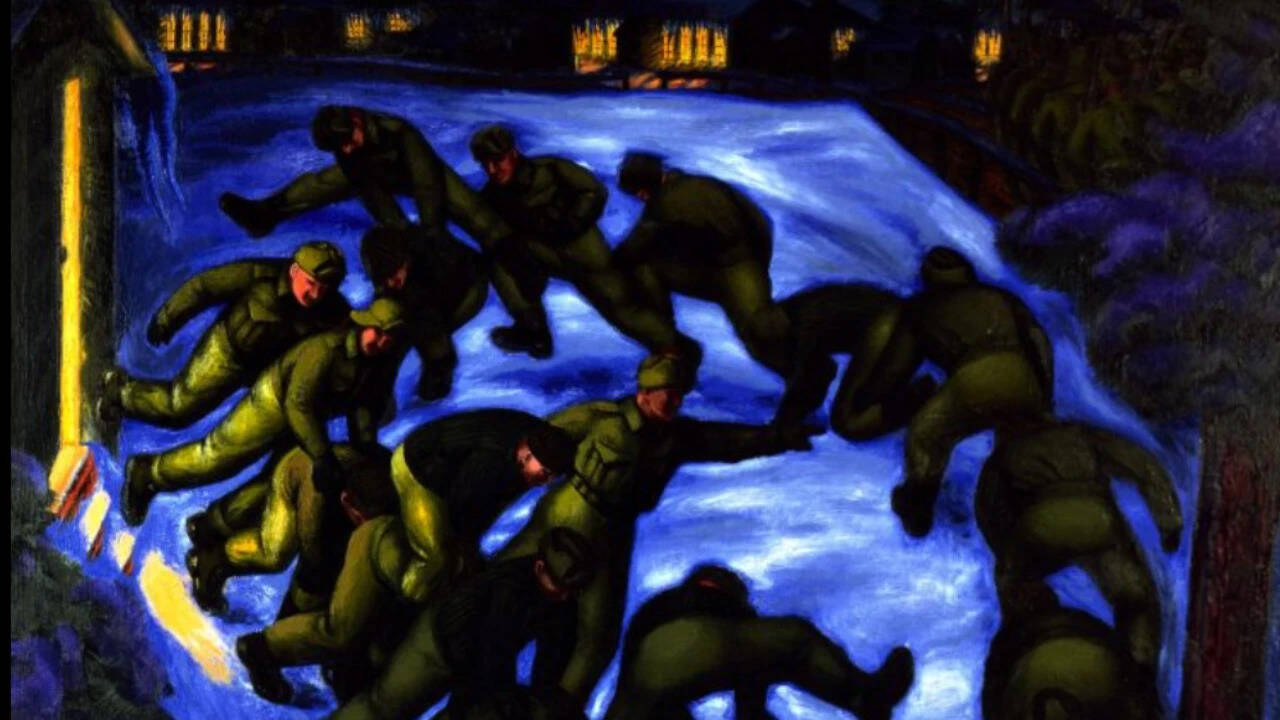
Hughes’ wartime work included detailed drawings and paintings of military life
A quiet life on Vancouver Island
After returning to the West Coast in 1946, Hughes settled at Shawnigan Lake with his wife, Fern. Strom filmed the area and the home where the artist lived while making her documentary. “He needed silence. Peace and quiet,” Strom said.Hughes spent much of his career focusing on the landscapes of British Columbia. He was deeply interested in nature and in recording places with careful detail.“I feel that, when I am doing my painting, it is a form of worship,” Hughes said in a 1961 CBC television production.Hughes had also considered whether to focus more on figures or landscapes, but eventually chose landscapes because he felt they represented the British Columbia and Canadian environment strongly and would sell more readily.Despite his growing reputation, he struggled financially at one stage and nearly gave up painting. His career received important support from art dealer Max Stern, who had previously represented Emily Carr.Stern tracked Hughes down at Shawnigan Lake in 1951 after receiving advice from Lawren Harris, a founding member of Canada’s Group of Seven. He later recalled meeting a shy artist who was not fully aware of the quality of his own work. Stern decided to represent him.After their first meeting, Stern bought all the work then available in Hughes’ studio for $500. The relationship helped Hughes build a stronger career while also giving him support in dealing with the public and the art market.
From C$200 yard sale find to millions
The value of Hughes’ work increased significantly as his reputation grew. His painting Lake Okanagan is one of the most striking examples. Bought at an Ontario yard sale for C$200 in 2001, it was sold for C$402,500, six years later.The price was part of a wider rise in the value of Hughes’ paintings. BC BookLook noted that Rivers Inlet sold for $920,000 in 2005, then the highest price paid for a work by a living Canadian artist.Other works have reached even higher prices. Hughes’ Fishboats, River Inlet sold for $2 million at Heffel Auction. In November 2025, his 1949 painting Entrance to Howe Sound sold for $4.8 million.Strom said Hughes’ story continues to attract attention because of the strength of his work and the contrast between his quiet personality and the growing value of his paintings. “His story keeps growing,” she said.