








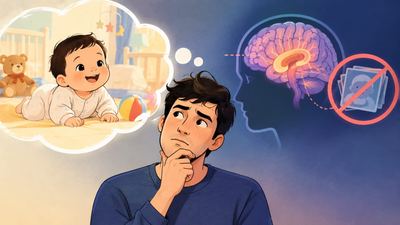
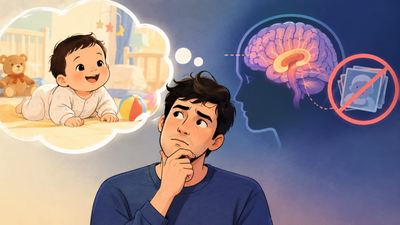
Most people cannot remember their first birthday, their first steps or the days they spent learning to speak. Even though those years shaped the rest of their lives, the memories usually disappear from conscious recall. This is known as infantile amnesia, or childhood amnesia. It refers to the lack of clear, personal memories from the first years of life. Most adults remember very little from before the age of three, while memories from the years between three and seven are often incomplete. But this does not mean babies have no memory.
Babies can remember things but…

Even though those years shaped the rest of their lives, the memories usually disappear from conscious recall.
For a long time, scientists believed that infants could not form lasting memories because their brains were still developing. Research has challenged that idea. A 2025 study published in the journal Science found that babies can encode information linked to episodic memory, the type of memory used to recall a specific event. Researchers from Yale University studied 26 infants between four months and two years of age. The babies were shown pictures of faces, objects and scenes. Later, they were shown the same picture alongside a new one. Researchers measured how long the babies looked at the familiar image and used functional MRI scans to study activity in the hippocampus, a brain region involved in memory.The study found that when the hippocampus was more active while a baby first saw an image, the baby was more likely to recognise it later. The findings suggested that infants can form memories even though adults may not be able to retrieve those memories years later. The research changed an important part of the discussion. The problem may not be that babies fail to create memories. It may be that those memories become difficult to access as the brain develops.
What is infantile amnesia?
Infantile amnesia is not the same as the memory loss caused by an injury or illness. It is a normal part of human development.A review published in Behavioral and Brain Sciences explained that adults generally cannot recall autobiographical events from infancy and have only scattered memories from early childhood. The review also found that infants are capable of learning and remembering, which makes the disappearance of early memories a more complex question. Researchers said infantile amnesia is unlikely to have just one cause. The development of several brain regions, changes in the connections between them and changes in brain chemistry may all contribute.The word “amnesia” can sound alarming, but infantile amnesia is common. It does not mean that a person has a damaged memory system.
The ‘hippocampus’ is still developing
One major part of the explanation involves the ‘hippocampus,’ a seahorse-shaped structure deep inside the brain. The hippocampus helps people form and retrieve memories of events. It also helps connect different details of an experience such as where something happened, who was present and what happened next. The hippocampus develops throughout childhood. Its development is not the only factor involved in memory, but researchers believe that changes in this region affect how early experiences are stored and later retrieved.A 2020 review in Child Development Perspectives found that the development of the hippocampus, the cerebral cortex and the connections between these regions contributes to the fragility of early memories. The researchers noted that memories formed during childhood are forgotten more quickly than memories formed later in life. This may help explain why a person can remember an event from school at the age of six but cannot recall being carried as a baby.
The brain changes rapidly during the first years

Researchers have also found that early experiences may affect later behaviour even when a person cannot consciously remember the original event.
The first years of life are a period of fast brain development. New connections form between nerve cells, some connections become stronger and others are reduced. One theory is that this constant change makes early memories less stable. As the brain reorganises itself, the networks involved in storing and retrieving memories also change.A study published in ‘Science’ found that increasing the production of new neurons in adult mice could make older memories harder to recall. Slowing the process in young mice improved their ability to retain memories over longer periods. However, this does not prove that the same process fully explains infantile amnesia in humans. Animal research offers clues, but human memory develops in a more complex social and language environment.
Language may help turn experiences into lasting memories
Another possible explanation is language. A baby may remember a familiar face, a sound or a repeated routine without being able to describe the experience. Adults, however, usually recall personal events in the form of a story: where they were, what happened and how they felt. As children learn language, they become better at organising experiences into narratives. Parents also begin asking questions such as: What did you do today? Who came to your birthday party? What happened at school? Do you remember visiting Grandma?These conversations may help children practise remembering and describing past events. Research has found that children whose parents discuss past experiences in greater detail often develop more detailed autobiographical memories. A review on infant memory development also identified language, social interaction and the development of a personal sense of self as important factors in the growth of autobiographical memory.Language is not the only explanation, though. Babies can form memories before they can speak, as the 2025 Yale research also suggests.
We remember skills even when we forget events
Not all early memories disappear in the same way. There is a difference between remembering an event and remembering how to do something. Psychologists often describe these as episodic memory and procedural memory. Episodic memory helps us recall a particular event, such as a birthday party or a visit to a park. Procedural memory helps us perform learned actions, such as riding a bicycle, swimming or using a spoon.A person may not remember learning to walk, but the body retains the ability to walk. Similarly, a child may not remember learning a language, but the knowledge remains part of everyday life.
Early experiences can still affect us
The absence of a clear memory does not mean that early experiences have no lasting effect. Early relationships, stress, care, learning and the surrounding environment can influence development. Researchers have also found that early experiences may affect later behaviour even when a person cannot consciously remember the original event.
Can forgotten baby memories be recovered?
Scientists are investigating whether some early memories remain in the brain in a form that cannot normally be accessed. In 2023, researchers studying mice reported that apparently forgotten early memories could be brought back by stimulating specific groups of neurons connected with those experiences. The study suggested that some memories may leave behind a neural trace even when they cannot be recalled normally. The findings do not mean that adults can recover their own baby memories through a simple technique. The research was conducted in mice, and it does not establish that human childhood memories can be restored in the same way.For humans, a photograph, family story or familiar smell may create a strong feeling of recognition. But that feeling does not always prove that the person has recovered an accurate memory from infancy. Memories can be reconstructed and influenced by information learned later.So, the reason we do not remember being babies is not simply that babies have no memories. Their brains are already learning, recognising and recording experiences. As the brain develops, however, many of those early memories become difficult or perhaps impossible for the adult mind to retrieve.