









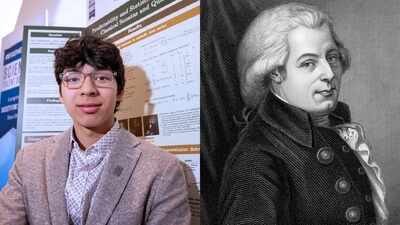
Mozart’s versatility is unparalleled, even today. Ever wondered what made him the ultimate musical architect, with every phrase perfectly placed and every note seemingly inevitable? Well, an 18-year-old from Philadelphia may have found the answer! Linus Chen-Plotkin analysed more than 600 classical compositions and discovered something that musicologists have debated for centuries but never quite quantified. Wolfgang Amadeus Mozart’s melodies are actually harder to predict than those of any other musician, including Beethoven and Schubert.
Teen proves Mozart’s music is unpredictable

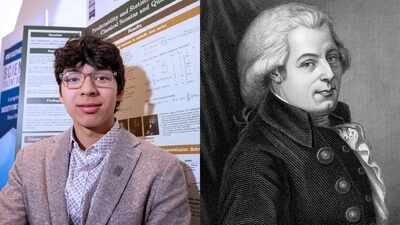
For his Regeneron Science Talent Search project, Linus built three statistical tests to measure something he calls a melody’s ‘memory’. His project, ‘Predictability and Statistical Memory in Classical Sonatas and Quartets’, was to find out how much earlier notes influence the ones that come after. The ‘memory’ tracks how much one note depends on the notes before it. High memory means earlier phrases keep influencing what comes next, making it more predictable. Low memory means the composer pivots quickly, keeping listeners slightly off-balance.The teenager ran these tests across 600-plus piano sonatas and string quartets by Joseph Haydn, Wolfgang Amadeus Mozart, Ludwig van Beethoven, and Franz Schubert. What he found was striking. Mozart’s music had shorter memory across all three tests, which means his melodies broke patterns faster. They were less predictable. Mozart honoured classical form while constantly slipping something unexpected past the listener’s ear. In other words, perfection in Mozart’s case didn’t mean predictability; it meant something far harder to achieve.Linus’ findings finally provide an answer to understanding Mozart’s works. For centuries, critics have thrown around words like ‘genius’ and ‘innovation’ without pinning down what they mean. Linus gave us a way to climb closer to the answer. The unpredictability is what made Mozart the genius he was. An 18-year-old wrestler from Philadelphia picked up statistical tools and told us something new about how Mozart’s mind worked. Perhaps Mozart would have enjoyed that twist.
Meet Linus Chen-Plotkin

Pic credit: Society for Science/Chris Ayers Photography
Born to Joshua Plotkin and Alice Chen-Plotkin, Linus hails from Philadelphia, PA. He is a student at the Germantown Friends School. He’s a varsity wrestler and an advanced Mandarin student. He is not a classical music prodigy who spent his childhood at conservatories, but he knows its mathematics. During the statistical analysis, he approached classical music as a dataset. He saw centuries of musical tradition as raw material for mathematical investigation. He believes his approach and other quantitative methods can help improve the understanding of areas that are typically studied qualitatively. Think music theory, art history, and literature. All these fields have relied on interpretation for centuries, but Linus thinks they don’t have to stay that way. Music is not really alien to him. In fact, he also sings and plays blues guitar at The Twisted Tail bourbon bar during his spare time. While he isn’t neck-deep in work, he doubles as a radio operator. Linus is also a licensed amateur radio operator and a former member and soloist of the Philadelphia Boys Choir & Chorale. Few people his age have taken so many different angles on the same art form!
Beyond the project
Linus isn’t stopping at the musical memory. He plans to go beyond. He’s collaborating with a Johns Hopkins professor on analysing the grammatical rules of rhyme and metre in Geoffrey Chaucer’s medieval poetry. He will be using the same approach on poems that belong to different centuries. The question is almost the same. Can we measure what makes great writing work? How does a poem resonate with the reader? What makes the best works the best?