








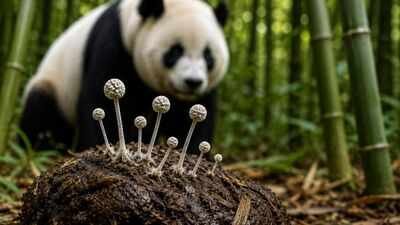
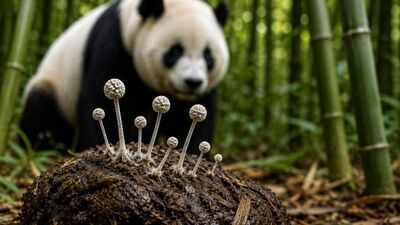
Scientists have identified a previously unknown species of fungus after isolating it from the faeces of a giant panda. Named ‘Mucor melanoleucus,’ it belongs to a group of fungi commonly found in soil and decaying organic material. To work out exactly where it belonged, researchers examined its physical features, observed how it grew under different conditions and analysed its DNA. The results showed that the fungus was closely related to another known species, yet different enough to be recognised as new to science. The finding also highlights the variety of microscopic life that can exist in animal waste, an environment that may seem unremarkable but can support a wide range of organisms. It adds to scientific knowledge of fungi associated with dung and shows that species new to science can sometimes turn up in the most unexpected places.
How did giant panda poop reveal a fungus never seen before
The fungus was described in a study published in ‘Current Microbiology.’ According to the study, researchers isolated the organism from the faeces of the giant panda, and named it Mucor melanoleucus. Animal dung can support a wide variety of microorganisms, including fungi. The study describes ‘Mucor’ as a species-rich group whose members are mainly found on dead organic material, particularly in soil and dung. The researchers did not identify the fungus as a new species based on a single test. Instead, they examined its physical characteristics, carried out physiological experiments and studied its genetic relationship with other members of the group. Together, the results showed that the fungus did not fit within any existing species.
How DNA analysis helped confirm the fungus as a new species
Genetic analysis was a key part of the identification process. The researchers examined two regions of ribosomal DNA and compared them with those of other members of the group. According to the study, the fungus was closely related to ‘Mucor saturninus.’ Despite that close relationship, however, the two species showed several important physical differences. The newly described fungus had smaller sporangia, the structures that produce spores, and smaller columellae, which are found within those spore-producing bodies. Its sporangiospores, on the other hand, were larger than those of M. saturninus.The researchers also reported that zygospores, specialised reproductive structures found in some fungi, were absent. When considered alongside the genetic evidence, these physical differences supported the classification of this new fungus as a separate species. According to the study, the work also contributes to knowledge of early-diverging fungi, especially those associated with animal dung. Habitats such as these may contain species that have not yet been formally recognised. The giant panda faeces were the starting point for the research, while lab experiments and genetic comparisons helped researchers determine exactly what they were looking at.
An unusual fungus adds to the hidden diversity of fungi
The study of ‘Mucor melanoleucus’ offers another example of the many environments in which fungi can occur. The researchers noted that members of the genus ‘Mucor’ can have both ecological and practical importance. Some species in the group are used in industries including food and pharmaceuticals, while others can cause ‘mucormycosis,’ a type of fungal infection. The newly described fungus has not been linked to any specific practical use or harmful effect. For now, its importance lies in expanding scientific knowledge of fungal diversity.The research also draws attention to animal dung as a habitat for microorganisms. Examining such environments can help scientists better understand fungal diversity and the relationships between different species. In this case, a sample from a giant panda provided the material for a closer look at a previously unknown fungus.