










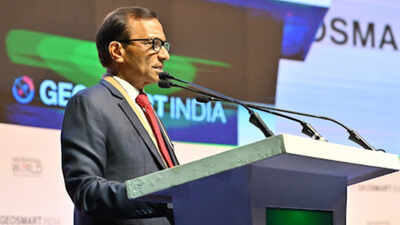
Two days after employee associations representing thousands of Isro staff sought a formal written clarification on Isro’s future, Pawan Goenka, chairman, Indian National Space Promotion and Authorisation Centre (IN-SPACe) said that Isro will remain the “bedrock of the Indian space sector”.“…Let me say it unequivocally: Isro’s role is by no means diminishing. It will remain the bedrock of the Indian space sector. The reforms since 2020 are about expanding India’s overall space ecosystem. IN-SPACe will facilitate and authorise greater non-govt participation, while NSIL will help commercialise mature capabilities,” he said in a statement.His statement about Space PSU NSIL helping commercialisation of mature capabilities comes at a time when IN-SPACe has been announcing Expressions of Interest (EoIs) and plans to transfer technology to the private sector.In fact, IN-SPACe had even announced an EoI inviting private industry to operate the proposed second spaceport in Kulasekarapattinam in Tamil Nadu, once it has been developed by Isro and the Department of Space.The joint representation by Isro employees had pointed to a recent public statement made by Goenka on Isro eventually “not manufacturing any launch vehicles”, they asked if his statement “represents an approved decision of the Govt of India, Space Commission or DoS… If approved, the date, authority and text of the policy decision may kindly be indicated.”
Share your thoughts in the comments
Be respectful · TOI community guidelines
“The idea is to let industry increasingly manufacture and scale mature launch vehicles, satellites and other systems, while Isro focuses on what it is uniquely placed to do: advanced R&D, scientific missions, strategic missions, new technologies, and infrastructure that is too complex for the private sector to develop on its own,” Goenaka said.He said Isro will remain at the core of India’s space programme leading frontier research and the next generation of national missions, including the Bharatiya Antariksh Station by 2035, an Indian crewed mission to the Moon by 2040, next-generation launch systems, and sustained lunar and planetary exploration.“The direction is not a smaller Isro. It is a larger Indian space ecosystem, with Isro pushing the technological frontier,” he added.