






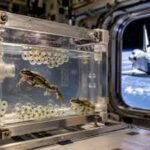

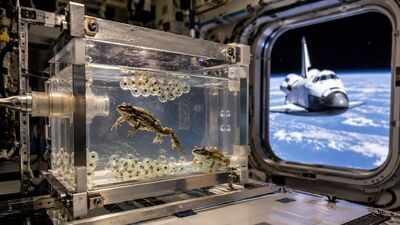
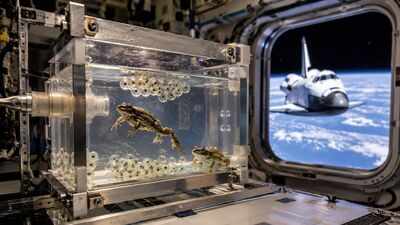
For a developing frog embryo, gravity is more than the force that keeps it on the ground. It can provide a reference for how the egg is oriented as development begins, helping establish the direction in which the embryo will form. Nasa wanted to find out what would happen if that reference disappeared. During a 1992 Space Shuttle mission, live frogs were taken into orbit and stimulated to produce eggs during the flight.According to Nasa Open Science Data Repository (OSDR), those eggs were then fertilised in space and placed in chambers where they could develop under microgravity. A second group was kept in a centrifuge, giving the embryos an Earth-like 1g environment for comparison. Scientists followed the embryos through their early stages, examining their structure after development and observing the behaviour of the tadpoles that emerged. The experiment offered a rare opportunity to watch amphibian development unfold without the constant pull of Earth’s gravity.
Nasa used frog embryos to test gravity’s role in development
The work came from a Nasa investigation led by Kenneth Souza, titled “Effect of Weightlessness on Development of Amphibian Eggs”. The experiment was managed through Nasa’s Ames Research Center and fell within developmental biology.Amphibian eggs were useful for this kind of research because their early development is comparatively easy to observe. Fertilisation sets off a sequence of changes in which the egg divides and reorganises itself. Scientists were particularly interested in the animal-vegetal axis of the egg, an arrangement that can shift after fertilisation on Earth as the egg responds to gravity.There was a broader developmental question behind the experiment. If gravity influences the orientation of an amphibian embryo, would removing that environmental cue interfere with the formation of its body plan? The shuttle provided a way to test that directly.
The experiment began with eggs produced in space
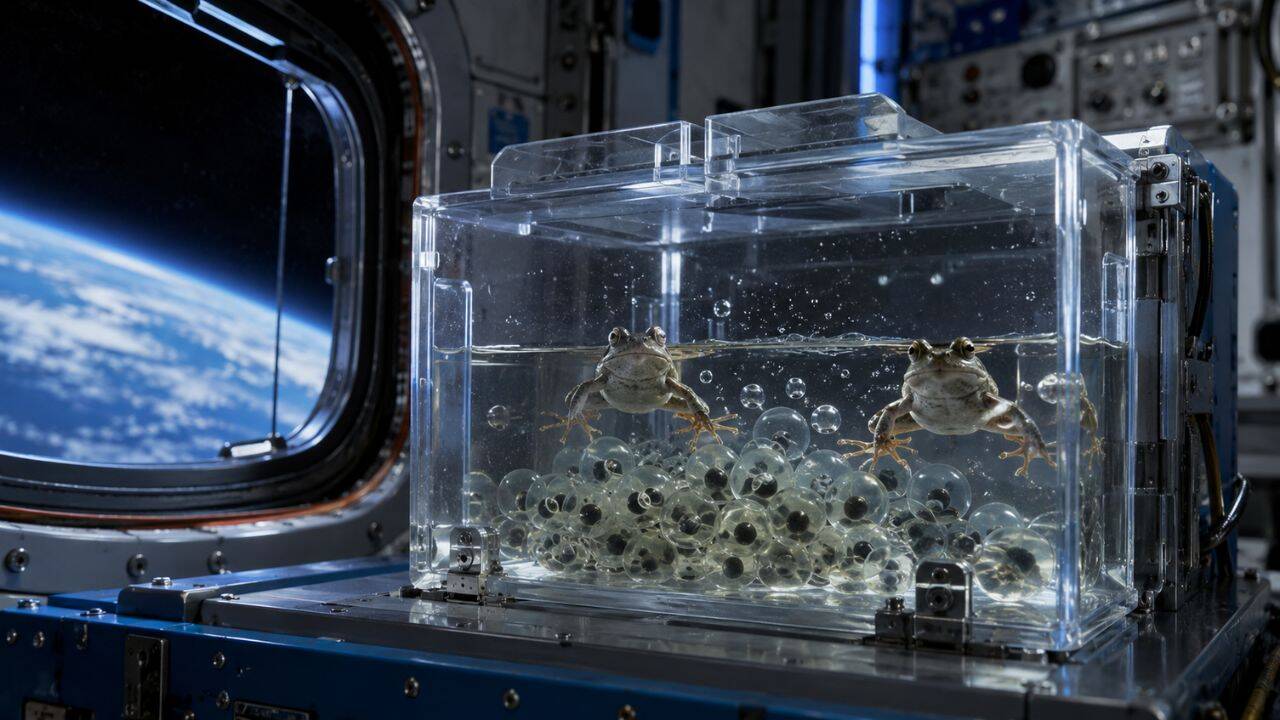
The frogs did not simply accompany a batch of eggs prepared on Earth. Hormones were used during the mission to stimulate the animals to lay eggs. The frogs received injections of human chorionic gonadotropin about 18 hours into the flight.The eggs were then collected and fertilised using sperm that had been prepared before launch and kept refrigerated until it was needed. Once fertilised, the eggs were placed inside chambers containing a dilute Ringer’s solution, allowing the embryos to develop while the spacecraft was in orbit.The experimental design included a useful comparison. Some eggs were placed in the shuttle’s Flight Experiment Unit centrifuge, where they experienced approximately 1g. Others remained in the microgravity portion of the apparatus.The scientists were not simply comparing ‘space’ with ‘Earth’. They had a group developing under simulated Earth gravity and another exposed to microgravity during the same flight.
The first signs of development looked largely normal
The first stages did not reveal the kind of disruption that might have been expected from removing gravity.Both groups had high rates of fertilisation. When the embryos reached the two-cell stage, the cleavage furrow; the indentation that separates one cell into two appeared in the expected position in both sets of embryos.As development continued into gastrulation, the embryos still did not show obvious external abnormalities. There were differences under closer examination, though. The embryos developing in microgravity had thicker blastocoel roofs, while the blastopore lip appeared at a somewhat different position along the egg’s vegetal side.These were real developmental differences, but they did not stop the embryos from progressing.By the neurula stage, development had continued without an obvious impairment. Fixed neurulae and tadpoles examined after the flight appeared normal.
Microgravity posed a problem after the embryos developed
The most important complication emerged when the tadpoles were examined after landing.Some of the tadpoles that had developed in microgravity had lungs that had not inflated. The experimental chambers contained air bubbles, but the young animals apparently did not locate the boundary between the air and water that they needed to reach in order to fill their lungs.It was not simply a matter of an embryo failing to form correctly. The animals had reached the tadpole stage, but a behaviour associated with the physical environment around them had become a problem.Without inflated lungs, the tadpoles would not have been able to proceed normally through the later stages required for complete growth and metamorphosis. Microgravity did not simply prevent amphibian embryos from developing. Much of the early programme continued. The difficulty came later, when the developing animals needed to interact with their surroundings in a way that depended on finding the air-water interface.
The tadpoles’ visual response changed after spaceflight
The experiment included a behavioural test as well as anatomical observations. Nasa scientists examined the tadpoles’ optomotor response; their tendency to track a moving visual stimulus. The flight tadpoles produced stronger responses than the control animals.One possible explanation was linked to the loss of gravity as a directional cue. On Earth, a tadpole has access to several kinds of information about its orientation, including gravitational information. In microgravity, that reference is greatly reduced. Visual cues may therefore have played a larger role in helping the animals determine how they were positioned.By nine days after the flight, the stronger optomotor response seen in the space-flown tadpoles had disappeared.
What the frogs revealed about development
The early embryos were capable of fertilisation and continued through major stages of development despite being raised in microgravity. There were measurable changes in their embryonic organisation, but these did not prevent them from reaching the neurula and tadpole stages.At the same time, the experiment exposed a problem that was easy to miss if development were judged only by the appearance of the embryo. A tadpole can look broadly normal while still facing a serious environmental challenge. In this case, the absence of a familiar gravitational reference appeared to matter when the animals needed to locate the surface and inflate their lungs.