








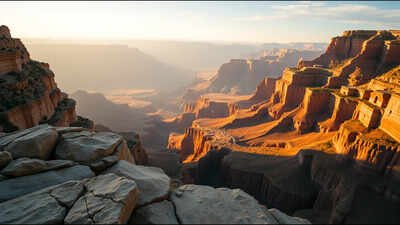
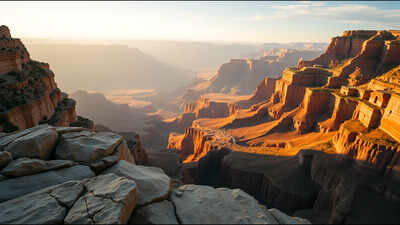
The Grand Canyon exposes roughly 2 billion years of Earth’s geological history, but more than half of that record is missing. Geologists call the enormous gap the Great Unconformity, a boundary where rocks representing more than a billion years of geological time are absent. The mystery has persisted for more than a century, with scientists proposing ancient erosion, tectonic upheaval and glaciation as possible explanations. Now, a study led by Thomas Gernon of the University of Southampton offers a way to connect those ideas: a colossal escarpment that may have formed across ancient North America as the supercontinent Rodinia began breaking apart around 800 million years ago. The researchers estimate the escarpment could have stood roughly 1 kilometre high and extended for thousands of kilometres. As it gradually retreated inland, erosion may have stripped away up to 8 kilometres of rock in places, leaving the ancient crystalline basement exposed. Later glaciation could then have removed additional material, helping produce the enormous gap preserved in the Grand Canyon today.
How researchers reconstructed the Great Escarpment of Laurentia
The study, titled Exhumation of Grand Canyon’s basement along the Great Escarpment of Laurentia, was published in Geology. The researchers combined plate-tectonic reconstructions with models of landscape evolution to investigate how western North America changed as Rodinia began to fragment. Their reconstruction suggests that a major escarpment developed along the margin of the ancient continent Laurentia, which included much of what is now North America. The proposed escarpment extended across a vast area corresponding to parts of modern Arizona, Utah, Idaho, Wyoming, Colorado, Texas, Oklahoma, Arkansas, Missouri and Illinois, making it a continental-scale feature rather than a landscape confined to the Grand Canyon.
Why a retreating cliff could erase more than a billion years of geological history
A major escarpment does not necessarily remain fixed in one place. Erosion gradually wears down its slopes while rivers transport sediment away, allowing the steep boundary between highland and lowland to retreat inland over geological time. The researchers argue that the proposed Great Escarpment of Laurentia behaved in a similar way. As Rodinia began breaking apart, tectonic forces created steep, elevated terrain that was particularly vulnerable to erosion. Over tens of millions of years, that erosion could have removed up to 8 kilometres of rock in some areas, exposing much older basement beneath it. That process could account for a substantial part of the Great Unconformity, but the researchers do not present erosion from the escarpment as the only process involved. Their model also helps reconcile the idea with earlier research pointing to intense glaciation during the so-called Snowball Earth period. A high, steep landscape created by continental rifting would have provided glaciers with terrain that could be especially effective at eroding and transporting rock. In this view, tectonic uplift and escarpment retreat created the conditions, while later glaciation helped remove and redistribute more of the exposed material.
What the ancient escarpment may reveal about Death Valley and the surrounding landscape
The researchers also identified features beyond the Grand Canyon that fit their reconstruction. Their model places Death Valley within a lower-lying basin associated with the ancient escarpment, where sediment could accumulate as material eroded from surrounding high ground. The proposed landscape would also have influenced drainage patterns and the movement of sediment across the continent as North America changed during the breakup of Rodinia. Those changes occurred hundreds of millions of years before the Colorado River began carving the modern Grand Canyon. The geological record preserved in the region therefore contains evidence of several very different landscapes occupying roughly the same area over immense spans of time: ancient mountains and escarpments, eroding highlands, glaciated terrain and eventually the canyon landscape familiar today.
Why modern escarpments provide clues to a landscape that disappeared 800 million years ago
One reason the proposed ancient landscape is difficult to reconstruct is that the escarpment itself no longer exists. Researchers therefore looked to modern examples for clues about how such features evolve. Large escarpments in places such as South Africa and Brazil show how steep continental landscapes can gradually retreat through erosion over immense periods of time. Their modern behaviour provides a useful comparison for understanding what may have happened along the ancient margin of Laurentia. The study does not claim to have solved every aspect of the Great Unconformity. Instead, it offers a framework that connects several processes previously considered separately: the breakup of Rodinia, the creation and retreat of a huge continental escarpment, intense erosion and the later effects of glaciation. Together, those processes could explain how kilometres of rock were removed and why more than a billion years of Earth’s geological record are missing from one of the world’s most famous landscapes.