










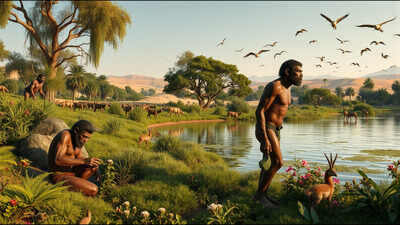
A new study suggests Neanderthals may have trekked far deeper into the Arabian Peninsula than scientists previously thought possible, reaching a lakeside site in what is now Saudi Arabia around 55,000 years ago. Researchers examined stone tools from Jebel Katefeh 1, a site beside an ancient lake near the city of Jubbah in the Nefud Desert. No Neanderthal bones or DNA have ever been found in Arabia, so the team relied on the shape of stone flakes to identify who made them. Using a statistical model built from sites with well-established toolmakers, researchers found the tools far more closely resembled those made by Neanderthals than by early Homo sapiens toolmakers nearby. New dating work narrowed the age of the site to about 55,000 years, a period when the desert was becoming wetter and greener, and Neanderthals were the only hominin group known to inhabit southwest Asia at that time.
How researchers identified Neanderthal stone tools in the Nefud Desert
Lacking bones or ancient DNA, the research team turned to the physical shape of stone flakes struck from carefully prepared cores, a technique that can preserve distinctive differences between toolmaking groups. The findings, published in the study Neanderthals in the desert? Population history best explains Middle Palaeolithic technological heterogeneity in Arabia, describe how the team measured hundreds of flakes from Jebel Katefeh 1 and a smaller nearby site called ALM 3. Researchers then compared them statistically against tools from other locations across Arabia, the Levant and northeast Africa where the identity of the toolmakers was already established. This comparison allowed the researchers to build a model capable of distinguishing patterns associated with Neanderthal toolmaking from those associated with early Homo sapiens. Because no human remains were recovered from Jebel Katefeh 1, the statistical analysis is central to the study’s argument that Neanderthals, rather than another hominin population, were responsible for producing the tools.
Why the discovery pushes the Neanderthal range farther south than expected
Neanderthals have traditionally been associated with Europe and other relatively cool environments, but archaeological discoveries over the past two decades have substantially expanded their known geographical range. Evidence has placed Neanderthals thousands of miles eastward into Siberia and across parts of the Middle East, while the new study suggests they may also have ventured deep into the Arabian interior. Establishing when people occupied Jebel Katefeh 1 was therefore crucial. Researchers excavated a new trench and used optically stimulated luminescence, a dating technique that measures when mineral grains were last exposed to sunlight, to establish the age of the sediment. The tools were recovered from a layer marking a transition between older desert sand and younger lake sediment, placing the occupation at a time when environmental conditions were changing. Around 55,000 years ago, parts of Arabia periodically became substantially wetter than they are today, creating lakes, grasslands and other habitats capable of supporting large populations of grazing animals. Those temporary green conditions may have opened routes through landscapes that are now among the driest places on Earth.
What outside experts think about the evidence for Neanderthals in Arabia
Independent archaeologists have described the evidence as compelling, while emphasising that the identification remains based on indirect archaeological evidence rather than human remains. Knut Bretzke, an archaeologist at the University of Tübingen who was not involved in the research, said the case for a Neanderthal presence in northern Arabia was strong and suggested that wetter conditions could have attracted grazing animals into the desert interior, potentially providing a reason for Neanderthals to follow them. He also noted that several sites used in the statistical comparison were surface sites, meaning their stone tools could have accumulated over extended periods rather than representing a single occupation. That limitation makes the precise interpretation of technological differences important. Study co-lead author Huw Groucutt, an archaeologist at the University of Malta, has likewise acknowledged that a Neanderthal fossil would provide much stronger confirmation. However, bones and ancient DNA are particularly difficult to preserve in Arabia’s harsh environment, leaving stone tools as one of the few surviving traces of human activity. If the interpretation is correct, the Jebel Katefeh evidence suggests Neanderthals were capable of travelling much farther into Arabia’s changing landscapes than previously documented, following temporary lakes and wildlife across an environment that today appears almost completely inhospitable to human settlement.