









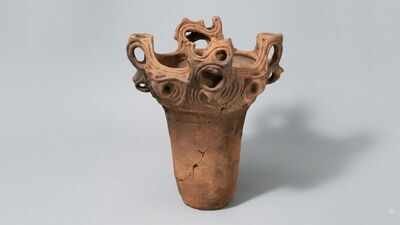
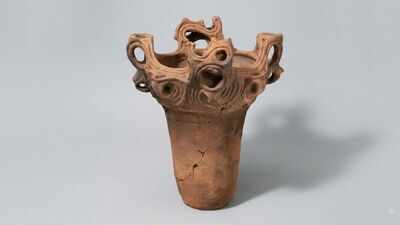
A striking clay vessel from ancient Japan appears as flames are rising from its rim. Known as the ‘Flame-Style’ deep pot, or Kaen doki, the vessel dates to the Middle Jōmon period, between 3500 and 2500 BCE. It was made from earthenware and decorated with cord-marked and incised patterns. Unlike a plain vessel, it has a tall body and an elaborate mouth formed by four groups of sculptural shapes that project forwards. The maker built these forms by coiling clay, then pierced them with openings and added smaller coils. Today, the carefully restored pot is part of The Metropolitan Museum of Art’s collection in New York. Its striking form and detailed construction offer a close look at the skill of Jōmon ceramic makers and the elaborate forms they created thousands of years ago.
What makes the Flame-Style deep pot a striking Jōmon vessel
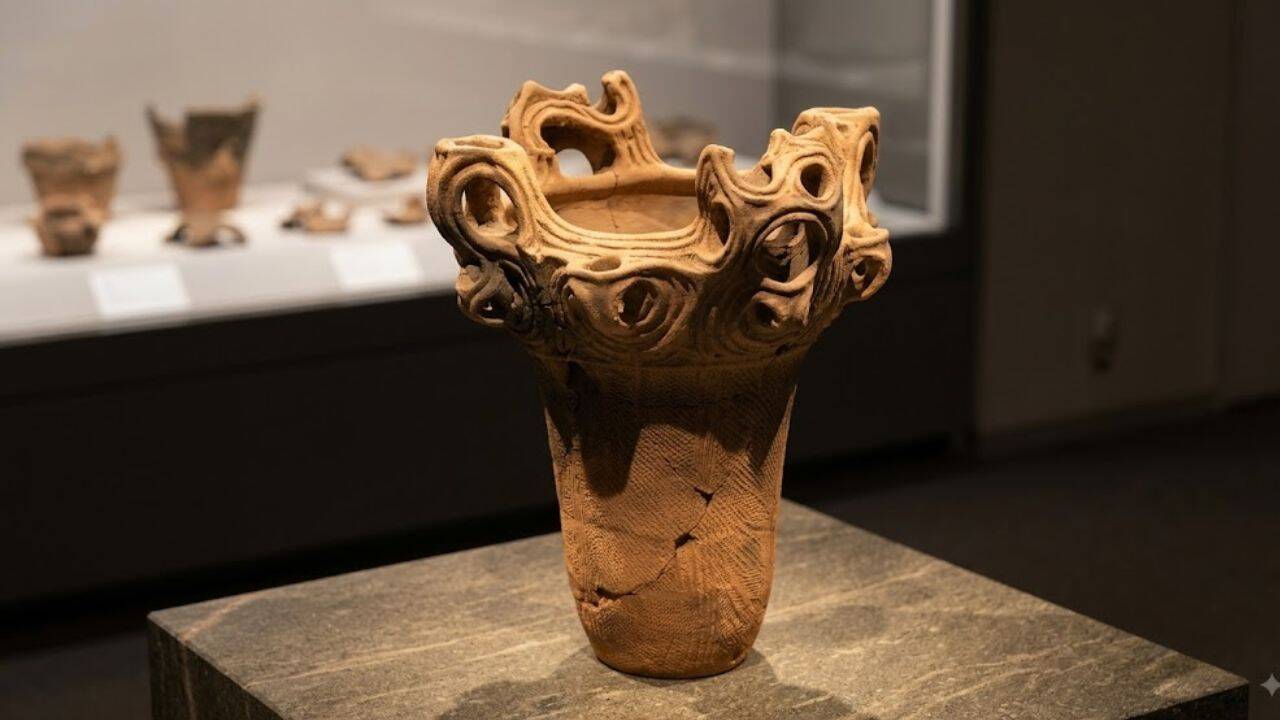
The ‘Flame-Style’ deep pot stands out because of the dramatic shape of its mouth. The vessel has a tall, flat-based body that widens slightly towards the top, while the upper section opens into four groups of sculptural forms. These shapes project forwards from the rim rather than forming a simple circular edge. The result is an elaborate silhouette that gives the vessel its distinctive flame-like appearance. The Met identifies it as a Middle Jōmon-period object from Japan, dating to 3500–2500 BCE. It measures 53.1 centimetres in height and is classified as an earthenware ceramic with cord-marked and incised decoration.
What makes the Flame-Style deep pot a striking Jōmon vessel (PC: AI Generated)
How the ancient Jōmon vessel was made and decorated
The pot was built by hand from clay coils rather than shaped into a simple, uniform container. At the top, the maker used coils to create the projecting decorative forms. Large and small openings were then pierced into these shapes, while additional smaller coils helped develop the elaborate rim. The body carries characteristic markings made by rolling twisted cords across the clay surface. These marks can be seen on the outside of the vessel and also in X-ray images. The pot also has incised decoration. Together, these techniques show how the maker combined construction and surface decoration to create a vessel with a highly detailed appearance.
What the Flame-Style deep pot reveals about Jōmon craftsmanship
The vessel offers a detailed example of the ceramic work produced during Japan’s Middle Jōmon period. Its construction required the maker to shape a tall body and an unusually elaborate mouth from clay. The cord markings provide another record of how the surface was decorated, while the sculptural rim adds depth and movement to the form. The vessel now appears nearly complete, but the Met notes that it has undergone careful restoration. Its fragile condition also means that it must be handled using specialised methods. X-ray imagery reveals both the cord markings and evidence of this restoration, giving researchers another way to examine the structure of the ancient ceramic today.
Where the Flame-Style Deep Pot is preserved today
The ‘Flame-Style’ deep pot is now part of the collection of The Metropolitan Museum of Art in New York. The museum currently displays it at The Met Fifth Avenue in Gallery 232. The object entered the museum through the Mary Griggs Burke Collection, given by the Mary and Jackson Burke Foundation in 2015. Its museum record identifies it as object number 2015.300.258. Because the vessel is an excavated Jōmon-period ceramic and remains extremely fragile, specialised handling is required. Its preservation allows visitors to see the form, markings and sculptural details of a Middle Jōmon vessel that was made thousands of years ago, while X-ray imaging offers additional evidence of its construction and restoration.