







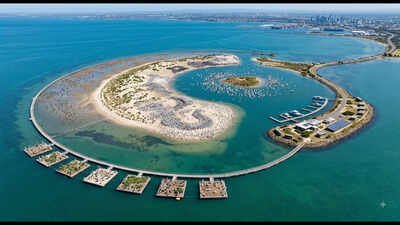
In the middle of the Netherlands, an unusual experiment in conservation began with an unlikely raw material: mud. Instead of treating the vast quantities of sediment accumulating on the floor of Markermeer as waste, Dutch engineers used it to create a new landscape. They built a chain of islands from sand, clay, silt and other material dredged from the lake, creating beaches, shallow waters, marshes and sheltered habitats where very little suitable habitat had existed before.The project, called Marker Wadden, was designed to help revive the ecology of Markermeer, a large freshwater lake whose ecosystem had deteriorated after decades of human intervention. But the most remarkable part came afterwards. Nature began moving in.Within just a few years, the newly created islands were being colonised by plants, insects and fish, while thousands of migratory and breeding birds began using the area for feeding, nesting and resting. What started as a huge engineering project was gradually becoming a living ecosystem.
Why the Netherlands needed to build new islands
Markermeer is a man-made freshwater lake created through one of the Netherlands’ enormous water-management projects. Before the lake was separated from the sea, the area was part of the Zuiderzee, a saltwater inlet of the North Sea. The construction of the Afsluitdijk in 1932 cut the Zuiderzee off from the North Sea, turning it into the freshwater IJsselmeer. Further engineering works eventually created Markermeer as a separate lake.These interventions transformed the landscape but also created an ecological problem. Markermeer is shallow and exposed, and large quantities of fine sediment can be stirred up from its bottom. The resulting cloudy water makes it difficult for sunlight to penetrate, affecting aquatic plants and the organisms that depend on them.The lake also lacked many of the shallow, sheltered habitats that support young fish, aquatic plants and waterbirds. Conservationists therefore proposed a radical solution: rather than trying to remove the sediment, use it to build new habitat. The concept became Marker Wadden.
Millions of tonnes of sediment became a new landscape
The first stage of Marker Wadden was not about creating a conventional island for people. Instead, engineers designed a landscape specifically for wildlife.Material from the bottom of Markermeer was dredged and deposited within carefully constructed boundaries. Sand was used to form protective structures, while softer sediment was placed inside them. As the material settled, it formed land at different elevations.This created a mixture of habitats rather than a single flat island. There were sandy beaches, shallow lagoons, wetlands, mudflats and higher areas where vegetation could establish itself. Channels and openings allowed water to move through parts of the landscape, helping create the dynamic conditions found in natural wetlands.According to an article titled ‘Rewilding the planet: An archipelago constructed of sand and mud is bringing new life to a dead lake but can this bold experiment have a lasting impact?’ published in Nature, around 37.2 million tonnes of material were dredged during construction, almost all of it from the lake itself. The first island was completed in 2016, with the wider archipelago developed in subsequent stages.The approach was significant because it combined large-scale Dutch engineering with a philosophy sometimes described as building with nature.The engineers created the initial conditions. They did not attempt to control every subsequent change. Wind, waves, sediment, plants and animals would help determine what the islands eventually became.
Birds were among the first visitors of the island
The speed at which wildlife began using Marker Wadden surprised even some of the people involved. The barren-looking islands soon attracted birds, including species that needed somewhere to rest or breed away from the exposed waters of Markermeer.As reported by the Department of Avian Ecology and Migration, Museum and Institute of Zoology, Polish Academy of Sciences, pioneer birds such as terns began arriving while parts of the landscape were still being formed. Some birds even travelled to the North Sea to find food before returning to the islands.As vegetation and aquatic life developed, the number and variety of birds increased. By 2021, 47 bird species were breeding on Marker Wadden. Around 60,000 migratory birds used the islands during the year to July 2021, according to the Nature report.Among the visitors were Eurasian spoonbills, greater flamingos and gull-billed terns. The appearance of gull-billed terns was particularly notable because the species had not bred in the Netherlands for decades.The islands were therefore becoming more than isolated pieces of land. They were turning into an important stopover and breeding area within a wider network of European wetlands.
The transformation was happening underwater too
The birds provided the most visible evidence of change, but much of Marker Wadden’s ecological development was taking place beneath the water.The new sheltered areas created conditions for aquatic plants and small organisms to establish themselves. Fish began using the shallow waters, particularly as nursery habitat for younger individuals.Researchers recorded numerous fish species around the islands, alongside fish larvae and a range of smaller organisms forming the foundations of the developing food web.This is important because the original problem in Markermeer was not simply that there were too few islands. The lake had lost a variety of habitats.By introducing shallow, sheltered areas, Marker Wadden created places where organisms at different levels of the food chain could live. Plants and microscopic organisms supported insects and small aquatic animals, which in turn provided food for fish and birds.The result was an ecosystem gradually building itself around a landscape that had not existed only a few years earlier.
The islands are artificial, but the ecosystem is not
There is an important distinction between building an island and building an ecosystem. The first was done by people. The second is being shaped by nature.The Dutch project did not attempt to recreate an exact historical landscape. Instead, it introduced habitats that were missing from the modern lake and allowed wildlife to determine what would happen next.That makes Marker Wadden an unusual form of ecological restoration. It is not a return to a pristine landscape that existed before human intervention. It is an attempt to create new ecological possibilities within a landscape that has already been heavily engineered.This distinction is central to the reporting in Nature, which presents Marker Wadden as a large-scale experiment in how humans can alter physical conditions and then allow natural processes to take over.
The new islands face a natural problem
Marker Wadden’s success does not mean the islands will remain unchanged. They were built largely from soft sediment, which naturally settles and compacts over time. As water drains from the material and the weight of the islands compresses the layers below, parts of the landscape can gradually sink.For an artificial island, this creates a long-term challenge. Unlike a natural coastal system, Marker Wadden does not receive a regular supply of sediment from tides and rivers that can continually rebuild the land. Researchers therefore continue to monitor how the islands evolve, including changes in their elevation, sediment movement and vegetation.This gradual transformation is not necessarily a failure. The project was designed to allow natural processes to shape the landscape rather than preserve it in exactly the form in which engineers created it. The question is whether those processes can maintain the shallow waters, wetlands and open areas that made the islands valuable to wildlife in the first place.
Creating habitat is only the first step
The changing landscape also raises a wider question for artificial-island projects: how long can newly created habitats continue to support the species they were designed to attract?The aforementioned 2026 study published in Estuaries and Coasts by Dominik Marchowski and colleagues offers an important insight. Researchers examined two artificial islands made from dredged sediment in Poland’s Szczecin Lagoon and found that waterbirds colonised them rapidly. The islands soon became important breeding grounds, including for species of conservation concern.But the researchers also found that these benefits can change as vegetation takes hold. On one of the islands, tall vegetation, including reeds and willow, covered less than 1% of the area in 2021 but had expanded to 23% by 2025. Their modelling suggested that continued vegetation growth could substantially reduce the open habitat used by ground-nesting birds within a few years.The finding adds an important qualification to the success story of projects such as Marker Wadden. Building new habitat can give wildlife an immediate boost, but maintaining that habitat may require long-term management. An island that begins as open sand and mud can eventually become a densely vegetated landscape, supporting a very different community of species.Marchowski and his colleagues therefore highlight both the potential and the limitations of dredged-sediment islands. Their isolation can provide valuable breeding refuges with reduced access for terrestrial predators, but the conservation benefits may diminish if the physical and ecological conditions that attracted birds in the first place disappear.Marker Wadden shows how sediment once regarded as a waste material can become a functioning wildlife habitat. The newer research adds another dimension to that story: successful restoration is not only about giving nature somewhere to begin; it is also about understanding how that habitat will change over time.