








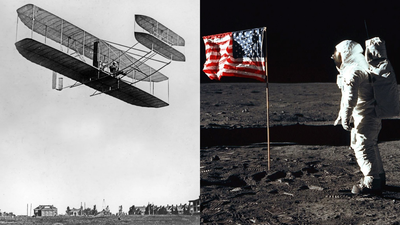
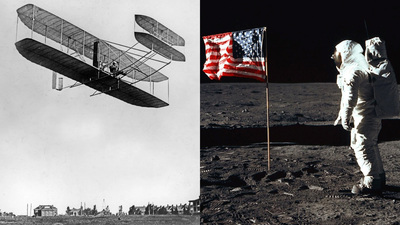
“I confess that in 1901, I said to my brother Orville that man would not fly for 50 years.” The remark by Wilbur Wright now reads less like doubt and more like a reminder of how rapidly human ambition can outpace expectation. Just two years later, on a cold December morning in 1903, he and Orville Wright proved themselves wrong, lifting a fragile machine into the air for 12 seconds and quietly rewriting history.What followed was not a slow march but an astonishing sprint. In just 66 years, humanity went from uncertain, trembling flight to placing a human footprint on another world. When Neil Armstrong stepped onto the lunar surface during Apollo 11 Moon landing, it was not just a triumph of engineering. It was the culmination of decades of relentless experimentation, geopolitical urgency, and scientific imagination led by NASA.
The fragile beginning of the Wright Brothers : Aerial lift, control, and propulsion
The Wright brothers’ aircraft succeeded not because it was powerful, but because it was controllable. The Wright brothers approached flight by breaking it down into simple problems and solving each one carefully. The first question was how anything could lift off the ground. A good way to understand this is by putting your hand outside a moving car window and tilting it slightly, you can feel the air pushing it upward. They realised wings need a curved shape so that air moves faster over the top and slower underneath, creating a pressure difference that lifts the aircraft. Instead of guessing, they built a small wind tunnel and tested hundreds of wing shapes, observing how air flowed over them. But lifting off was not enough. Earlier machines had managed brief hops but were impossible to control, like trying to ride a bicycle without a handlebar.The real breakthrough came when they solved the problem of control and movement together. They designed a system that allowed the pilot to balance and steer the aircraft in different directions, making it stable rather than unpredictable. To keep the aircraft moving forward, they added a small engine, similar to how a bicycle needs continuous motion to stay upright. They also designed propellers like rotating wings, which pushed air backward and pulled the aircraft forward. When all these elements worked together, lift, control, forward motion, and balance, the machine could not only take off but stay steady and be guided through the air. That is what made their 12-second flight historic, it was not just flying, but controlled flight.
War and the rise of high-speed aerodynamics
As aviation entered the World Wars, engineering shifted toward speed, altitude, and durability. Aircraft construction moved from wood and fabric to aluminium alloys, making planes lighter and stronger. Engineers refined wing shapes and fuselage designs to reduce drag and improve airflow, allowing aircraft to travel faster and more efficiently.Engines became more sophisticated. Superchargers were introduced to compress air and maintain engine performance at high altitudes where oxygen is scarce. The arrival of the jet engine marked a major turning point. Instead of propellers pushing air backward, jet engines expelled high-speed exhaust gases to generate thrust. This required advances in turbine design, heat-resistant materials, and combustion systems. These developments pushed aircraft into new performance ranges and laid the groundwork for technologies that would later be adapted for spaceflight.
Rockets: Escaping Earth ’s gravity
The move from aviation to space required a completely different approach to propulsion. Aircraft depend on air, but rockets must operate in the vacuum of space. This led to the development of liquid-fuel rocket engines, where fuel and oxidiser are combined in a combustion chamber to produce extremely high-speed exhaust.Early rocket designs demonstrated that it was possible to generate enough thrust to overcome gravity. Engineers then developed multi-stage rockets to improve efficiency. By discarding empty fuel stages during flight, the rocket became lighter and could accelerate further. The Saturn V used in the Apollo missions was a prime example of this principle, with each stage firing in sequence to push the spacecraft beyond Earth’s gravitational pull.Guidance systems became equally important. Gyroscopes and early onboard computers were used to maintain direction and stability, ensuring that the rocket followed a precise trajectory through space.
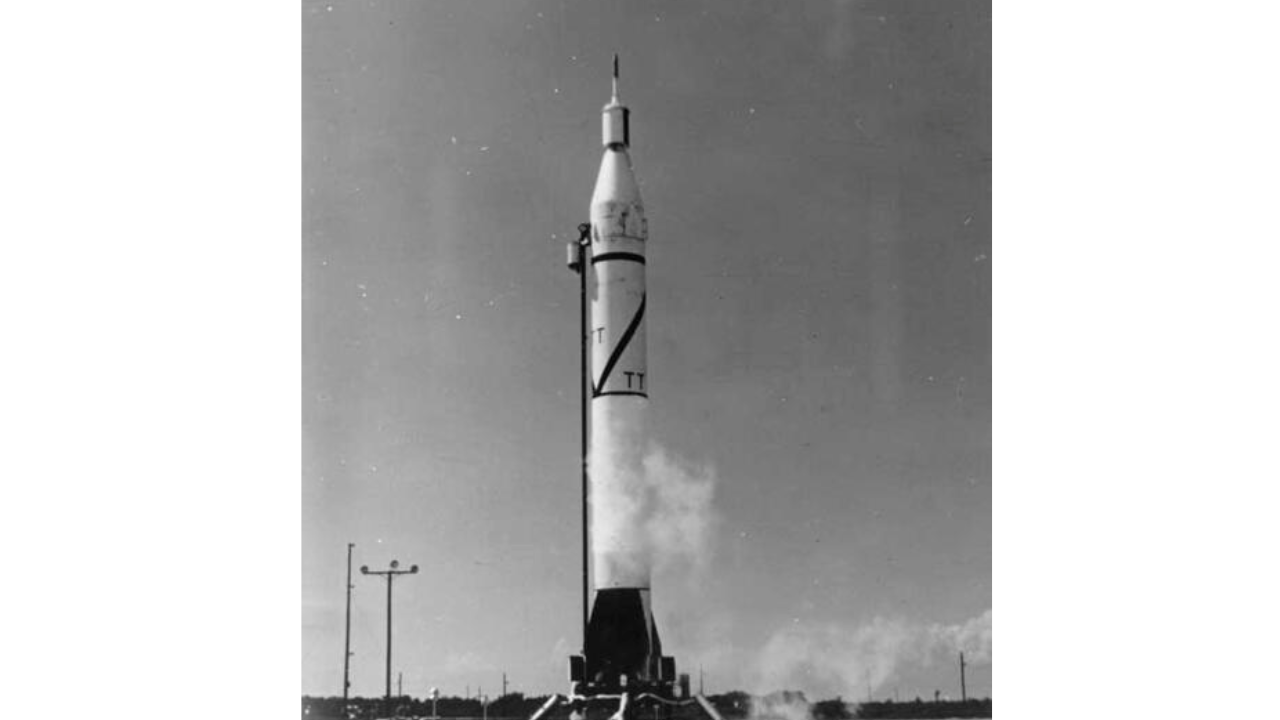
Juno I rocket (Explorer 1 launch, 1958)
Apollo engineering: Computing, navigation, and survival in space
By the time of Apollo 11, engineering had become a complex integration of multiple scientific disciplines. The Apollo Guidance Computer played a central role in navigation and control. Despite its limited processing power, it could perform real-time calculations that allowed astronauts to adjust their trajectory and land safely on the Moon.The spacecraft itself was divided into specialised modules. The command module served as the crew’s main cabin and was designed to withstand the intense heat of re-entry. The service module provided propulsion and life-support systems. The lunar module was built specifically for landing on the Moon and operating in a vacuum, which meant it did not require aerodynamic shaping.Astronauts relied on advanced space suits that functioned as personal life-support systems. These suits regulated oxygen supply, temperature, and pressure, allowing humans to survive in an environment with no atmosphere. Returning to Earth posed another challenge, as the spacecraft had to endure extreme temperatures during re-entry. This was solved using a heat shield that absorbed and dissipated the energy generated by friction with the atmosphere.
Evidence Written in science, not just history
The Apollo missions produced lasting scientific evidence that continues to be studied today. The lunar rock samples brought back to Earth have been analysed by researchers across the world, providing insights into the Moon’s composition and geological history.Another enduring contribution is the placement of laser reflectors on the lunar surface. Scientists still use these instruments to measure the distance between Earth and the Moon with remarkable precision. These ongoing experiments demonstrate that the achievements of Apollo were not only historical milestones but also continuing sources of scientific knowledge.
The Moon landing debate that never faded
The Apollo 11 Moon landing has also remained a subject of persistent conspiracy theories over the decades. Some have long argued that the landing was staged, drawing attention to details in photographs such as shadows, lighting, and the absence of visible stars, while others link their claims to the intense geopolitical rivalry of the Cold War era. These ideas began circulating soon after the mission but found renewed life with television documentaries and, later, the internet, where they continue to spread across forums and social media. Over time, the Moon landing has come to occupy a unique space not just in scientific history, but in popular culture, where it is both celebrated as a defining human achievement and questioned as part of a broader distrust of institutions.
The 66-year leap: A convergence of disciplines
What makes the 66-year journey extraordinary is the convergence of multiple fields of science and engineering. Aerodynamics, materials science, thermodynamics, computing, and human physiology all advanced rapidly and often simultaneously. Each breakthrough built upon the previous one, creating a chain of innovation that made the Moon landing possible.The Wright brothers established controlled flight. Wartime engineers refined speed and structural design. Rocket scientists developed the means to escape Earth’s gravity. NASA brought these elements together into a single coordinated effort that achieved one of humanity’s greatest milestones.
From Moon to Mars: Engineering the next leap
Today, the legacy of those 66 years continues to shape the future of space exploration. Advances in reusable rockets, propulsion systems, and autonomous navigation suggest that another period of rapid progress may be underway.The journey from the first powered flight to the Moon demonstrated what is possible when science, engineering, and ambition align. The next chapter will depend on whether humanity can once again combine these forces to push beyond its current limits.