








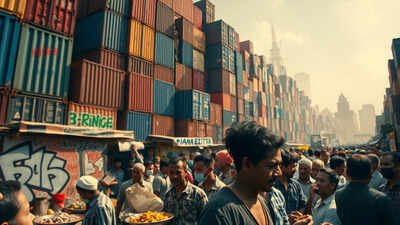
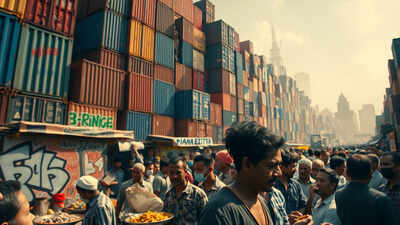
On the outskirts of Bishkek, the capital of Kyrgyzstan, sits Dordoi Bazaar, a sprawling 100-hectare market built almost entirely from stacked shipping containers, now recognised as the largest wholesale and retail trading hub in Central Asia. What began in the chaotic years following the collapse of the Soviet Union has grown into a self-contained economic ecosystem, complete with its own internal roads, packing stations and a distinct social world inside each container shop. Years of sustained academic fieldwork inside the market have traced how it has weathered decades of economic volatility, and in April 2026, the bazaar’s long-serving founder found himself publicly challenged by Kyrgyzstan’s president over whether the market’s success has come at the cost of modernisation.
How Dordoi Bazaar emerged from the Soviet collapse
Dordoi Bazaar’s origins trace back to the economic upheaval that followed the Soviet Union’s collapse in 1991, when Askar Salymbekov purchased the land that would eventually become the market and began placing the first shipping containers that gave the bazaar its distinctive architecture. According to research by Dr Claudia Eggart, a social anthropologist who completed her PhD at the University of Manchester studying the market, these vast informal trading networks that emerged across the former Soviet Union during this period became a powerful engine of what scholars have termed globalisation from below, integrating formerly centrally planned economies into global trade networks through improvised, ground up commercial infrastructure rather than formal state led development.Eggart’s research, conducted through extended fieldwork at Dordoi across 2021 to 2022, 2024 and 2026, forms part of a broader comparative study examining Dordoi alongside the remarkably similar container built 7th Kilometer Market in Odesa, Ukraine, work she is developing into a book titled Lived Geopolitics, tracing how both markets evolved from the Soviet collapse through to more recent geopolitical upheavals, including Russia’s full scale invasion of Ukraine in 2022.
What daily life inside the market actually looks like
Despite its industrial, uniform appearance from above, vast stretches of stacked corrugated metal containers, Eggart’s research describes a market with a rich and varied daily rhythm at ground level. Each container shop opens onto its own distinct social world, and the market’s daily cycle moves through clearly defined phases, from the intense pace of morning trading through to a midday slowdown when the market fills with the scent of roasting meat and fresh dough, as food stalls representing a culinary map of Central Asia serve dishes including Dungan laghman, Uzbek plov and Uyghur samsa alongside a growing presence of barista coffee shops.Behind the retail activity, an extensive logistics operation runs in parallel, according to Eggart’s account, with workers threading through the crowds delivering goods to packing stations near the market’s long-distance bus terminal, where merchandise is compressed into tightly packed bales and sacks, since every centimetre of shipping space matters for minimising the cost of moving goods onward to buyers across the region.
Why the market remains so sensitive to regional economic shifts
Dordoi’s role extends well beyond serving Bishkek and its immediate surroundings. According to Eggart’s research, the bazaar functions as one of the main entry points through which consumer goods from countries including China, Turkey and South Korea reach shops and markets across Kazakhstan, Russia and Uzbekistan, making it a critical node within a wider transnational trade network stretching across Eurasia.This central role in regional supply chains comes with significant exposure to external shocks. Eggart’s work highlights how Dordoi’s extensive commercial reach makes its trade networks highly sensitive to shifts in tariffs, exchange rates and broader economic conditions within its main partner countries, meaning disruptions originating far outside Kyrgyzstan’s own borders, from pandemics to changes in Russian or Chinese trade policy, can ripple directly through into the daily fortunes of individual container shop traders inside the market.
Why the bazaar’s founder faced public criticism in 2026
Despite decades of resilience through repeated economic crises, Dordoi’s model has recently come under direct political pressure. In April 2026, Kyrgyzstan’s president Sadyr Japarov publicly reprimanded Salymbekov, now 71, arguing that the market’s iconic container-based structure had failed to modernise and should have already been redeveloped into a more polished complex resembling retail developments Japarov had seen in Dubai or Istanbul. Japarov also raised concerns that years spent working in cramped container shops could take a genuine toll on traders’ health, a claim Eggart’s research does not dismiss outright even while noting how deeply Salymbekov’s standing as the market’s founder is regarded within Kyrgyzstan, where he is considered something close to a national hero for having built one of the country’s most vibrant economic engines from essentially nothing.
Why researchers keep returning to markets like Dordoi
For researchers like Eggart, what makes Dordoi and comparable post Soviet container markets so compelling is precisely the tension between their industrial scale and the intensely personal, individual stories playing out inside them. Her research is guided centrally by a single recurring question: how local entrepreneurs have managed to keep their businesses, and by extension the market itself, running despite recurring economic crises and long-standing predictions that markets like Dordoi would eventually decline or disappear altogether.More than three decades after Salymbekov placed the first containers on what was then empty land outside Bishkek, Dordoi Bazaar stands as a striking example of how informal, improvised economic infrastructure built in the aftermath of the Soviet collapse can harden into permanent, large-scale institutions, even as those same institutions now face genuine pressure to reinvent themselves for a very different economic and political era.