








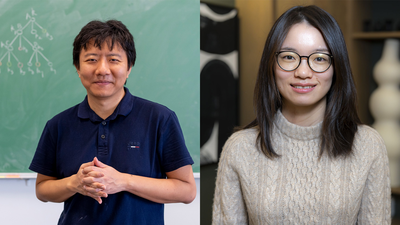
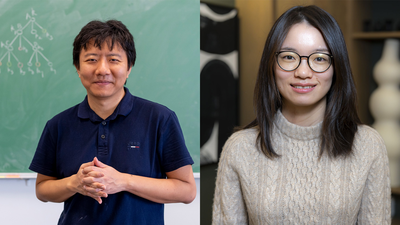
Two Chinese mathematicians have made history by becoming the first Chinese recipients of the Fields Medal, widely regarded as the highest honour in mathematics. Hong Wang and Yu Deng were recognised for solving long-standing mathematical problems that had challenged researchers for more than a century, marking a milestone not only for Chinese mathematics but also for the wider scientific community. Announced at the International Congress of Mathematicians in Philadelphia, the awards celebrate discoveries that are expected to influence fields ranging from geometry and physics to engineering and data science. Their achievement has also drawn international attention to the growing global impact of mathematical research.
How the Chinese mathematicians made history after solving a century-old puzzle
The Fields Medal is awarded every four years by the International Mathematical Union to mathematicians under the age of 40 whose work has made outstanding contributions to the subject. Often described as the mathematics equivalent of a Nobel Prize, it is considered the discipline’s most prestigious recognition.According to the BBC, Wang and Deng shared the 2026 Fields Medal with John Pardon of the United States and Jacob Tsimerman of Canada. Each laureate received a prize of C$15,000, but the award is valued far more for its scientific prestige than its monetary value. Wang’s victory also marks another historic achievement, as she is only the third woman ever to receive the Fields Medal since it was first awarded in 1936.
Hong Wang solved one of geometry’s greatest mysteries
Hong Wang was honoured for groundbreaking work on the three-dimensional Kakeya conjecture, a problem that has fascinated mathematicians for more than a century.The Kakeya problem asks how a line segment can rotate through every possible direction while occupying the smallest possible space. Although deceptively simple to describe, the question lies at the heart of modern harmonic analysis and geometric measure theory, with applications extending to signal processing, image reconstruction and data analysis.Wang’s breakthrough resolved a major part of this famous problem, providing new mathematical tools that researchers believe will influence several branches of pure and applied mathematics.
Yu Deng tackled a century-old problem in the mathematics of gases
Yu Deng received the Fields Medal for solving a long-standing problem involving the mathematical equations that describe how gases behave across different physical scales.His work addressed questions connected to one of David Hilbert’s famous mathematical challenges proposed in 1900, which have shaped mathematical research for more than a century. By establishing rigorous links between microscopic particle interactions and the large-scale motion of gases, Deng helped resolve a problem that has challenged generations of mathematicians and mathematical physicists.His research provides a stronger theoretical foundation for understanding kinetic theory, an area that underpins much of modern statistical physics.
A milestone celebrated around the world
The achievement sparked widespread celebrations across Chinese social media, where millions of users hailed the country’s first-ever Fields Medal winners. The BBC reported that hashtags celebrating the award quickly attracted millions of views, with many describing the moment as a landmark in the history of Chinese science and mathematics.Beyond national pride, the awards highlight the increasingly international nature of modern mathematics. Both Wang and Deng studied at Peking University before pursuing advanced research abroad, reflecting the global collaboration that now drives many of the world’s most important scientific discoveries.
Why the Fields Medal matters
Unlike many scientific breakthroughs that make immediate headlines, advances in mathematics often reveal their importance over decades. Fundamental discoveries in geometry, analysis and mathematical physics frequently become the basis for technologies developed years later, influencing everything from cryptography and artificial intelligence to medical imaging and communications.The recognition of Hong Wang and Yu Deng therefore extends beyond two individual achievements. Their work demonstrates how solving abstract mathematical questions can expand humanity’s understanding of the natural world while providing the foundations for future scientific and technological innovation.