







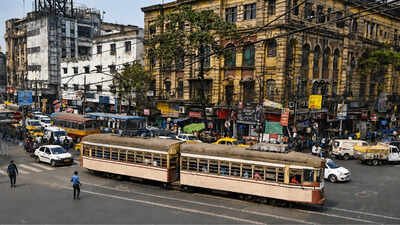
At the Tollygunge Tram Depot, amid rows of ageing tramcars that have quietly watched the city change, one vehicle still draws attention. Tram No. 201 stands ready for service. To generations of cinema lovers, it is instantly recognisable. In the 1966 Hindi classic Baharein Phir Bhi Aayengi , the tram glides across the Maidan in the song ‘Suno Suno Miss Chatterjee’, becoming as much a part of the frame as the actors themselves.But No. 201 has another story to tell. It was never built for Kolkata. It once ran on the streets of Bombay. When the western metropolis dismantled its tram system in the 1960s, the Calcutta Tramways Company bought several of its tramcars. No. 201 was among them. Six decades later, it waits for another chapter — one that may finally arrive.For the first time in years, hope has returned to the city’s tramways.One of the earliest transport announcements made by Bengal’s new govt was its decision to revive the city’s tram network — a dramatic reversal of the previous administration’s policy, which had steadily dismantled routes, paved over tracks and reduced the system to a handful of heritage services.The govt has already engaged RITES (Rail India Technical and Economic Service) to prepare a comprehensive blueprint for the revival of what remains the oldest surviving tram system in the Asia-Pacific region.Transport minister Arjun Singh says the plan is not merely symbolic. “The revival of the tram was promised by none other than our Prime Minister Narendra Modiji. It is therefore not merely a commitment; it is one of our highest priorities,” Singh said.The plans go well beyond preserving nostalgia. “Along with restoring heritage trams, we are exploring battery-operated trams that can run without overhead electric wires. This will allow us to expand the tram network into new areas while preserving the city’s historic character,” he added.Among the govt’s more ambitious proposals is a tram corridor connecting two of Bengal’s most important pilgrimage centres — Kalighat and Dakshineswar — along the banks of the Ganga and the Adi Ganga. If realised, it could become one of India’s most scenic urban transport corridors.A 153-Year JourneyThe story of Kolkata is inseparable from the story of its tram.Long before the Metro transformed urban commuting, the tram shaped the city’s geography, economy and neighbourhoods.The first horse-drawn tram rolled out on Feb 24, 1873, covering just 3. 9km between Armenian Ghat and Sealdah. The objective was simple: to connect Kolkata’s river port with its rapidly expanding railway network. Armenian Ghat even housed a railway booking office for passengers travelling to Howrah.The real revolution came in 1902, when Kolkata introduced electric traction, replacing horsepower with electricity generated at its own power station in Nonapukur. It marked the beginning of one of the world’s earliest electric urban transport systems.In 1943 came another historic milestone. When the new Howrah Bridge — later named Rabindra Setu — opened to traffic, the first public transport vehicle allowed to cross it was a tram.By the 1950s, Kolkata’s tramways had entered their golden age. Nearly 470 tramcars carried close to 410 million passengers annually, making the tram the backbone of the city’s public transport network.Was Decline Engineered?The decline, tram historians argue, was never inevitable. According to tram researcher Sagnik Gupta, successive planning decisions gradually disconnected the network from the very locations that generated the highest passenger traffic.The first major setback came in the 1970s, when tram access to Sealdah was removed during construction of the Sealdah Flyover.The Howrah terminus followed in the early 1990s, with authorities arguing that heavier steel-bodied trams could adversely affect the bridge — an explanation that tram experts continue to dispute.The Ballygunge-Gariahat connection disappeared. Several Howrah routes, including Bandhaghat and Shibpur, were shut. Later, the Behala-Joka line was isolated after the construction of the Taratala Flyover and eventually closed.“Each closure reduced ridership, which in turn was cited as justification for further closures,” said Mahadeb Shi, a tram enthusiast and filmmaker.The last major investment came in the 1980s, when the World Bank supported modernisation worth Rs 46.2 crore. Seventy-five new tramcars were built, 60 refurbished and more than 100 modernised. But the momentum faded.A Heritage Worth SavingDespite decades of neglect, Kolkata’s tramways retain something no other city has.Many of its wooden-bodied tramcars are over a century old and remain operational — an engineering achievement unmatched anywhere in the world. Debasis Bhattacharya, president of the Calcutta Tram Users Association (CTUA), has spent more than three decades fighting to save the network.“It is music to my ears that the govt wants to revive the tram,” he says. “At one point, we had almost lost hope as tracks were being covered with bitumen despite court orders. Successive govts paralysed the tram, cut passenger access and then declared it unviable.”The turning point came when citizens, environmentalists and tram enthusiasts approached Calcutta High Court through multiple public interest litigations. A Division Bench headed by T. S. Sivagnanam halted the bituminisation of tram tracks and set up an expert committee to prepare recommendations for revival. That legal intervention has kept alive the possibility of a wider restoration, said Pradeep Kakkar of People United for Better Living in Calcutta (PUBLIC).
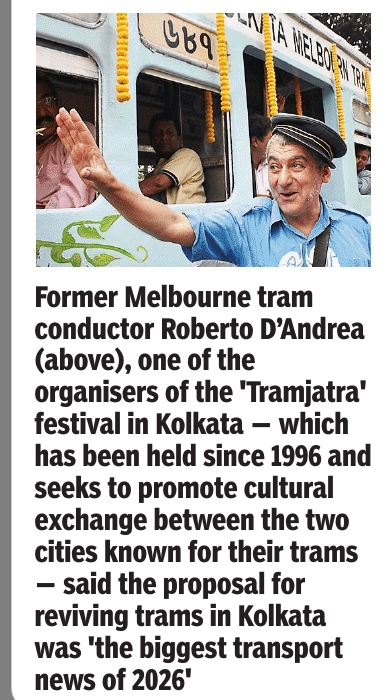
Transport For FutureSupporters argue that bringing back the tram is not about preserving a museum piece. It is about building a sustainable transport system for the future.Kolkata’s experience could matter beyond Bengal. As Metro networks expand, Indian cities still need clean, high-capacity transport for shorter neighbourhood journeys. Modern trams can serve as feeders, carry more passengers than buses and run without local emissions. Kolkata’s revival could act as an example for other Indian cities.International experts agree. Roberto D’Andrea, a former Melbourne tram conductor who has organised the cultural exchange festival Tramjatra between Melbourne and Kolkata since 1996, describes the proposal as “the biggest transport news of 2026”.“Kolkata should not merely preserve its tram, it should expand it. The tram… can play a major role in fighting climate change,” he says.Environmentalists make a similar point. Vinay Jaju of SwitchON Foundation believes low-carbon public transport, combined with cycling and walking infrastructure, offers cities one of the most effective responses to both climate change and worsening urban pollution.Legal environmentalist Rittwik Dutta of the Legal Initiative for Forest and Environment (LIFE) points to London’s experience as a warning. London abandoned its electric tramways in 1952 in favour of diesel buses. Only months later, the city experienced the catastrophic Great Smog, a disaster that many historians believe was aggravated by rising vehicular emissions.“Abolishing Kolkata’s tram would have been a very expensive mistake,” Dutta says.
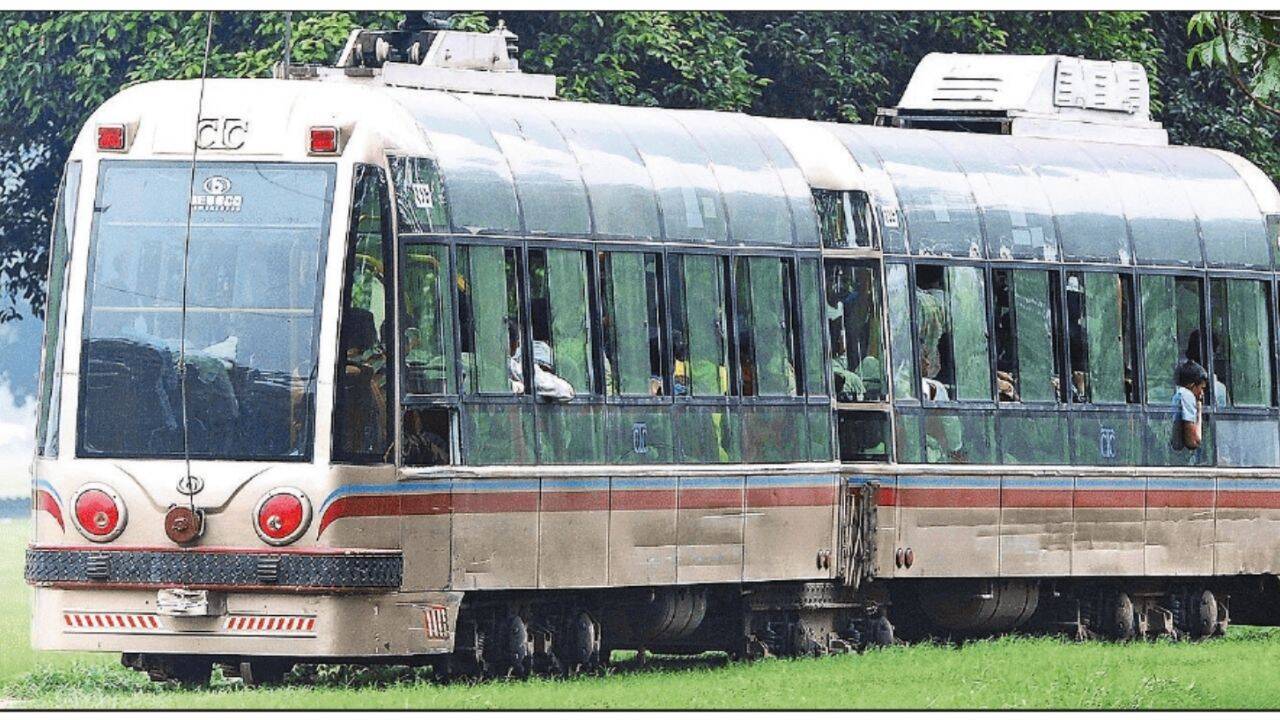
A Second ChanceFor decades, Kolkata’s tram became a symbol of decline — a slower vehicle overtaken by faster roads, flyovers and buses. Yet history has an unusual way of returning.Around the world, cities that once dismantled tramways are now rebuilding them as climate-friendly mass transit systems. Modern tram networks have emerged in cities from Paris and Sydney to Dubai and Shenzhen.Kolkata, remarkably, never lost its tram altogether. It simply allowed it to fade. Now, at 153 years old, the world’s oldest surviving electric tram system may finally get the second chance it has long awaited.If the govt’s plans materialise, Tram No. 201 may once again leave the Tollygunge depot — not merely as a relic from a classic film, but as a symbol of a city rediscovering one of its greatest gifts.